Gathering, listing and smashing

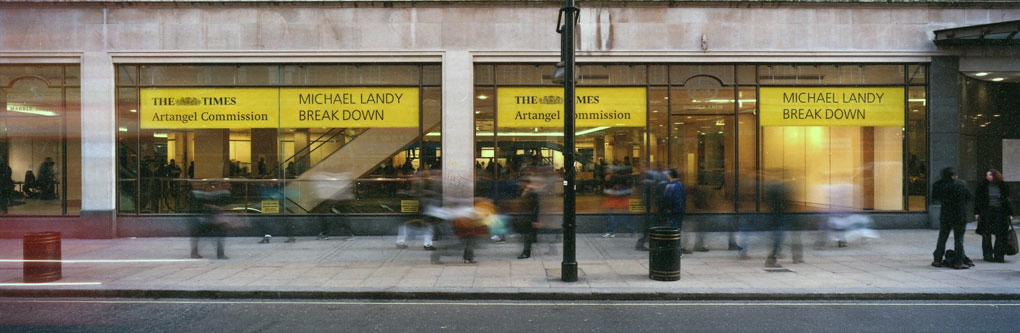
Michael Landy, Break Down, 2001

If I’m honest, I’m a bit of a hoarder. I know I really need to start throwing things out, but somehow I don’t get round to it. And being an artist gives me an extra excuse, or so I tell myself. I have all kinds of junk squirreled away as stuff I might sometime use to make work. Yeah, right. But however much I know I need a clear out and however much I like art that is driven by obsession – a lot, on both counts – I know I could never have made Break Down. The extremity of Michael Landy’s project fascinates and terrifies me in equal measure.

Continue reading

In mid air

Cornelia Parker, Cold Dark Matter, 1991

It started with a shed. It was full of all the sort of stuff that somehow gets collected in a shed over time. Sheds are useful. They are places to keep things that we want but don’t quite have space for and this one was pretty full. Cornelia Parker started by putting the shed in a gallery – Chisenhale in east London – before moving it to a field and getting the British Army to blow it up.

Parker then carefully gathered up the pieces and suspended them in the gallery around a central light bulbas though time had frozen mid-explosion.

Continue reading

Sensory overload

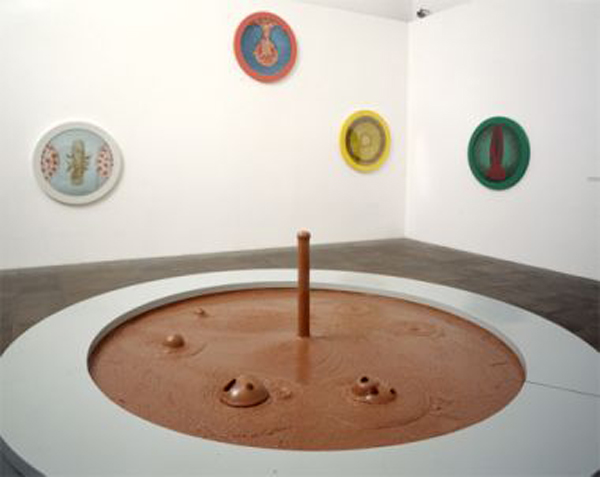
Helen Chadwick, Cacao, 1994

I guess I’m still thinking about chocolate – it is still Easter after all – but yesterday’s post also left the desire/disgust dichotomy firmly in my mind too so today’s post being about Helen Chadwich’s work might easily have been predicted. And where better to start than with Cacao, Chadwick’s 1994 chocolate fountain. At first sight the work looks like a mud bath of some sort and the spluttering as air bubbles through certainly sounds a lot like the bubbling mud of a hot spring. But things aren’t quite that simple. Firstly there’s the central column to consider: it’s hardly reminiscent of a decorative fountain with water falling prettily, indeed it appears deliberately and somewhat comically phallic. But it’s not really the way the work looks and sounds that I remember most vividly – though both are clear in my mind – it’s the heady smell of chocolate that fills the space. So much chocolate and none of it for eating! Ultimately then, this is a work that looks and sounds slightly unpleasant and has a smell that quickly becomes cloying, and yet I’ve always wanted to stay with it longer than is strictly necessary.

Continue reading

Artful eating

Janine Antoni, Gnaw, 1992

What better time than Easter Sunday to be thinking about chocolate. Lots of chocolate. And having posted about artists working with their own body the last couple of days, today I’m all about an artist who uses her body not as the source of the image but as the tool to make the work. In Gnaw, Janine Antoni gnawed away at a 600lb block of chocolate and another of lard, using the blocks as two parts of a three part installation. The work is a strange one. On the one hand chocolate is delicious, but lard?! Okay, so I’m a vegetarian, a block of lard is never going to be something I enjoy being faced with in a gallery or anywhere else, but I think disgust is a pretty universal response.

Continue reading

Stripped bare

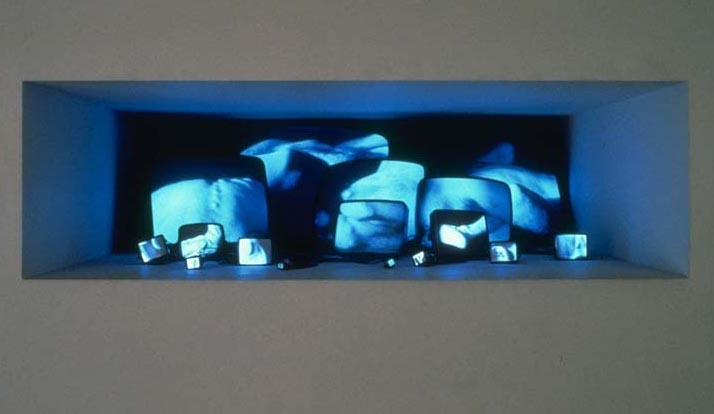
Gary Hill, Inasmuch As It Is Always Already Taking Place, 1990

Like Nam June Paik, Gary Hill often uses the physicality of the television as part of the work but for Hill the box is something to shed leaving the screen and the tube behind it to occupy the space. Multi-screen video works become installations in which the means of display takes on its own significance. Inasmuch As It Is Always Already Taking Place is, in a way, a self portrait, albeit a fragmented one and one which tells us little about Hill.

Continue reading

Boxes of tricks


Nam June Paik, TV is Kitsch, 1996

As we lose the analogue television signal, the impetus to get rid of old analogue televisions is even stronger. The cathode ray tube makes them bulky and heavy next to the sleek lines of plasma and LCD televisions and the need to have an external box to pick up a signal adds to the feeling that the time has come. But that same bulk that seems so annoying in the average living room is key to quite a lot of art from the last few decades. The box is part of what can blur the boundaries between moving image and sculpture. In the case if Nam June Paik’s TV is Kitsch it is the physical presence of the television casings that gives the work its form.

Continue reading

Make do and mend

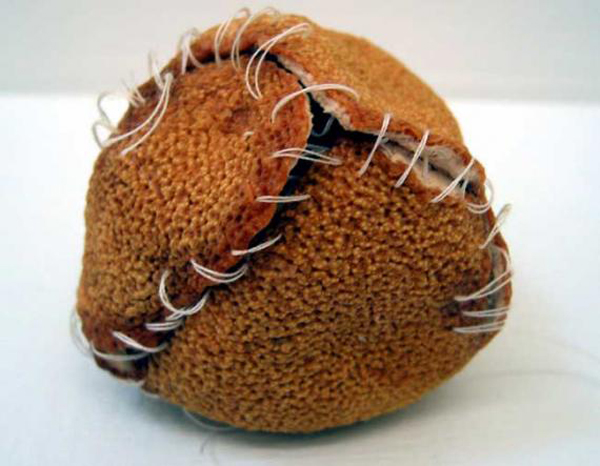
Zoe Leonard, Strange Fruit (for David) (detail), 1992-97

There is something sad and touching about emptied out fruit stitched back up in a futile attempt at mending. But there’s also something about it that amuses me in a way. I think in Zoe Leonard’s installation Strange Fruit (for David) the thing that both moves me and makes me smile is the scale of the thing. It feels like a point that could have been made with a few pieces has taken control and not let Leonard stop; the empty fruit are scattered liberally across the floor, filling the space. In total roughly three hundred pieces of fruit have had their peel or skin dried out and put back together with stitching or other forms of fixing or adornment.

Continue reading

Art on acid

Painting with hydrochloric acid on nylon, 1961

There are lots of ways to paint, as a quick wander through any major art museum will amply demonstrate. But there are those who change out understanding of art through their work, and Gustav Metzger is one such. Metzger’s notion of auto-destructive art, which he initially defined in 1959, was an interesting and highly-influential on which was rooted in the belief that Western society was failing (Metzger has been a Marxist all his adult life). The idea is that the work has the capacity to destroy itself or that it is destroyed by the actions of its creator.

Gustav Metzger: Auto-Destructive Art (1959)
Auto-destructive art is primarily a form of public art for industrial societies.
Self-destructive painting, sculpture and construction is a total unity of idea, site, form, colour, method, and timing of the disintegrative process.
Auto-destructive art can be created with natural forces, traditional art techniques and technological techniques.
The amplified sound of the auto-destructive process can be an element of the total conception.
The artist may collaborate with scientists, engineers.
Self-destructive art can be machine produced and factory assembled.
Auto-destructive paintings, sculptures and constructions have a life time varying from a few moments to twenty years. When the disintegrative process is complete the work is to be removed from the site and scrapped.

Continue reading

Truth and the power of words

Jenny Holzer, Truisms, 1977-9 displayed at Times Square, 1982

For Jenny Holzer the work lies in the words rather than the particular way in which they are disseminated. So her Truisms have been projected in public spaces, worn as T-shirts, placed on gallery walls, plaques, stickers and postcards and more. The art lies in getting the words out there. Of course there are aesthetic and conceptual decisions about how and where they appear but it is the text and the way the audience encounters it that drives these.

Among the means of display Holzer employs, several involve sites or approaches more usually associated with advertising automatically colouring our response to the messages. Holzer’s slogans often challenge the political status quo in some way, making this appropriation of public display mechanisms all the more interesting.

Continue reading

Sign systems

Bob and Roberta Smith, Make Art Not War, 1997

There is of course a very long tradition of text painting. It’s just that it’s not an art tradition but a commercial one: signwriting. Though shop signs are seldom painted now it’s still a form we recognise. This is an approach to painting that is about immediate communication of a message. And it’s an approach Bob and Roberta Smith uses very effectively as art.

Continue reading