Class war restaged

Deller Battle of Orgreave 4

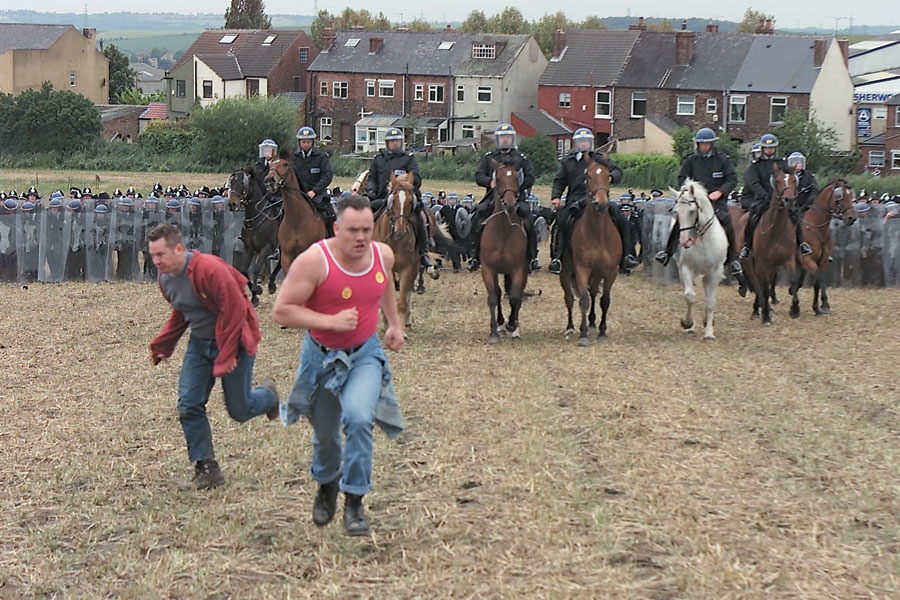
Jeremy Deller, The Battle of Orgreave, 2001

As the media marks the death of Margaret Thatcher with blanket television coverage looking back at her time in office some familiar images are brought back to mind. But sometimes it’s hard to disentangle the memories: which of the images am I really recalling from the 1980s? In the case of the images of the 1983/4 miners’ strike, the boundaries between news footage and re-enactment are very blurry in my head. I remember the strike very well; I remember the marches and the benefit gigs, I remember throwing money into collection buckets every day on my way to and from work, probably with a ‘coal not dole’ badge on my coat, and I remember the news reports. At least, I think I do. But there’s a distinct possibility that some of that memory is somewhat second hand. The images of Orgreave that are so clear in my mind come not just from the news reports of the time, shocking though they were, but also from Jeremy Deller’s 2001 re-enactment of the event, filmed by Mike Figgis.
Continue reading

Gone

Gone with the Wind

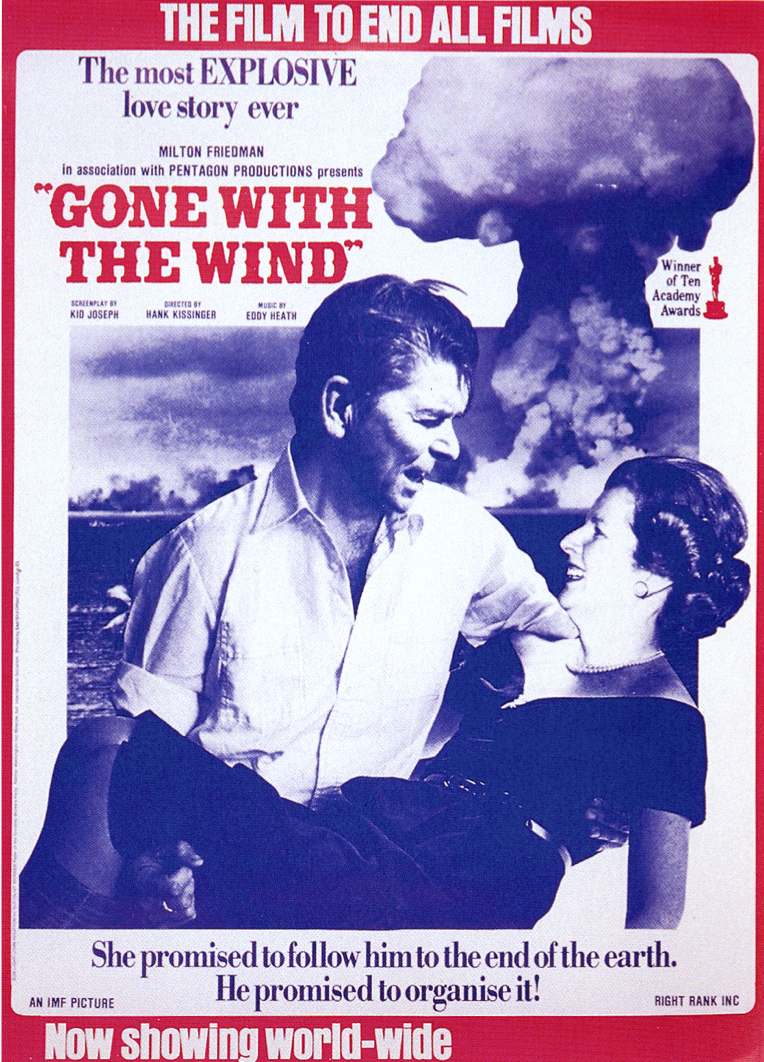
Bob Light and John Houston, Gone With The Wind, 1982

Artists and designers reuse existing images all the time; think collage, think appropriation. And there’s a long tradition of photomontage as a way to make a political point with a powerful visual simplicity that I fully expect to write about further in a later post. IN reworking of the poster for Gone With The Wind for the Socialist Worker, Bob Light and John Houston brought together an iconic film poster (Reagan, after all, had a former career in Hollywood, albeit as very much a B movie actor; he was certainly no Clark Gable) with the politics of the 1980s with both humour and a serious intent.

Continue reading

Learned behaviour

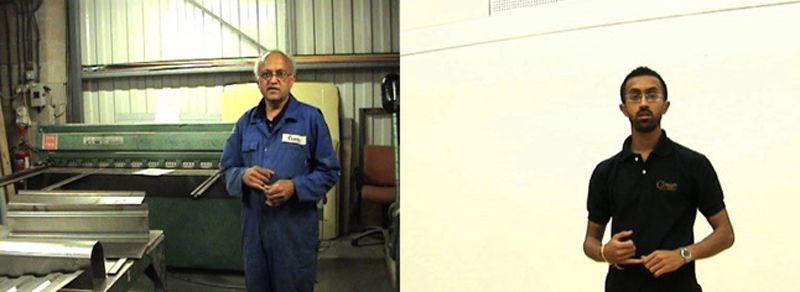
Hetain Patel, Dance Like Your Dad, 2009

Hetain Patel, To Dance Like Your Dad, 2009

At some point, all children copy adults. Admittedly, this doesn’t usually take the form of restaging a parent talking about their work, but that’s the basis of Hetain Patel’s To Dance Like Your Dad, a simple but effective video work shown at Frieze by Chatterjee and Lal. Shown on two screens, the work consists of Patel’s father showing us round his place of work and explaining what happens. Patel himself appears on the right hand screen, performing his father’s role in sync with the original. The parent and child relationship is seldom simple and while we may be fiercely proud of our parents they also have the capacity to embarrass. Here there is a sense of pride and respect in the act of restaging – and in filming Patel senior at work in the first place – but the notion of potential embarrassment is right there in the title. Dad dancing is generally not a good thing, after all.

Continue reading

Closing the gaps

Elizabeth Price, The Woolworths Choir of 1979, 2012

Elizabeth Price, The Woolworths Choir of 1979 (still), 2012

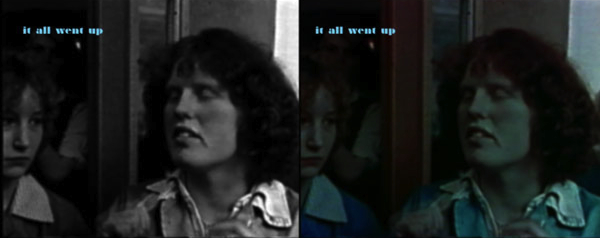
With the end of the year rapidly approaching and with the start of the academic year having provide rather too hectic for me to manage regular blogging as well, now seems like a good time to close some of the gaps by looking back at some of the art I’ve seen but not written about this in 2012. And where better to start than with the Turner Prize – which in fact I have already written about but for MostlyFilm rather than here – and with the work I correctly predicted would win. Of the work in the Turner Prize exhibition, other than Paul Noble’s Nobson drawings which I’ve seen from time to time over the years that he’s been making them, it was Elizabeth Price’s The Woolworths Choir of 1979 and that I was most familiar with having seen it quite by accident at MOT International earlier in the year. That encounter was an intriguing one; I’d headed to Bond Street to see, I think, Nancy Holt or maybe Jamie Shovlin at Haunch of Venison and had a enough time to spare to pop in to MOT without having checked what was on there.

Continue reading

Party pieces

Bob and Roberta Smith, Join the Art Party, 2012

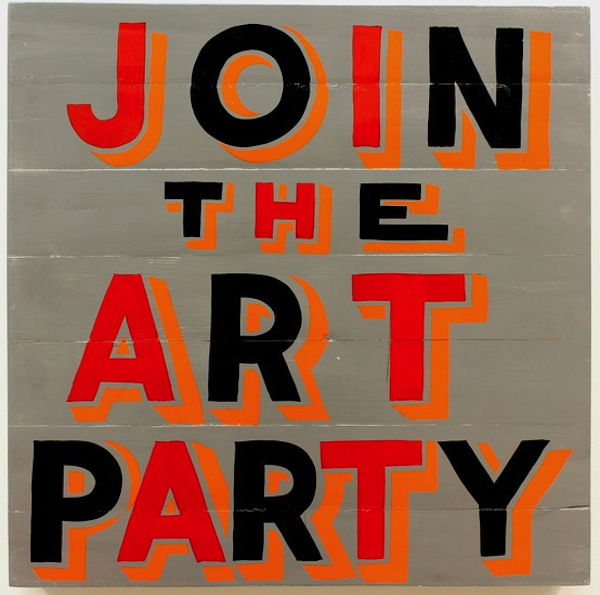
Bob and Roberta Smith knows how to make a point. In the exhibition The Art Party USA Comes to the UK at Hales Gallery at the moment (okay, not for much longer but there’s still a chance to catch the show if you’re quick), he’s in full-on soap box mode – he’s even made his own soap boxes for the occasion – in a bid to entice us to join the Art Party of the USA. The starting point for the Art Party was Bob and Roberta Smith’s May 2011 letter to Michael Gove, which he published to encourage others to write in to emphasise the importance of art in the school curriculum. Not a political party in any traditional sense, according to the website in order to join one simply needs to “make some art and encourage others to do so!”

Continue reading

The other side

Mark Wallinger, Threshold to the Kingdom, 2000

If there’s a hellishness to When Parallel Lines Meet at Infinity that makes it possible to see  Mark Wallinger’s journey through the underground as a journey to the underworld, then his work Threshold to the Kingdom can be seen as representing an altogether better passage to a different world. The journey here is a simple one – through a set of automatic doors into the arrivals hall at London City Airport – but it is made in slow motion and to the accompaniment of glorious choral music which gives the arrival an uplifting feel. Some are greeted by friends, others pass through to continue their journey alone but there is a feeling  of calm even when it briefly looks like paths might converge and collisions occur.

Continue reading

In the round

Mark Wallinger, When Parallel Lines Meet at Infinity, 1998

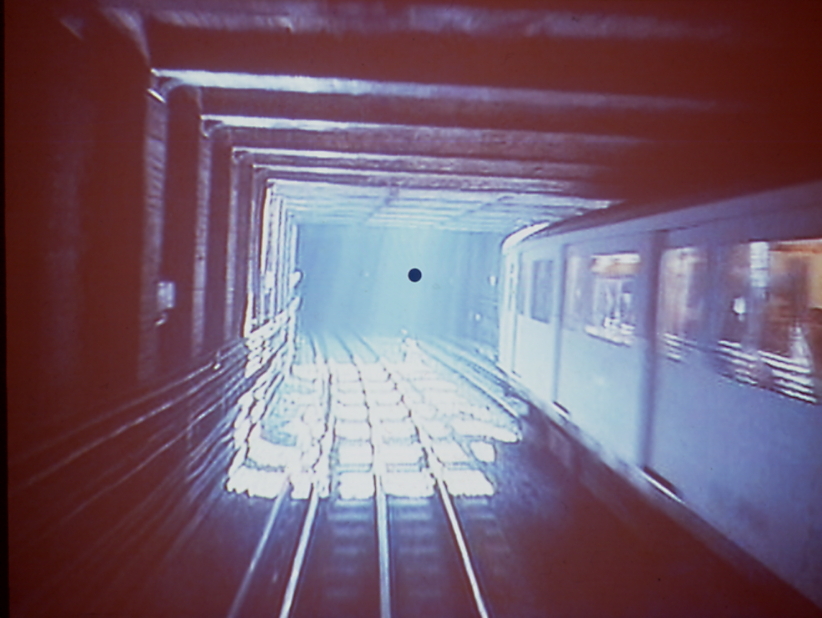
While I’m still on a transport theme, however tenuous some of the connections have been, it seems relevant to ponder a work by Mark Wallinger that I saw in his Whitechapel show however many years ago that was (yes, yes, Google would know) and which has stayed in my mind but refuses to quite come into sharp focus for me. What I remember is a wall sized video projection of the view from a Circle Line tube train as it went round in circles. Standing watching the tracks as we travel forward along them is a slightly giddying experience. There’s no sense of separation. And there’s always something slightly vertiginous about a wall-sized projection; the lack of the framing device of the wall around the edge of the projected image means there’s a strange sense that this is a world we could pass directly into.

Continue reading

A bumpy ride

Richard Wilson, Hang On A Minute Lads, I’ve Got A Great Idea…, 2012

As a starting point for sculpture, the last line of The Italian Job might not seem like an obvious, sensible or even remotely workable choice but then Richard Wilson isn’t an artist to let a little thing like impracticality get in the way of a good idea. So, how better to join in the flag-waving of this summer than by balancing a replica of a red, white and blue coach over the edge of the roof of an iconic seaside building? Having written about this summer’s bus-based art a while ago for MostlyFilm, I hadn’t intended to post about this here but a spate of transport related posts have brought it back to mind and you can never have too much sunny, smile-inducing art. Well, you probably can, but let’s plough on regardless.

Continue reading

Art about art – Mel Brimfield: Between genius and desire at Ceri Hand Gallery

Mel Brimfield, Vincent (Portrait with Fur Hat and Bandaged Ear), 2012

Mel Brimfield makes art about art in a very different way to others that I’ve written about here before (the reworkings of Hogarth’s A Rake’s Progress by David Hockney and Yinka Shonibare or Gregory Crewdson’s remained Edward Hopper picture, for instance). As with Shonibare’s Diary of a Victorian Dandy, Brimfield’s work is performative but there’s a humour in the work that feels more connected to Nina Katchadourian’s Self-portrait as Sir Ernest Shackleton though in Brimfield’s work the performances are collaborations between artist and performer. The resulting works – photographs, videos and sculpture – reference not only the artists Brimfield is looking at but also our ideas about art and the way the artists have been represented in films. Brimfield’s exhibition Between Genius and Desire at Ceri Hand Gallery Project Space – the gallery’s first show in London – gave me a lot to both think and smile about.

Continue reading

Shadow play

Lis Rhodes, Light Music, 1975 (installed at Tate Modern, 2012)

Performance art in museums is still something of a rarity. Though film/video installations do fare a bit better, the prospect of having a space dedicated to showing practices such as these in a major museum is an exciting one. Given that I am also intrigued by the reuse of former industrial spaces, all in all I’m quite excited about the opening of The Tanks – the vast underground tanks that once held the oil for Bankside power station – at Tate Modern. Converted, like the building itself, by architects Herzog + De Meuron, The Tanks are not remotely like the white wall gallery spaces we’ve come to expect. Like the Turbine Hall, The Tanks – two large circular spaces plus some smaller rooms – have been left unashamedly industrial.

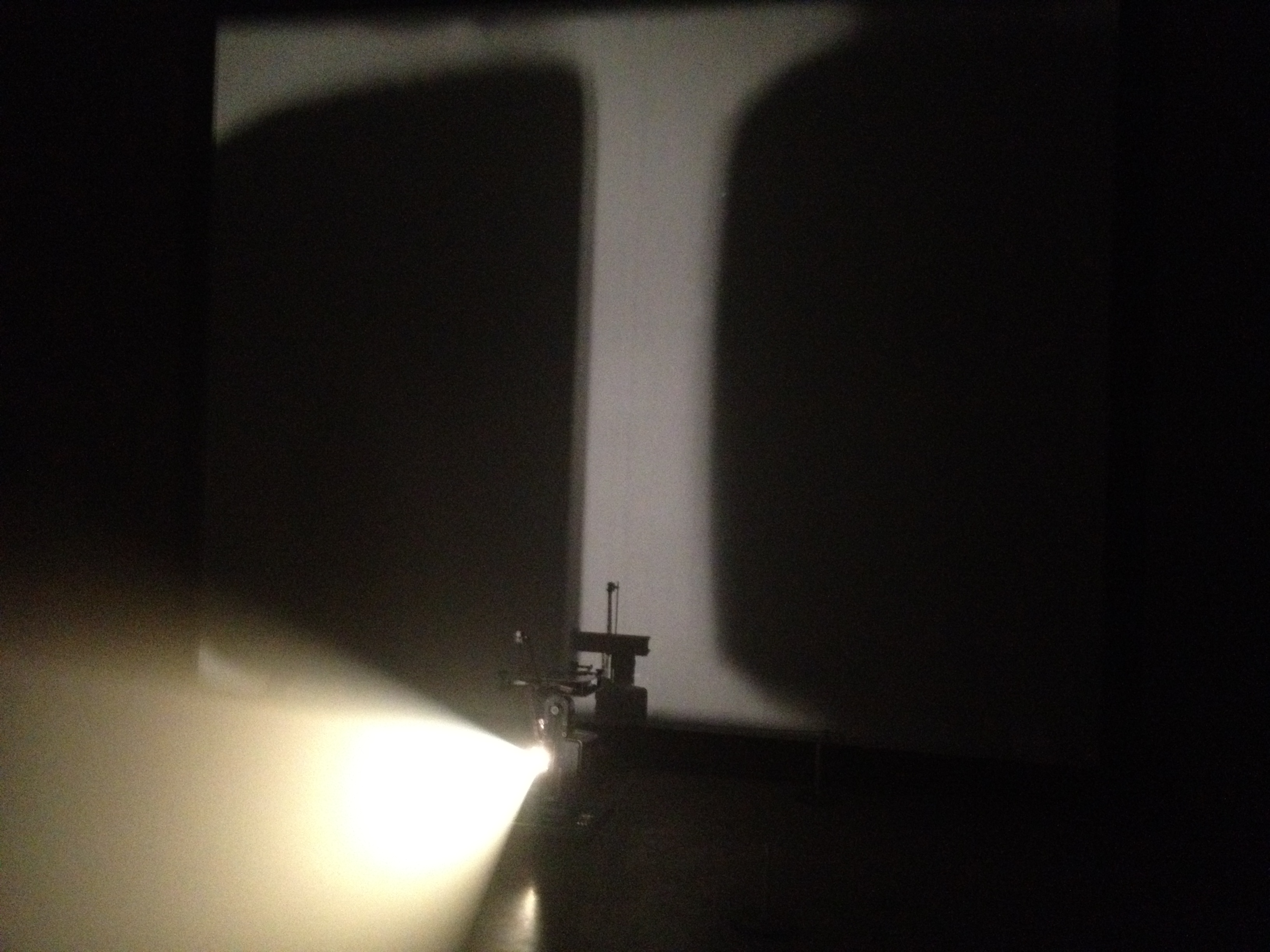
In many ways Lis Rhodes’s Light Music which I saw in The Tanks at Tate Modern reminded me of Anthony McCall’s solid light works, such as Line Describing a Cone (1973). There is the same use of a hazy space to accentuate the beams of projected light. But it is also a very different work. Though both can be described as drawings, Light Music feels more random, as the lines one screen come and go; like much of Rhodes’s work, in some ways, this feels more like collage.

Continue reading