Party pieces

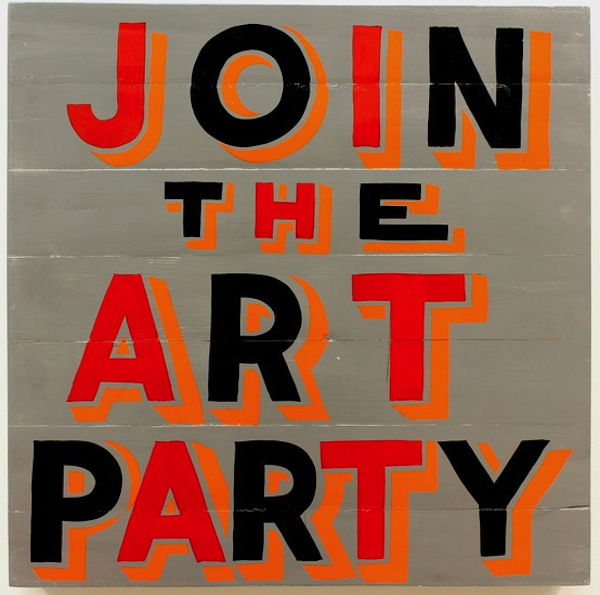
Bob and Roberta Smith, Join the Art Party, 2012

Bob and Roberta Smith knows how to make a point. In the exhibition The Art Party USA Comes to the UK at Hales Gallery at the moment (okay, not for much longer but there’s still a chance to catch the show if you’re quick), he’s in full-on soap box mode – he’s even made his own soap boxes for the occasion – in a bid to entice us to join the Art Party of the USA. The starting point for the Art Party was Bob and Roberta Smith’s May 2011 letter to Michael Gove, which he published to encourage others to write in to emphasise the importance of art in the school curriculum. Not a political party in any traditional sense, according to the website in order to join one simply needs to “make some art and encourage others to do so!”

Continue reading

On the road

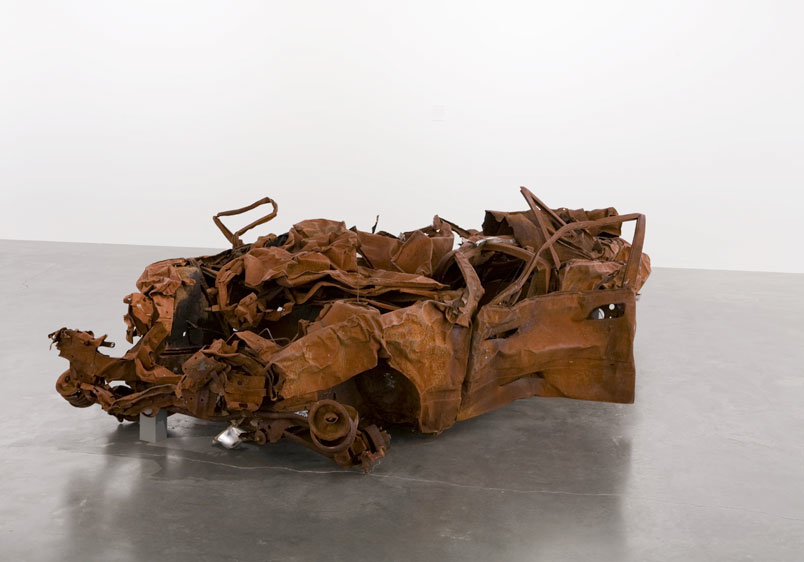
Jeremy Deller, It is what it is, 2009

Though I’ve mentioned this work in a previous post, it seems pertinent to make it the subject of a post now given that, like David Černý’s Quo Vadis, the basis of the work is a car as a signifier of world events. The car in Jeremy Deller’s It is what it is, was destroyed in a suicide bomb attack in Iraq in 2007. The mangled wreckage here, as is often the case in media reports of war, stands in for the destruction of human life, in this case the deaths of thirty eight people. Though we are all too used to seeing images of such vehicles, finding oneself confronted with the real thing is a wholly different experience. Deller has gone beyond this though and taken the wrecked car on a road trip around America, using it as a catalyst for discussion about Iraq.

Continue reading

Every picture hides a story

Mats Bergsmeden, from the series Border Line, 2004–12

The pictures in Mats Bergsmeden’s series Border Line are very beautiful landscape photographs. Most seem like idyllic places, indeed my immediate thought was of the pastoral idyll of landscape painting and this seems to be Bergsmeden’s intention, with the specific reference of the landscape tradition in European painting during the Age of Enlightenment. Some of the pictures are of places where man’s intervention is limited to controlling nature but in some there are signs of the built environment and industry. Though all the images are unpopulated, in some we seem to be approaching signs of human activity; there is a sense that we are on the outside looking in. It would be possible to appreciate these as beautiful landscape photographs without reading anything more into them, but that would be to completely miss the point.

Continue reading

Where activism meets art

Ai Weiwei, Remembering, 2009

It’s possible for text to become meaningless shapes when we’re too close to it, especially if it’s written in an unfamiliar script. At first glance, maybe even to those who read Mandarin, the colourful wall of the Haus der Kunst Museum in Munich which faced visitors to Ai Weiwei’s 2009 exhibition So Sorry, might have seemed more like a cheerful pattern rather than the poignant words of a grieving mother. The colour palette of red, yellow, green and blue is more redolent of children’s books than works of art and certainly doesn’t immediately suggest a memorial. Look closer and it’s clear that the building blocks of the banner are brightly coloured backpacks, the sort that children often use as school bags. But this is a work that needs an explanation.

Continue reading

Building in hope

Yael Bartana, Summer Camp, 2007 (still)

Yael Bartana, Summer Camp (still), 2007

There are many ways of making political art. For some the point needs to be made in an explicit way while others are happier to leave things open to interpretation. Though Summer Camp is much easier to make sense of than And Europe Will Be Stunned, which I wrote about here recently, Yael Bartana is clearly towards the open to interpretation end of the scale. In Summer Camp, Bartana records the rebuilding of the house of a Palestinian family in the village of Anata (east of Jerusalem) by volunteers organised by the Isreali Committee Against House Demolitions (ICAHD), a non-violent direct action group both protests about house demolitions and seeks to rebuild demolished houses. The team of volunteers filmed by Bartana included both Palestinians and Isrealis as well as people from other countries. In a sense then, Summer Camp is effectively a documentary, but as with the films that form And Europe Will Be Stunned there’s more to it than that. 

Continue reading

Art by post

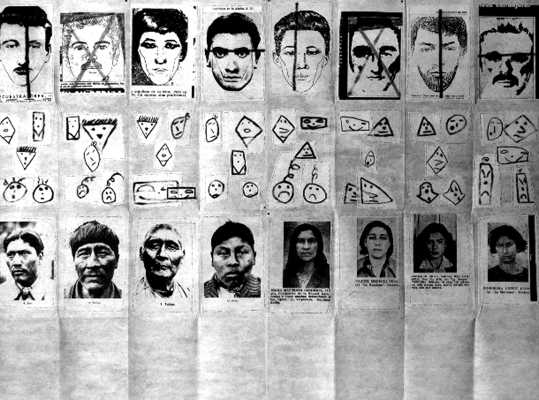
Eugenio Dittborn, The 11th History of the Human Face (500 years) (Airmail painting no.91), 1990

For as long as there’s been an art world, art has travelled. In an increasingly international, multi-centre art world that’s truer than ever and artists working at an international level might have exhibitions in several countries at any one time. For some artists though getting their work out isn’t easy. For Eugenio Dittborn the question of how to get the work out has determined the nature of the work itself. Based in Santiago de Chile, for Dittborn the issue is not just about distance but about the problem of making art while living under a repressive regime and in 1984, with Chile governed by the military, he started to make what he calls Airmail Paintings. Collage-based works, these are made of lightweight, foldable materials and are posted to the galleries that exhibit them – often in segments to be assembled on arrival – with the envelopes becoming part of the work.

Continue reading

Costume drama

Yonka Shonibare, Diary of a Victorian Dandy: 11.00 Hours, 1998

For Yinka Shonibare, Hogarth’s The Rake’s Progress was a starting point for an exploration of art history and the representation of black people rather than something to be reworked for a new time. And with a fascination with the Victorian era, Shonibare chose to change both the narrative and the period in which it’s set, creating a series of photographs called Diary of a Victorian Dandy, made over a period of three days at a stately home in Herefordshire. And though Hogarth’s series is a clear inspiration, the story of Shonibare’s dandy is told in five scenes seemingly taking place in a 24 hour period and each titled with just the time of day. The dandy – played by the artist – rises late. He is attended by many servants; contrary to the narrative we see played out across the history of Western painting, it is the dandy who is black rather than one of the servants who seem to dote on him.

Continue reading

The power of place

Yael Bartana, An Europe will be Stunned, exterior installation view, Polish Pavilion, Venice Biennale, 2011

Given the subject matter of identity and nationhood that lies at the heart of Yael Bartana’s And Europe will be Stunned and the way the trilogy explores the possibility of return and the dangers of nationalism and totalitarianism, the context in which I first came across the work – in the Polish Pavilion at the 54th Venice Biennale – was a fascinating one. It is unusual but not unheard of for an artist who neither lives in nor comes from a country to be selected to represent it at Venice and this was the first time Poland had been represented by an artist who wasn’t a Polish national. And, of course, the history of the Venice Biennale along with the architecture of the national pavilions, the positioning of them within the Giardini and factors like when different countries built or acquired their pavilions offers an interesting, albeit inevitably incomplete, picture of the politics of Europe in particular. Add to this the fact that in 2009 Poland was represented by Krzysztof Wodiczko, who left Poland in 1977 and has been a Canadian citizen since 1984, with Guests, a work about migration and the status of immigrants who remain forever ‘guests’ in their new homes, and the Polish pavilion becomes a fascinating, and intensely loaded, location for Bartana’s installation.

Continue reading

More questions than answers

Yael Bartana, Mary Koszmary (Nightmares), 2007

I don’t go to see art expecting easy answers. I like work that makes me think. (I like work that just bowls me over visually too, but I’m going to assume that’s a given rather than getting bogged down by trying to make an exhaustive list of types of art I like. Let’s just work on the basis that I like art. And, for my purposes here, that thinking is a bonus and a bit of confusion is fine.) I’m not scared of challenging work and I don’t necessarily expect to get it straight away. I’m pretty tenacious; I’ll go back for a second look (if I can, my tendency to see exhibitions on the day they close can be something of a limitation in this respect) or read whatever background information I can find. All of which should be borne in mind when I say that I’ve seen Yael Bartana’s And Europe will be Stunned three times now and I’m still trying to figure out exactly what I think about it.

The work is made up of three connected films – Mary Koszmary (Nightmares), Mur i wieża (Wall and Tower) and Zamach (Assassination) – made over a period of several years and is based around the premise of a movement encouraging the return of Jews to Europe. You won’t often find me focusing on biographical information, but it’s relevant here: The artist, Yael Bartana, is an Isreali Jew whose grandparents died in Poland during the Holocaust.

Continue reading

Contested land

Willie Doherty, Dead Pool II, 2011

At first sight, Willie Doherty’s recent photographs – included, along with works from throughout Doherty’s career, in the exhibition Disturbance, currently at the Towner Art Gallery in Eastbourne – are beatiful if somewhat bleak images of a desolate  landscape. But like all Doherty’s work the subject matter is Northern Ireland and even that basic level of knowledge – coupled with the titles of works such as Dead Pool II or Seepage – means that the photographs carry a very different resonance.

Continue reading