World turned upside down

Zoe Leonard, Arkwright Road, 2012

Given my recent preoccupation with work that transforms the space its shown in, making us focus on the gallery in a new way, it’s really about time I wrote about Observation Point, Zoe Leonard’s exhibition at Camden Arts Centre. Doubtless I would have written about this sooner, but I kept forgetting to go and see it; I love Camden Arts Centre and it’s really easy to get to for me but somehow those two facts seem to conspire to make me miss show after show there. Thankfully, this is one I didn’t miss.

Pretty much the only thing I knew about the exhibition before hand was that Leonard had turned one of the gallery spaces into a camera obscura. I was slightly worried that making my visit during a late night opening might prove to be a mistake but though the space – and the projected image of the road outside – was dim, it was nonetheless fascinating. Despite the work taking its title from the road the gallery is on, the lens points not at Arkwright Road but at the relentlessly busy Finchley Road to the side of the building. The traffic is constant but the skyline is also arresting with a large crane stretching from the wall onto the floor and across the space.

Continue reading

Contested land

Willie Doherty, Dead Pool II, 2011

At first sight, Willie Doherty’s recent photographs – included, along with works from throughout Doherty’s career, in the exhibition Disturbance, currently at the Towner Art Gallery in Eastbourne – are beatiful if somewhat bleak images of a desolate  landscape. But like all Doherty’s work the subject matter is Northern Ireland and even that basic level of knowledge – coupled with the titles of works such as Dead Pool II or Seepage – means that the photographs carry a very different resonance.

Continue reading

Dividing the space

Gordon Matta-Clark, Splitting, 1974

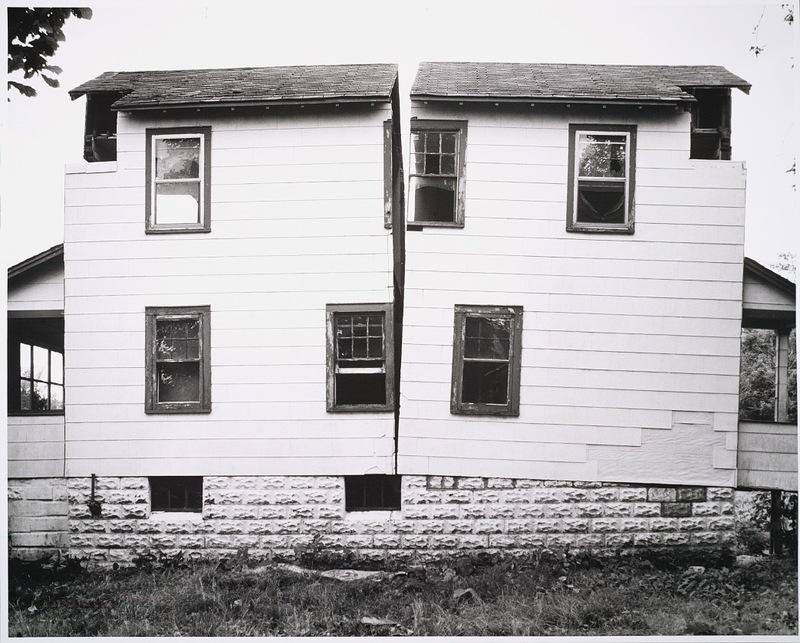
One of my main preoccupations over the last couple of weeks while preparing for the end of year exhibition is how to divide up the space. Obviously for me this involves figuring out where the walls should go and what should go where to make the exhibition make as much sense as possible. But, you know, a bit of literal mindedness and it’s only a small leap from how to divide the studio to Gordon Matta-Clark and the chainsaw and sledgehammer approach to redefining architectural space.

The 1970s may have a lot to answer for in all sorts of ways, but some pretty ground-breaking – or in Matta-Clark’s case building-breaking – art was made then and it’s work that still resonates and that continues to influence subsequent generations of artists.

Continue reading

This exhibition does not do you justice

David Shrigley, Untitled, 2011

I like David Shrigley’s work. It makes me laugh. Why then did I approach his Hayward Gallery exhibition with a sense of dread? Well now, let’s see. Firstly, the strength of Shrigley’s work lies in its simplicity and that’s something that can get wearing when seen en masse. Secondly, the Hayward Gallery is a very big space even allowing for the fact that Shrigley is sharing it with Jeremy Deller’s Joy in People (which warrants a post of its own at the very least). Thirdly – and this one’s the big one – I’ve yet to see a Shrigley solo show I properly liked. Despite that tinge of dread I tried to stay hopeful. With my expectations low, surely a pleasant surprise was in order? Well, yes. And, more importantly, no…

Continue reading

Mutton dressed as lamb

Cindy Sherman, Untitled 359, 2000Cindy Sherman, Untitled #359, 2000

Cindy Sherman started making her Untitled Film Stills thirty-five years ago. I suppose it’s part of the nature of that project that though the images are now very familiar and though others have moved into Sherman’s territory in the meanwhile, her images don’t seem dated. In mimicking different film genres, Sherman created a body of work that has a certain level of timelessness built in. Nonetheless, thirty-five years is a long time and the Cindy Sherman who appears in the pictures in the on-going Untitled series over the past decade or so is very different from the young woman who appeared in the Untitled Film Stills. Sherman is now middle aged and the work she’s made in recent years reflects this; she is a woman of a certain age.

Continue reading

Long hot summers

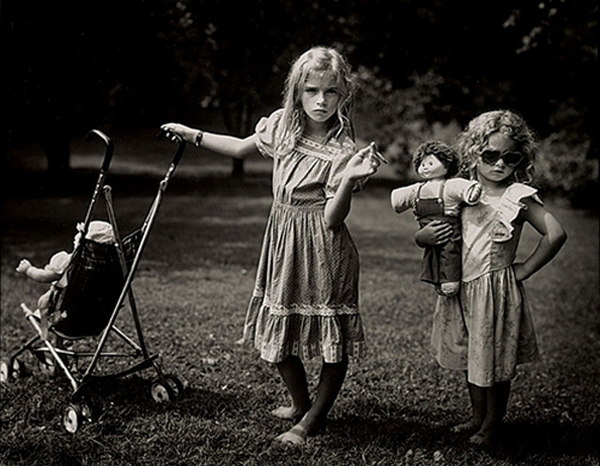
Sally Mann, The New Mothers, 1989

Sally Mann’s series of photographs of her children Emmett, Jessie and Virginia, made over a seven year period and both exhibited and published as Immediate Family, tells of the freedom of long hot summers spent in the countryside around the family’s home in Lexington, Virginia. Mann photographed the children only in the summer when they were out of school and free to play. Made with a large format camera, the pictures are very far removed from the informal snapshots we generally take to document family life. These pictures – whether they look it or not – are deliberately posed and carefully made. The children are playing but their play is for the camera.

Given the heat of the Virginia summer, it’s perhaps unsurprising that the children are often naked and it’s this that has caused the greatest controversy. Given the hysteria that now surrounds images of children it’s hard to see Immediate Family without factoring in the issues that now surround the representation of children.

Continue reading

Counting the days

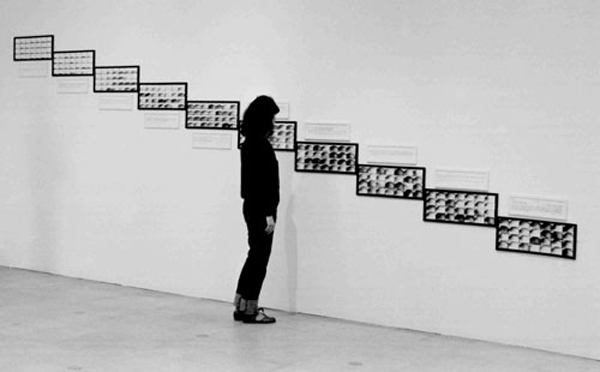
Susan Hiller, Ten Months, 1977-79

To an extent the work of both Jenny Saville and Judy Chicago is seen as feminist in part because it reclaims the female nude for women artists. So far so good, but why then do I take issue with Chicago’s approach – or at any rate to The Dinner Party – while finding Saville’s work challenging and relevant? In part of course it’s to do with the earnest nature, and perhaps hippy thinking, of 1970s feminism. So do I have the same response to other work from that era? Well, yes and no.

Susan Hiller’s Ten Months takes the artist’s pregnancy as it’s subject matter. Hiller photographed her growing belly throughout and arranged the photographs in 10 grids, read from left to right and stepping down the wall, each one corresponding to a lunar month. So far, so hippy. Along with the images, each grid has a text taken from Hiller’s journal. The text for each month is brief and the editing process brings the work back on track for me.

Continue reading

Bodily functions

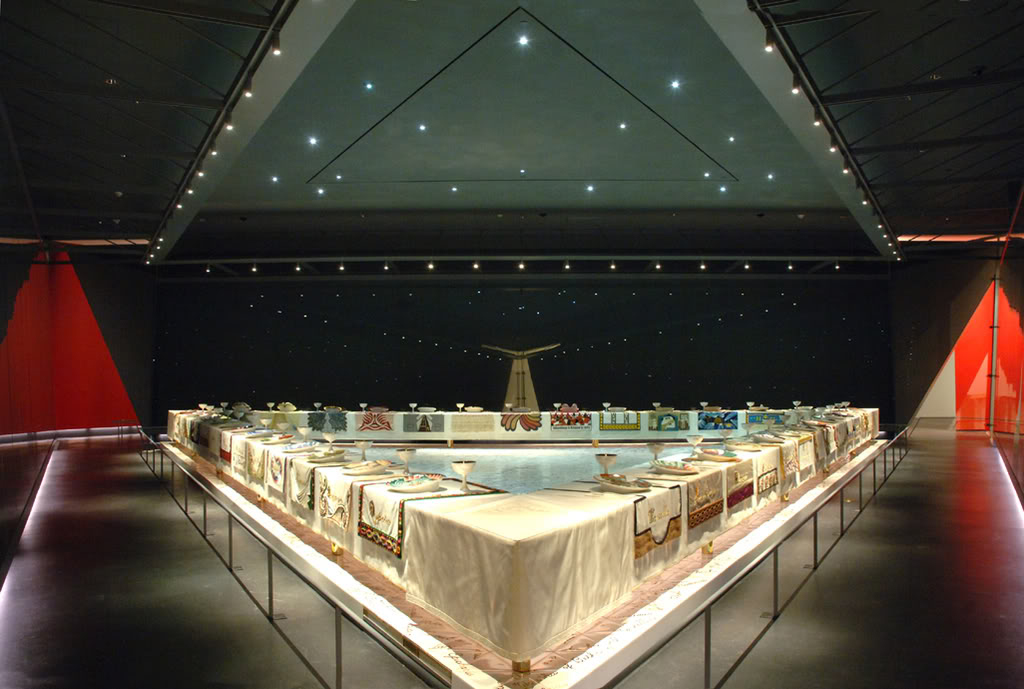
Judy Chicago, The Dinner Party, 1974-79

The reputation of the 1970s isn’t great. If you type ‘1970s the decade’ into its search box, Google helpfully suggests the additions ‘that taste forgot’ and ‘style forgot’. Thanks for that. In fairness, in all sorts of ways it was a pretty rubbish decade. But it was also a decade in which some pretty great art was made and one in which women used art as a political weapon as never before. Probably. I’m sure there are plenty of earlier examples, but there was a pretty significant connection between female artists and the emerging women’s movement. Feminist artists like Mary Kelly, Martha Rosler, Judy Chicago and others made work that challenged previous modes of representation and sought to celebrate women and the female body on their own terms. Inevitably, the results weren’t always pretty.
Continue reading

Tales of the uncanny

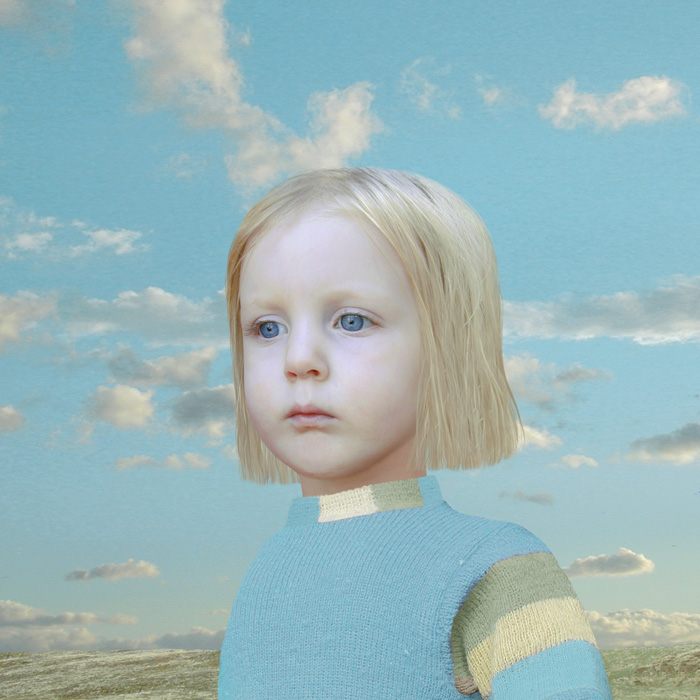
Loretta Lux, Dorothea, 2001

Children are weird. Well, in the world of Loretta Lux they are anyway. It’s hard to work out exactly what’s wrong, but clearly something’s up. It’s partly the washed out colours but there’s definitely more. These children don’t seem entirely real. They have a doll-like quality and though they lack the telltale golden eyes, there is perhaps something of the Midwitch Cuckoos about them. At very least, they seem to be in a trance of some sort.

Continue reading

On the edge

Rineke Dijkstra, Kolobrzeg, Poland, July 26 1992, 1992

Staying with portraiture but today with a little more information that simply what the subject looks like, Rineke Dijksta’s Beach Portraits take a typological approach that suggests she  shares some influences with Thomas Ruff. Despite a consistency of approach, Dijkstra doesn’t seek to achieve the same level of neutrality at Thomas Ruff does with the Posrtraits series. Apart from the images I’m concentrating on here, the series includes pictures of boys and of groups of adolescents but in the interests of not ramblong on too much I’m limiting myself to looking at three of the pictures of girls.

Dijkstra’s Beach Portraits series is of adolescents standing facing the camera with the sea behind them. Despite the simplicity of this approach, each has a slightly different stance which suggests very different levels of confidence. The girl photographed in Kolobrzeg, Poland, July 26 1992 has a relaxed stance and her gaze seems to connect with the viewer. What I find most touching about this picture is the slightly ill-fitting swimsuit which looks as though it may be cut for a slightly more developed figure, damp at the bottom suggesting she’s just come out of the sea but hasn’t been swimming.

Continue reading