The sound of breaking glass

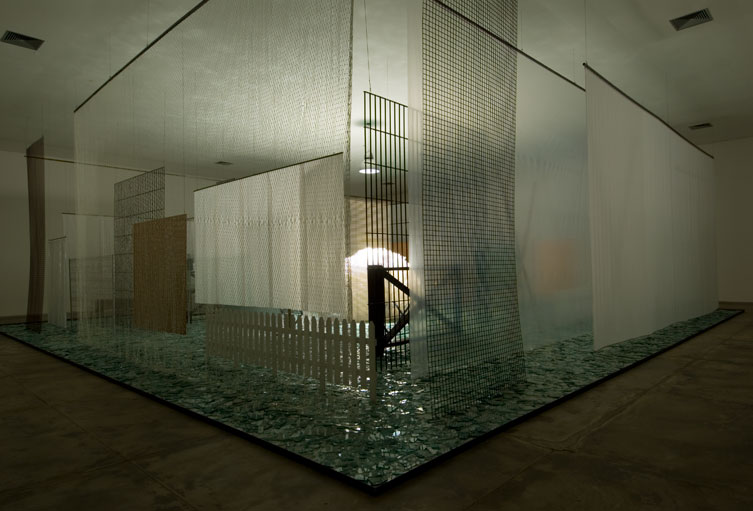
Cildo Meireles, Through, 1983-89/2008

Installation art can be risky. It’s just that usually the risks are more about whether the pieece will work and whether viewers will respond as one hopes rather than whether they’ll stumble on a floor of broken glass. But having risked his own freedom by making overtly political work while living in a military dictatorship, Cildo Meireles was never likely to be put off by something like a slight – and largely theoretical – risk of an audience member sustaining a minor injury. Unlike the harmless threat of the long shadows and caged-in feeling of being in a Mona Hatoum installation, Meireles’s Through does involve a level danger, albeit a low one.

Continue reading

Casting a long shadow

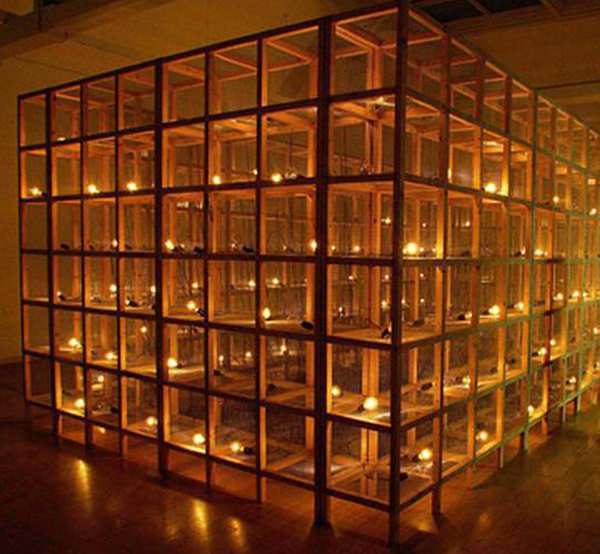
Mona Hatoum, Current Disturbance, 1996

The whimsy of Noble and Webster’s use of shadows is witty enough but ultimately – for me at least – the work is unsatisfyingly slight. I enjoy it well enough at the time but the work never really gets under my skin. But shadow is a powerful force and it’s one that Mona Hatoum uses to really good effect.

In installations like Current Disturbance – which I saw at the Whitchapel Gallery in 2010 – Hatoum uses shadow as a meaning force. The bare lightbulbs fade in and out and the crackle of an electric current gives a sinister edge to the changing light levels. The gridded structure – reminiscent of the cages occupied by battery hens perhaps – feels prison-like. The installation has an architectural feel, but if this is a city space it is a densely-populated and uncomfortable one.

Continue reading

Gathering, listing and smashing

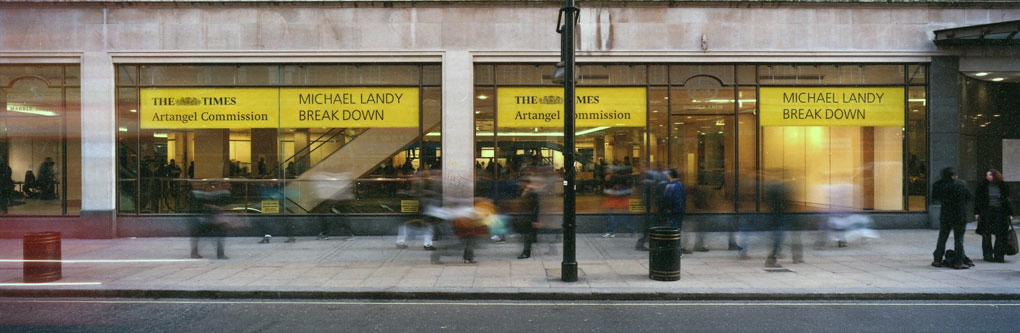
Michael Landy, Break Down, 2001

If I’m honest, I’m a bit of a hoarder. I know I really need to start throwing things out, but somehow I don’t get round to it. And being an artist gives me an extra excuse, or so I tell myself. I have all kinds of junk squirreled away as stuff I might sometime use to make work. Yeah, right. But however much I know I need a clear out and however much I like art that is driven by obsession – a lot, on both counts – I know I could never have made Break Down. The extremity of Michael Landy’s project fascinates and terrifies me in equal measure.

Continue reading

In mid air

Cornelia Parker, Cold Dark Matter, 1991

It started with a shed. It was full of all the sort of stuff that somehow gets collected in a shed over time. Sheds are useful. They are places to keep things that we want but don’t quite have space for and this one was pretty full. Cornelia Parker started by putting the shed in a gallery – Chisenhale in east London – before moving it to a field and getting the British Army to blow it up.

Parker then carefully gathered up the pieces and suspended them in the gallery around a central light bulbas though time had frozen mid-explosion.

Continue reading

Artful eating

Janine Antoni, Gnaw, 1992

What better time than Easter Sunday to be thinking about chocolate. Lots of chocolate. And having posted about artists working with their own body the last couple of days, today I’m all about an artist who uses her body not as the source of the image but as the tool to make the work. In Gnaw, Janine Antoni gnawed away at a 600lb block of chocolate and another of lard, using the blocks as two parts of a three part installation. The work is a strange one. On the one hand chocolate is delicious, but lard?! Okay, so I’m a vegetarian, a block of lard is never going to be something I enjoy being faced with in a gallery or anywhere else, but I think disgust is a pretty universal response.

Continue reading

Stripped bare

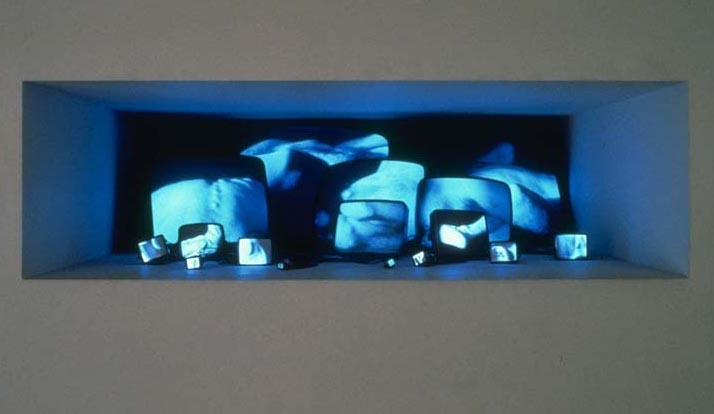
Gary Hill, Inasmuch As It Is Always Already Taking Place, 1990

Like Nam June Paik, Gary Hill often uses the physicality of the television as part of the work but for Hill the box is something to shed leaving the screen and the tube behind it to occupy the space. Multi-screen video works become installations in which the means of display takes on its own significance. Inasmuch As It Is Always Already Taking Place is, in a way, a self portrait, albeit a fragmented one and one which tells us little about Hill.

Continue reading

Boxes of tricks


Nam June Paik, TV is Kitsch, 1996

As we lose the analogue television signal, the impetus to get rid of old analogue televisions is even stronger. The cathode ray tube makes them bulky and heavy next to the sleek lines of plasma and LCD televisions and the need to have an external box to pick up a signal adds to the feeling that the time has come. But that same bulk that seems so annoying in the average living room is key to quite a lot of art from the last few decades. The box is part of what can blur the boundaries between moving image and sculpture. In the case if Nam June Paik’s TV is Kitsch it is the physical presence of the television casings that gives the work its form.

Continue reading

Make do and mend

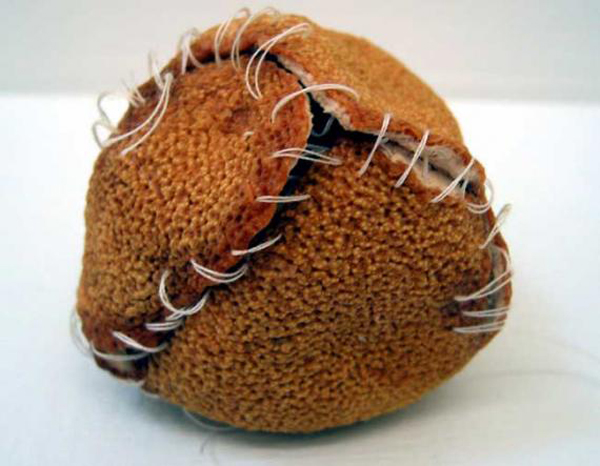
Zoe Leonard, Strange Fruit (for David) (detail), 1992-97

There is something sad and touching about emptied out fruit stitched back up in a futile attempt at mending. But there’s also something about it that amuses me in a way. I think in Zoe Leonard’s installation Strange Fruit (for David) the thing that both moves me and makes me smile is the scale of the thing. It feels like a point that could have been made with a few pieces has taken control and not let Leonard stop; the empty fruit are scattered liberally across the floor, filling the space. In total roughly three hundred pieces of fruit have had their peel or skin dried out and put back together with stitching or other forms of fixing or adornment.

Continue reading

Webs of deceit

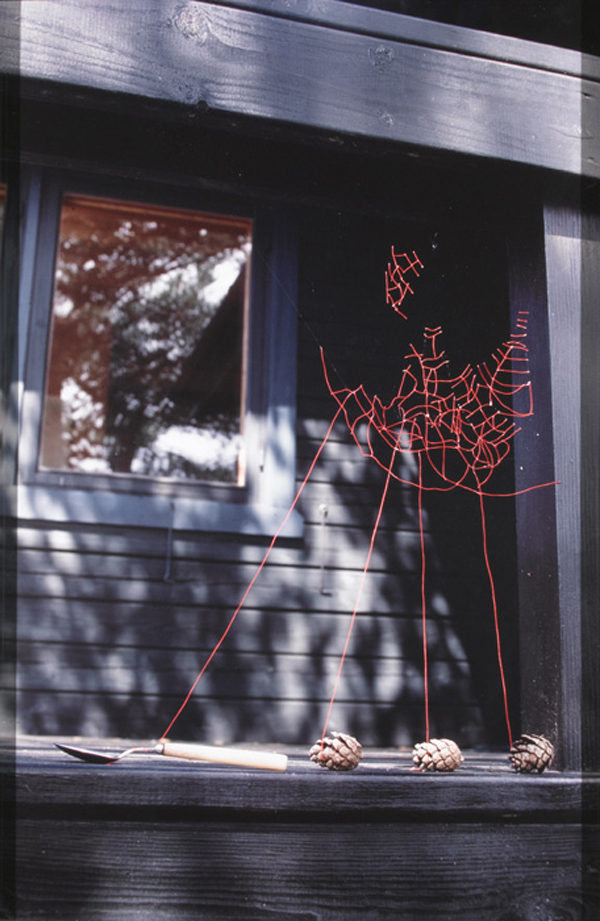
Nina Katchadourian, Mended Spiderweb #14 (Spoon Patch), 1998

I confess to not much liking spiders. If they stayed outdoors I’d feel a lot more benevolent towards them, but when they come inside and scurry about like they own the place they make me distinctly edgy. But even I acknowledge that they do make very beautiful webs. In her Mended Spiderweb series – part of a large body of work called Uninvited collaborations with nature – Nina Katchadourian has helped out by patching up damaged spiders’ webs with fine red thread. The results are not only very beautiful, they are also unexpectedly interesting.

Continue reading

Art on acid

Painting with hydrochloric acid on nylon, 1961

There are lots of ways to paint, as a quick wander through any major art museum will amply demonstrate. But there are those who change out understanding of art through their work, and Gustav Metzger is one such. Metzger’s notion of auto-destructive art, which he initially defined in 1959, was an interesting and highly-influential on which was rooted in the belief that Western society was failing (Metzger has been a Marxist all his adult life). The idea is that the work has the capacity to destroy itself or that it is destroyed by the actions of its creator.

Gustav Metzger: Auto-Destructive Art (1959)
Auto-destructive art is primarily a form of public art for industrial societies.
Self-destructive painting, sculpture and construction is a total unity of idea, site, form, colour, method, and timing of the disintegrative process.
Auto-destructive art can be created with natural forces, traditional art techniques and technological techniques.
The amplified sound of the auto-destructive process can be an element of the total conception.
The artist may collaborate with scientists, engineers.
Self-destructive art can be machine produced and factory assembled.
Auto-destructive paintings, sculptures and constructions have a life time varying from a few moments to twenty years. When the disintegrative process is complete the work is to be removed from the site and scrapped.

Continue reading