Dystopian dreams

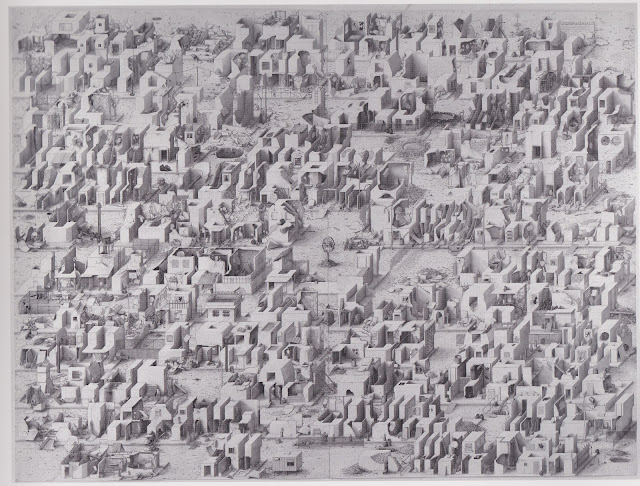
Paul Noble, Nobson Central, 1998-9

The world of Paul Noble is a strange one. His imagined city, Nobson Newtown, which he started constructing in the form of monumental drawings in the late 1990s, is a complex space. The houses are modernist boxes; the city includes open spaces and evidence of a degree of urban planning reminiscent of the utopian ideals of the garden cities and new towns of the early to mid twentieth century. Everything, surely, should be perfect?

Continue reading

The whole story

Fiona Banner, Apocalypse Now, 1997

Stories can be told in many different ways, words on the page and images on a cinema screen being two of the most common. It’s when the means of story-telling becomes words on a cinema screen that things start to get confusing. I’m not sure how easy it’d be to try to follow the story of Apocalypse Now from Banner’s piece of the same name, but the narrative is all there. It’s just that it’s there as a hand-written text on a page the size and shape of a cinema screen. And only yesterday there I was claiming Sean Landers choice of line length seemed excessive!

Continue reading

Laughter and pain

Adel Abdessemed, Mémoire (still), 2012

I should have known from the start that there would be more to Adel Abdessemed’s Mémoire than was apparent at first glance. After all, his work is never quite as it seems and there is almost always a degree of violence and pain somewhere in the work. But watching Mémoire, my first response was laughter. This was a baboon spelling words out on an magnetic whiteboard. Maybe if I watched long enough it would start writing Shakespeare. Isn’t that what monkeys are meant to do given time?

Continue reading

Nothing to see here

Robert Rauschenberg, White Painting (Three Panel), 1951

After yesterday’s pile of shit, today is perhaps a day for a bit of breathing space: art with nothing to look at. It stands to reason: if there’s nothing to see, there’s nothing to get squeamish about.

Continue reading

Drawing and the process of looking

Claude Heath, Venus of Willendorf (detail), 1995

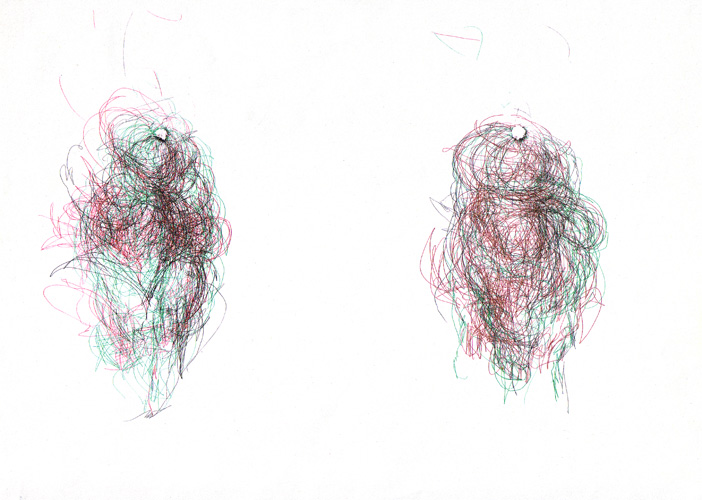
Drawing and looking are inextricably linked but just as there is more than one way to draw there is more that one way to look. If the aim is to get as close as possible to recording what something looks like, a camera will generally do a better job but drawing can bring something extra to the equation. It might be about making a representation that’s more expressive, or one that offers multiple viewpoints simultaneously or a version of how something feels for instance.

Continue reading