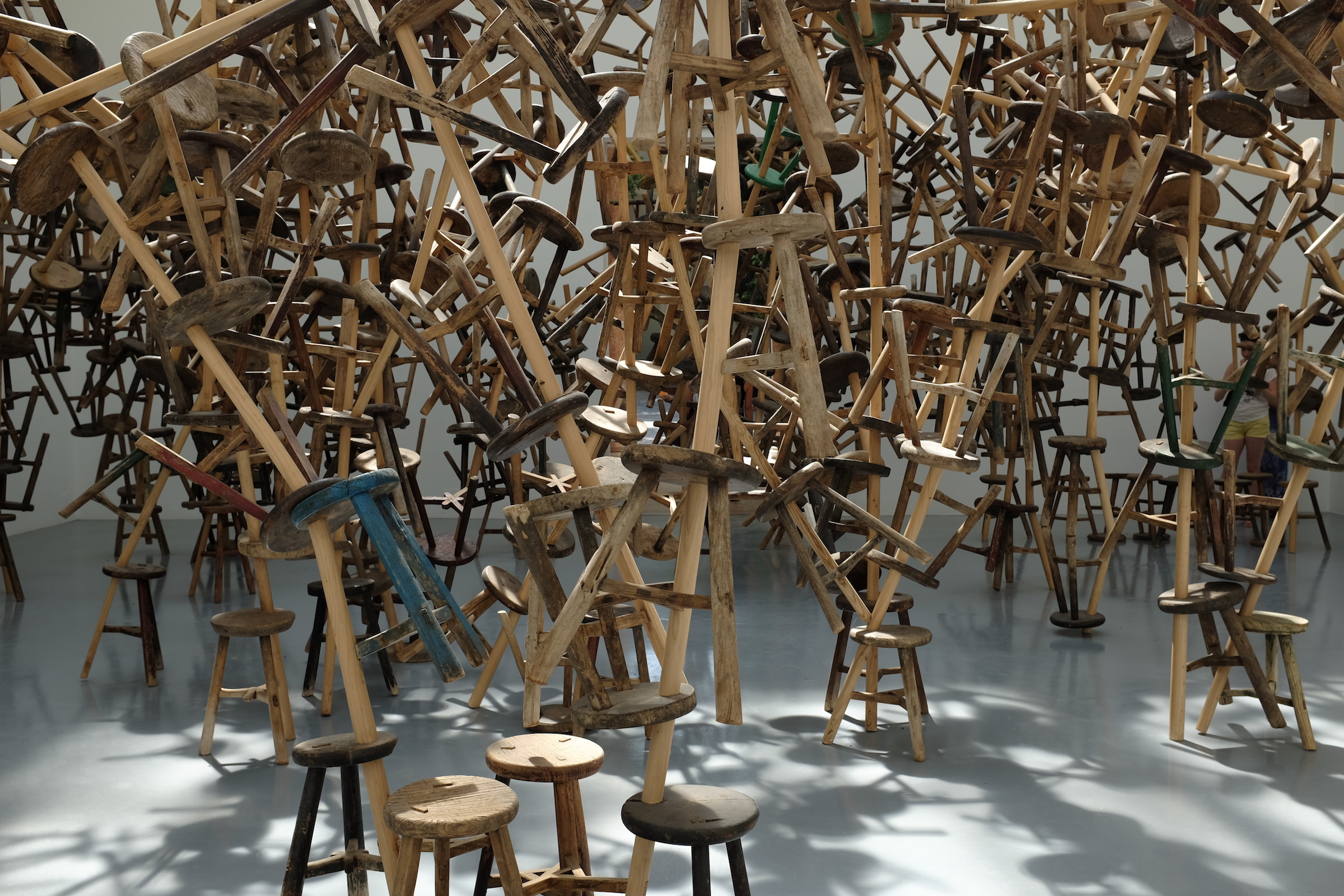
An explosion of seating – nowhere to sit

Ai Weiwei, Bang, 2013 (installation in the German Pavilion at the 55th Venice Biennale)

Ai Weiwei, Bang, 2013 (installation in the German Pavilion at the 55th Venice Biennale)

The first thing that confused me about the German Pavilion at last year’s Venice Biennale was that it was in France. Well, not France the actual country, but in France’s pavilion: the two countries swapped buildings for the 55th Venice Biennale as a cultural exchange. Walking into the building the first work on show – in a large central space that generally dictates the tone of anything shown there – was Bang, an installation made of an exploding forest of wooden three-legged stools by the not even a bit German artist (and subject of my last couple of posts) Ai Weiwei. What did it all mean?
Continue reading

Watching them, watching him

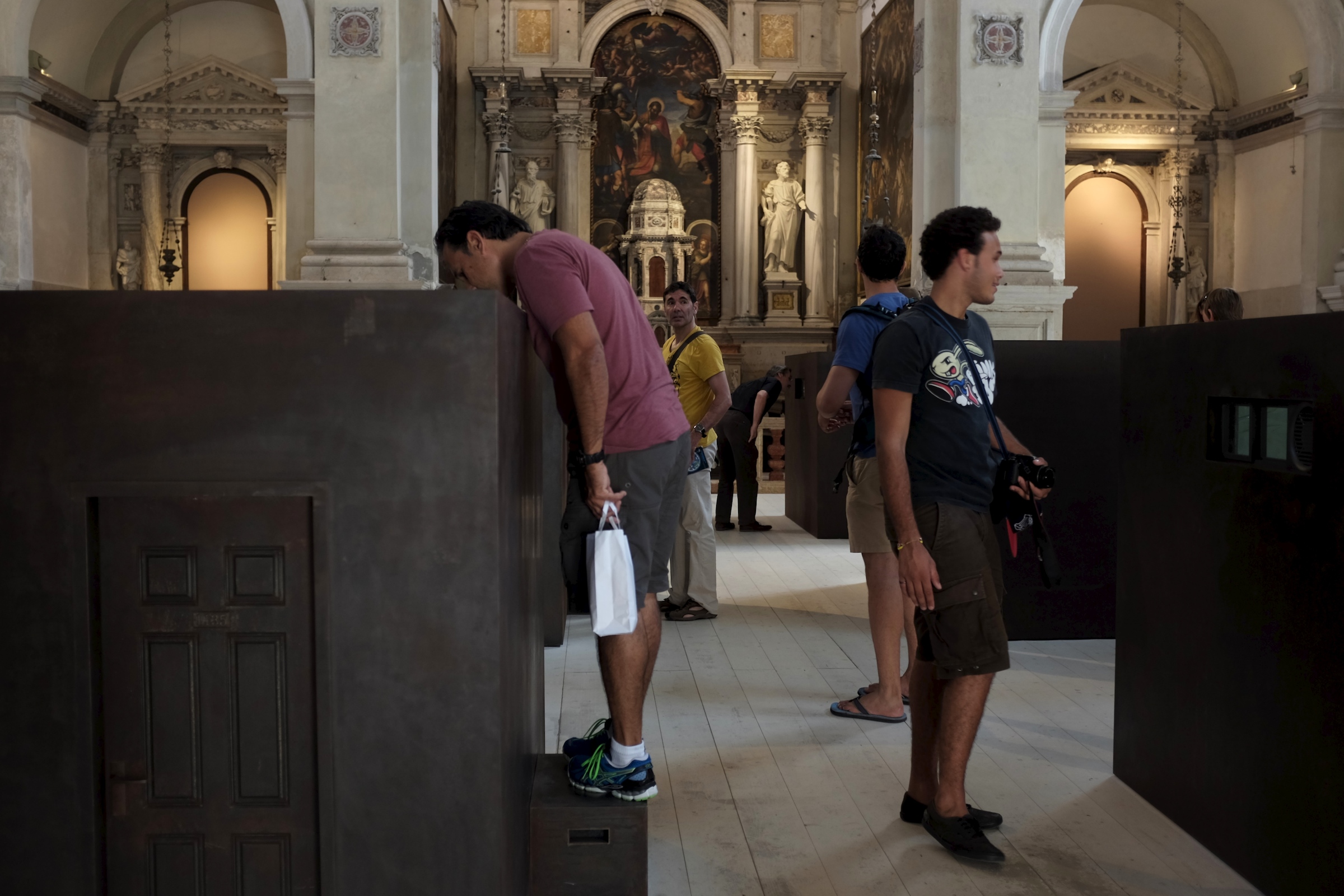
Ai Weiwei, S.A.C.R.E.D., 2013 (installation view,  Sant'Antonin Church)

Ai Weiwei, S.A.C.R.E.D., 2013 (installation view, Chiesa di Sant’Antonin, Venice as part of Disposition organised by Zuecca Projects and the Lisson Gallery)

Walking into a church in Venice and finding six large black crate-like boxes would be a fairly odd regardless but add couple of dozen other art lovers into the equation, wandering around the space and climbing on little black boxes to peer intently into the crates is a distinctly strange and somewhat unsettling experience. Like most churches in Venice, Chiesa di Sant’Antonin, a fourth century building extensively reworked in the Baroque style in the mid seventeenth century, has a rather ornate interior. The austere black boxes that dominate the floor of the space are an incongruous sight; once one gets beyond the immediate visual confusion, the context raises some interesting questions.

Continue reading

Straight talking

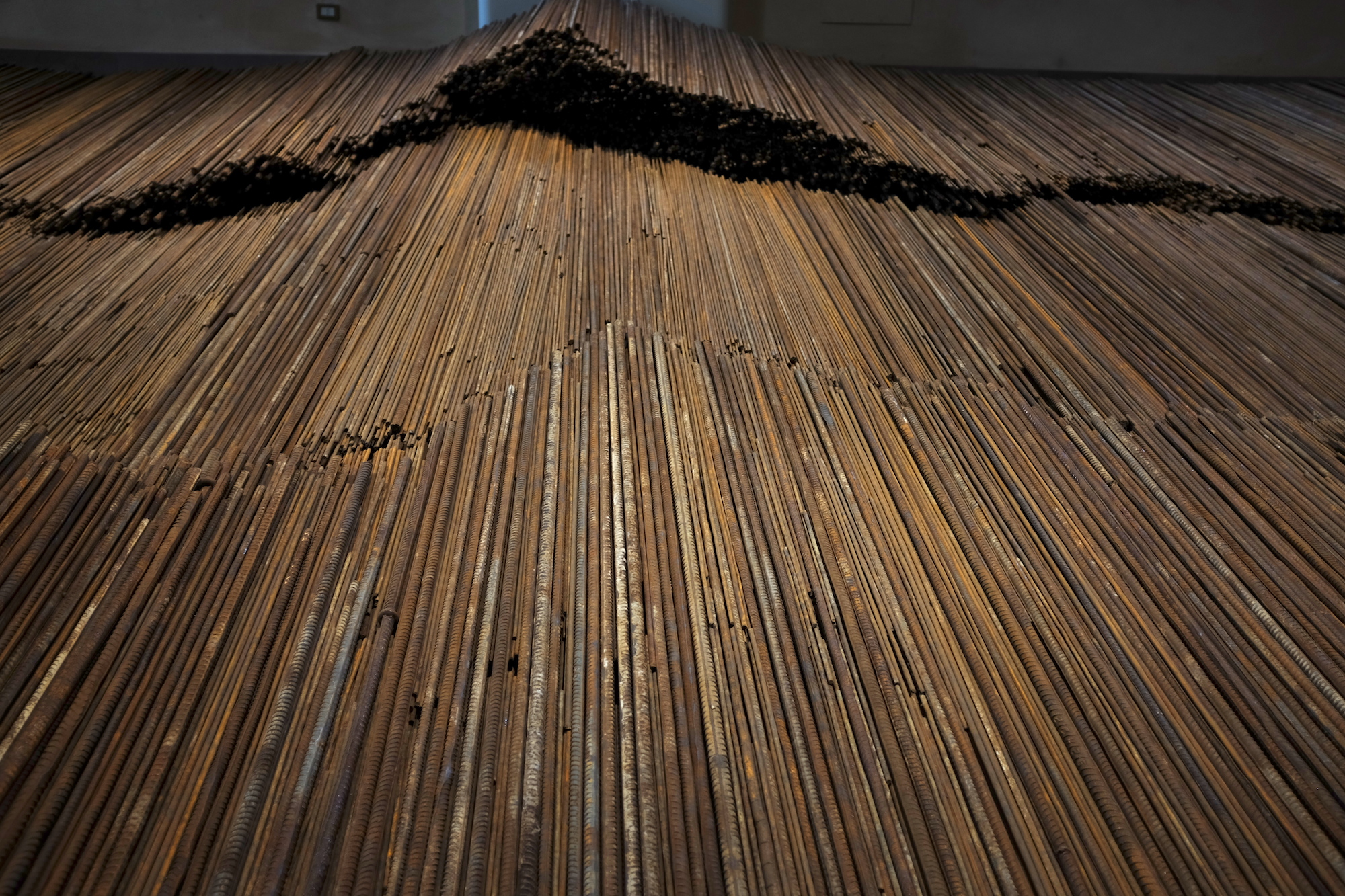
Ai Weiwei, Straight, 2012 (installed at Zuecca Project Space, Venice, 2013)

When the 54th Venice Biennale opened in June 2011, Ai Weiwei had been under arrest in China for two months, his absence as powerful a presence in the art world as his work. Museums and galleries rallied; petitions were signed, posters hung and badges worn. Banners questioning Ai’s whereabouts or calling for his release hung from the galleries that represented him; his Circle of Animals / Zodiac Heads sculpture was on show in London and New York, the Sunflower Seeds had only recently gone from the Turbine Hall at Tate Modern. In Venice, Ai was largely absent; he had no work at the Biennale and was scarcely mentioned in any official capacity.

Guiseppe Sampone Zuecca Project Space 2011 crop

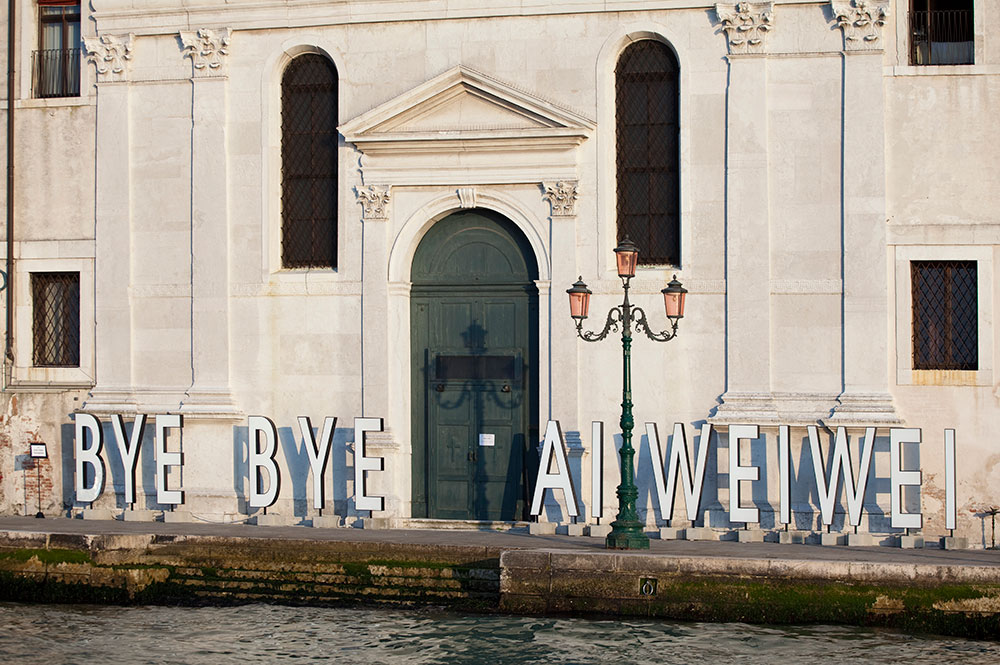
Guiseppe Stampone, Bye Bye Ai Weiwei, outside Zuecca Project Space, 2011

Somewhat confusingly (and, some argued, insultingly), his absence was acknowledged as part of a collateral exhibition by a large sign which read, in four foot tall illuminated letters, ‘Bye bye Ai Weiwei’ positioned prominently on the waterfront on Giudecca island, an, at best, ill-judged work by artist Giuseppe Stampone. Cut forward two years and, though still not allowed to leave China, Ai’s presence was rather more apparent at the 2013 biennale. And this time we got to see his work, some of it in the very building that sign stood outside two years ago, the Zuecca Project Space.

Continue reading

Sitting pretty

installation view of Japan Pavilion, Venice 2013

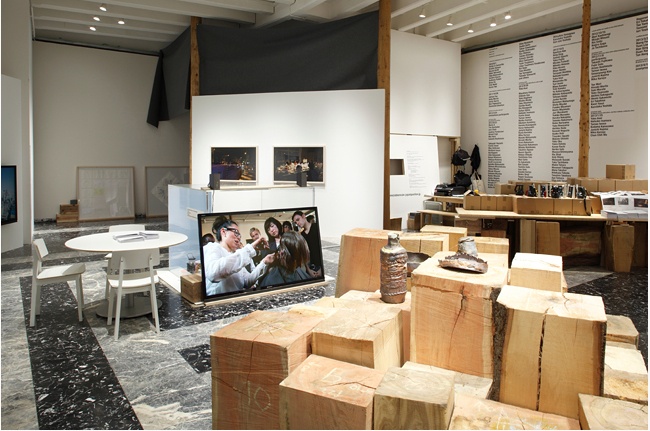
Koki Tanaka, installation view of exhibition in Japan Pavilion, Venice Biennale, 2013

One of the frustrations of art fairs, biennales and the like is the intense time pressure of trying to see everything you want to see in a day (or contemplate buying another ticket to go back, an unappealing option even if one has an extra day free to make it possible), making video and performance works really tricky. On the plus side, the excuse to have a bit of a sit down is often welcome so it’s not all bad. Certainly at last year’s Venice Biennale some of the works I enjoyed the most were time based including a number I really wanted to go back and spend more time with given the chance (didn’t really happen in the case of the things I most wanted to revisit, unfortunately, but that’s the way it goes really). I’ll write more about some of the works that have stayed with me most clearly in the coming days, I hope, but I’ll start with a show that mixed video and objects in a space that still bore the traces of the previous year’s architecture biennale. None of which is what interests me most about the work.

Continue reading

A moveable feast

Joana Vasconcelos, Trafaria Praia, 2013

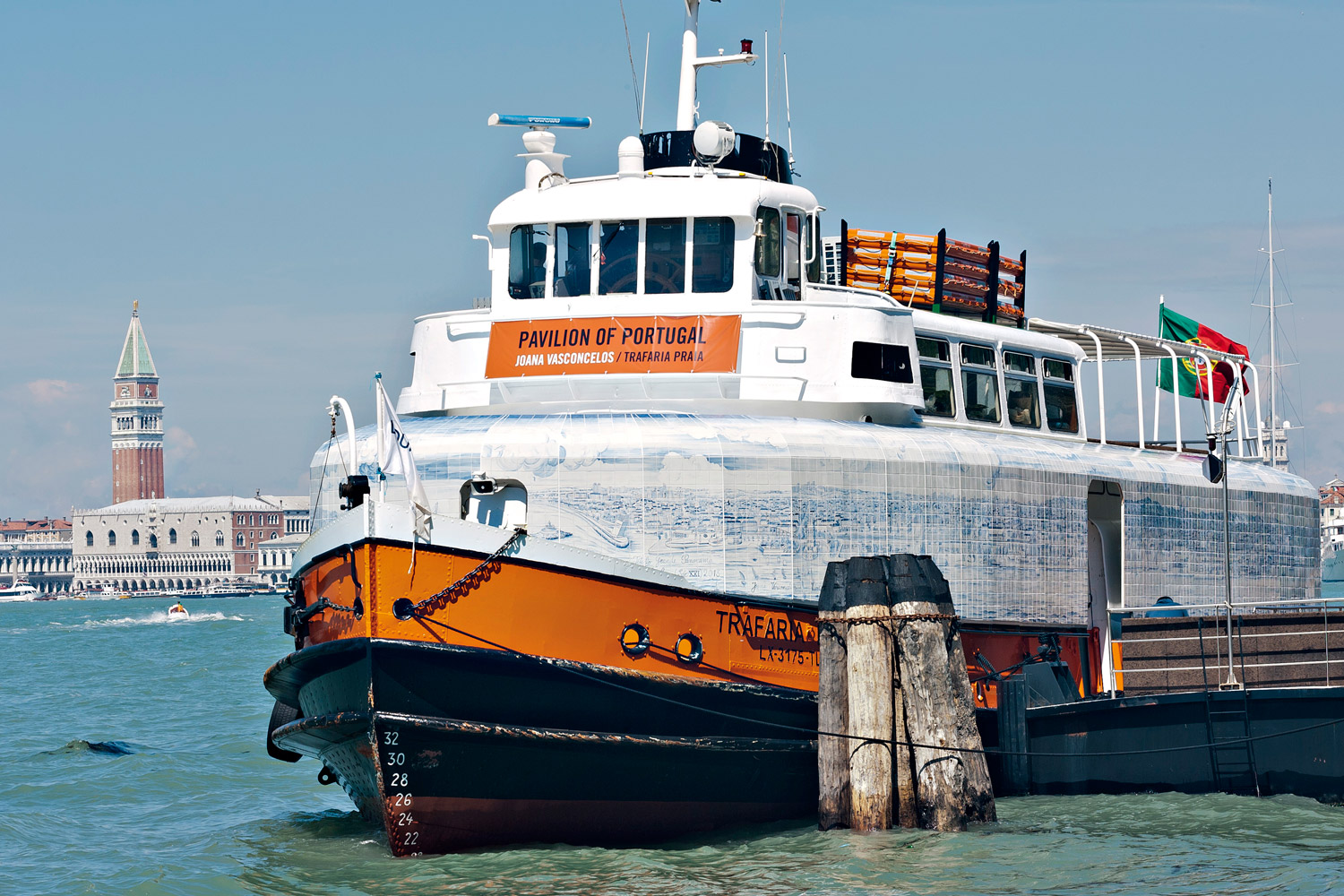
Joana Vasconcelos, Trafaria Praia, 2013

Given that this is the season on sparkly lights, it seems timely to remind myself about Joana Vasconcelos’s Trafaria Praia, the Pavilion of Portugal at the 2013 Venice Biennale. Part art installation, part ferry, this was an unusual space even for Venice. Vasconcelos transformed a Lisbon ferry into an installation that made regular tours of the lagoon. The boat was moored close to the exit of the Giardini – one of the two main Biennale sites and home to many national pavilions – but those who timed their visits right could take a short trip around the lagoon on the Trafaria Praia.

Given more time, I suspect I’d have enjoyed the trip well enough but the pressure of trying to see everything I want to at biennale is such that time based works are inevitably tricky and this is a city where being on land is the novelty so my visit to Trafaria Praia was restricted to visiting the boat at its mooring point. Until I boarded the boat I’d kind of forgotten about the excess of Vasconcelos’s work but, even if it’d been really fresh in my mind, nothing of hers I’ve seen before would have quite prepared me for this.

Continue reading

Starting over

John Pawson, Perspectives, 2011

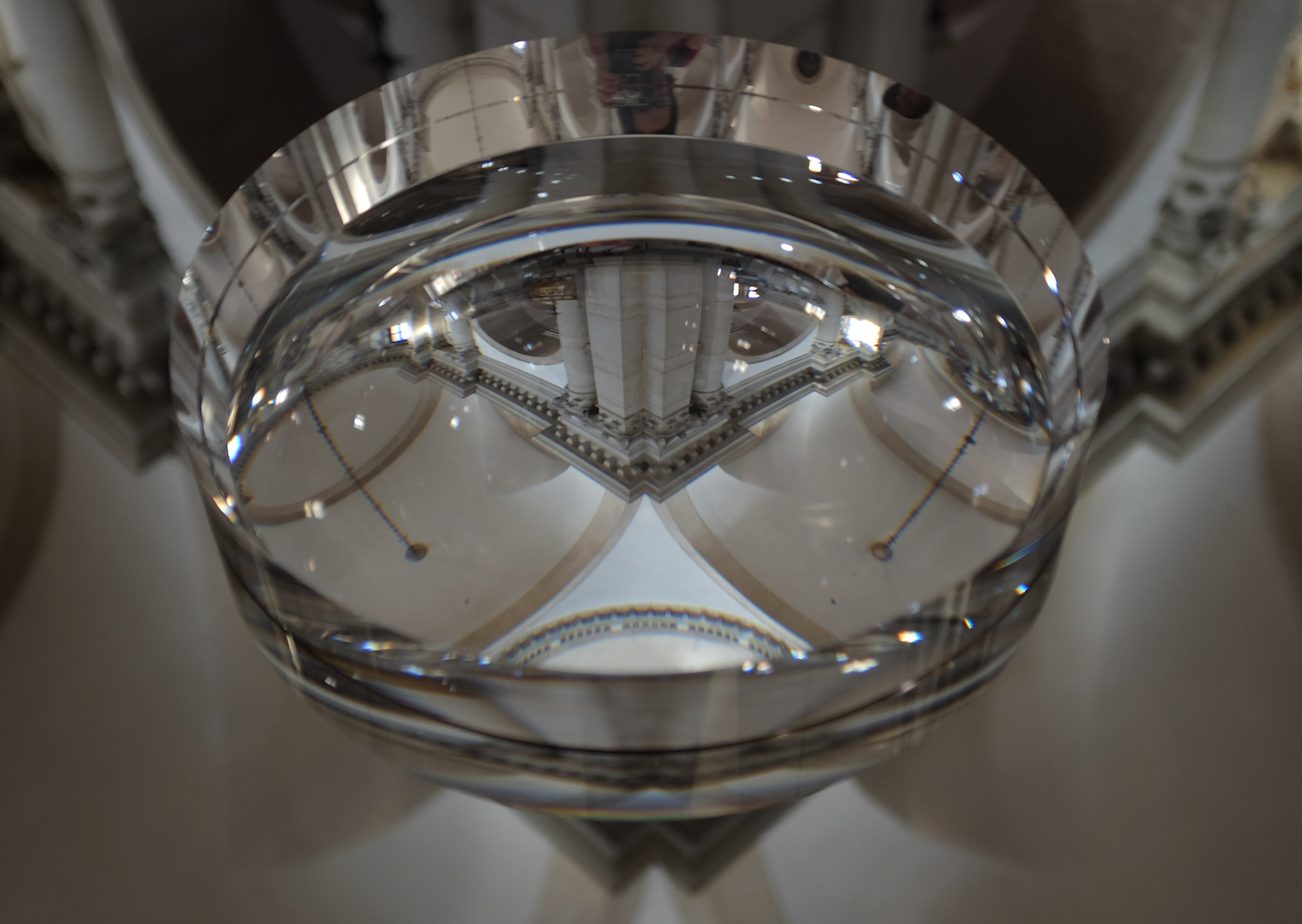
John Pawson, Perspectives, 2011 (installed in San Giorgio Maggiore, Venice, 2013)

So, having lost my blogging mojo in 2013, it’s clearly time for a bit of a fresh start and a resolution to get back to writing random stuff about art on a vaguely regular basis in 2014.*  It seems appropriate to start with a bit of a catch-up on things I’ve seen or been preoccupied by recently but not rambled on about. In some ways I quite like getting a bit of distance on stuff before posting so expect a preponderance of posts about the things that have stuck in my mind most clearly from 2013.

Continue reading

Visualising an idea: Fischli/Weiss’s Rock on Top of Another Rock

Fischli/Weiss, Rock on Top pf Another Rock, 2010, NorwayFischli/Weiss, Rock on Top of Another Rock, 2010

By the side of a tourist route in Norway a large rock sits improbably on top of another rock. Were one to drive past and fleetingly glimpse this rock pairing, it would be possible to catch sight of them and wonder idly whether this was a balancing act made by man or nature. Are the rocks there to mark the way? Are the the site of some ancient ritual? Are they like that following a landslide? If one weren’t looking out for them, contemporary art probably wouldn’t be one’s first thought. In fact though, this curious arrangement – the momunmental equivalent of countless pictures on Flickr – is Rock on Top of Another Rock by the Swiss artists Peter Fischli and David Weiss. Londoners might know a newer incarnation of the work which currently occupies a site in Kensington Gardens just outside the Serpentine Galley (of which, more later I rather suspect).

What interests me here isn’t the work – though that does fascinate me and it’s a work I’d really love to see – it’s the process of proposing such a sculpture. Just as Michael Landy drew out his idea for Break Down – the subject of a previous post – so, according to Peter Fischli, who spoke about the work and the process of its commissioning at the V&A earlier in the year, Fischli/Weiss used an image as a core element of their proposal. Unlike Landy though, they didn’t make a drawing. Instead, they found an image on the internet. The nature of the image may come as a bit of a surprise…

Continue reading

Visualising an idea: Michael Landy’s Break Down

Michael Landy Breakdown drawing

Michael Landy, P.D.F. Product, Disposal Facility, 1998

As an idea, setting up a disposal facility to destroy all one’s possessions is pretty unusual and it’s certainly not one that conjures up an immediate image in the mind. There would be many ways to go: a big crushing machine perhaps, or maybe some sort of funnel and an industrial scale waste disposal unit like the ones you sometimes see in kitchen sinks but huge, or, well all sorts of other possibilities really. Which is what makes Michael Landy’s P.D.F. (do you see what he did there?) so fascinating.

Continue reading

Stuff and nonsense

Michael Landy, Gameboy drawing, 1998

Michael Landy, Gameboy drawing from Breakdown

I’ve written about Michael Landy’s Break Down here before, but at the time I focused firmly on the event and the photographic documentation. Breakdown, an Artangel commission that saw Landy destroy all his possessions with the help of a team of overall-clad operatives and a production line style ‘disposal facilty’ set up in the former C&A store on Oxford Street, came back to mind for a few reasons. Mainly, I’ve been trying to reduce the clutter levels in my house and while there’s a long way to go I’ve become pretty familiar with the local charity shops and reacquainted myself with stuff that’s long been lurking in what can only reasonably be described as the junk room. While I’m probably worse than most people at getting round to dumping the clutter, I think many of us do attach memories to things in a way that can make it hard to acknowledge our lack of practical need for objects that may hold sentimental value, however slight.

Continue reading

Looking back

Tate St Ives Summer 2013

Linder, Joining Valley, 2013

There’s a lot to enjoy in the summer exhibition at Tate St Ives, some of which I’ll quite likely write about later, but the work that really made me smile was one of Linder’s collages. I was already enjoying looking at this work and at the way the series of small collages shared a space with sculptures by Barbara Hepworth, but my enjoyment of Joining Valley wasn’t really about the work at all. It was one of those moments when something you haven’t thought about in years is suddenly brought back to mind by a chance encounter with an image on a gallery wall.

For me, Joining Valley is all about the kettle.

Continue reading