Everyday art

Jeremy Deller, Open Bedroom, 1993 (reconstruction)

Like David Shrigley, Jeremy Deller is an artist whose work doesnt always fit easily into the gallery space. Unlike Shrigley though, when his work is brought together as an exhibiton it exceeds expectations. Joy in People at the Hayward Gallery is a show that is much more than the sum of its parts. And there are some pretty great parts.

In 1993, while others were holding open studios, Deller staged Open Bedroom, his first exhibition, in his parents’ house while they were on holiday. The work, his teenage bedroom presented as art, is reconstructed here as the route into both the show and the head of the artist. We get to open drawers and cupboards and explore the ideas, images and objects that fascinated the young Deller. It’s a great start and a useful grounding for a show that picks up these enthusiasms and makes them art.

Continue reading

This exhibition does not do you justice

David Shrigley, Untitled, 2011

I like David Shrigley’s work. It makes me laugh. Why then did I approach his Hayward Gallery exhibition with a sense of dread? Well now, let’s see. Firstly, the strength of Shrigley’s work lies in its simplicity and that’s something that can get wearing when seen en masse. Secondly, the Hayward Gallery is a very big space even allowing for the fact that Shrigley is sharing it with Jeremy Deller’s Joy in People (which warrants a post of its own at the very least). Thirdly – and this one’s the big one – I’ve yet to see a Shrigley solo show I properly liked. Despite that tinge of dread I tried to stay hopeful. With my expectations low, surely a pleasant surprise was in order? Well, yes. And, more importantly, no…

Continue reading

Without words

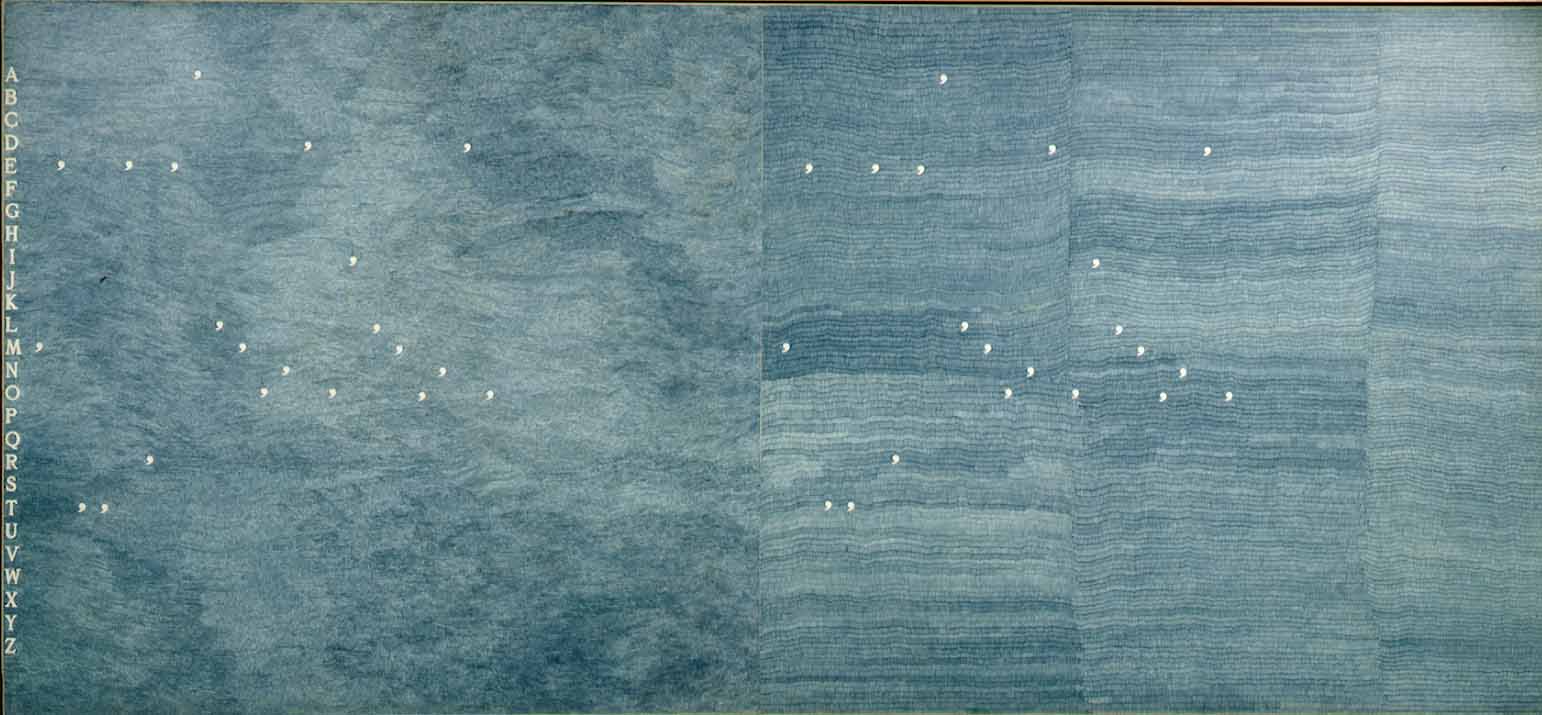
Alighiero Boetti, Mettere Al Mondo Il Mondo (Bringing the World into the World), 1975

There are three paying exhibitions at Tate Modern at the moment. The Damien Hirst exhibition is being widely advertised and has been the subject of a lot of media attention. Of the other two, the Yayoi Kusama seems to have generated the most discussion. Hirst is of course a household name and Kusama was already firmly in the consciousness of Londoners with an interest in contemporary art following Walking in my Mind at the Hayward Gallery in 2009 which was heavily centred on her work, indeed her polka dot wrapping of the trees along the South Bank ensured that her work also reached a signifcant non-art audience. The Hirst and Kusama exhibitions are also the ones making the most – visual – noise in the gallery, and while the Hirst was proved mercifully quieter than I had expected when I visited, they do seem to be attracting the bigger crowds.

There were things I liked about the Hirst – it was good to see those early works again and entertaining to stare in horror at the worst excesses of his more recent output – and I really liked the Kusama exhibition (at some stage I may well write about both) but it’s the other show – Alighiero Boetti: Game Plan – that I found by far the most inspiring.

Continue reading

Mutton dressed as lamb

Cindy Sherman, Untitled 359, 2000Cindy Sherman, Untitled #359, 2000

Cindy Sherman started making her Untitled Film Stills thirty-five years ago. I suppose it’s part of the nature of that project that though the images are now very familiar and though others have moved into Sherman’s territory in the meanwhile, her images don’t seem dated. In mimicking different film genres, Sherman created a body of work that has a certain level of timelessness built in. Nonetheless, thirty-five years is a long time and the Cindy Sherman who appears in the pictures in the on-going Untitled series over the past decade or so is very different from the young woman who appeared in the Untitled Film Stills. Sherman is now middle aged and the work she’s made in recent years reflects this; she is a woman of a certain age.

Continue reading

Long hot summers

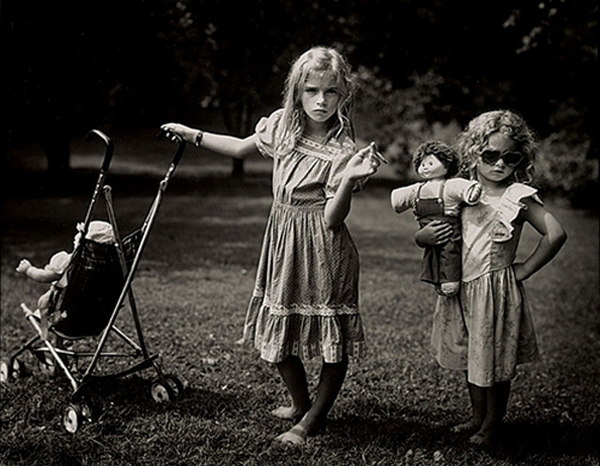
Sally Mann, The New Mothers, 1989

Sally Mann’s series of photographs of her children Emmett, Jessie and Virginia, made over a seven year period and both exhibited and published as Immediate Family, tells of the freedom of long hot summers spent in the countryside around the family’s home in Lexington, Virginia. Mann photographed the children only in the summer when they were out of school and free to play. Made with a large format camera, the pictures are very far removed from the informal snapshots we generally take to document family life. These pictures – whether they look it or not – are deliberately posed and carefully made. The children are playing but their play is for the camera.

Given the heat of the Virginia summer, it’s perhaps unsurprising that the children are often naked and it’s this that has caused the greatest controversy. Given the hysteria that now surrounds images of children it’s hard to see Immediate Family without factoring in the issues that now surround the representation of children.

Continue reading

Motherhood as art

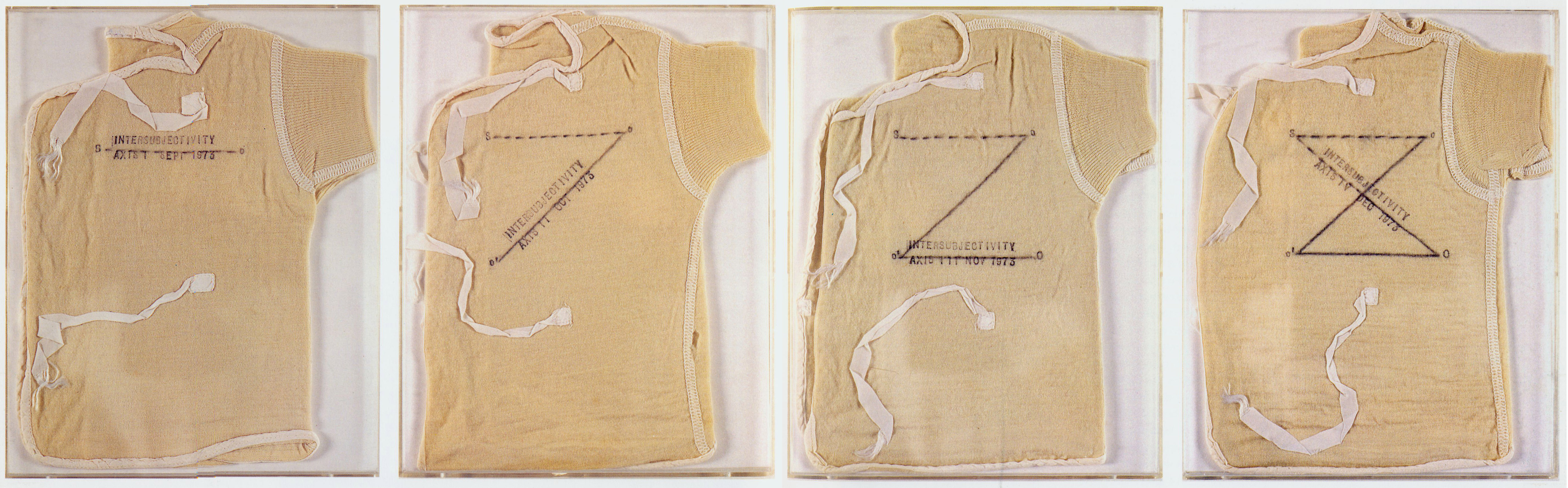
Mary Kelly, Post-Partum Document (detail: vests, from Introduction), 1973-79

Like Susan Hiller, Mary Kelly documented her pregnant belly as art but it is the work she made after the birth of her childfor which she is better known. Post-Partum Document made between 1973 and ’79, the first years of her son’s life, is an extensive document of the mother and child relationship and of the nature of motherhood. The work is in six sections and contains over a hundred items of documentation from the vests shown above to diary notes, graphs and other data and artefacts such as stained nappy liners. The work is driven by the process of making it and clearly parts of that process aren’t pleasant.

Continue reading

Counting the days

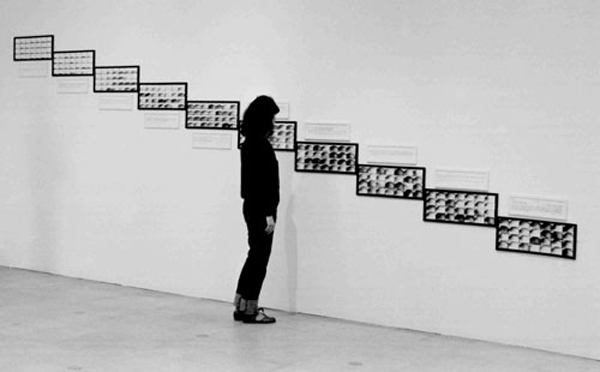
Susan Hiller, Ten Months, 1977-79

To an extent the work of both Jenny Saville and Judy Chicago is seen as feminist in part because it reclaims the female nude for women artists. So far so good, but why then do I take issue with Chicago’s approach – or at any rate to The Dinner Party – while finding Saville’s work challenging and relevant? In part of course it’s to do with the earnest nature, and perhaps hippy thinking, of 1970s feminism. So do I have the same response to other work from that era? Well, yes and no.

Susan Hiller’s Ten Months takes the artist’s pregnancy as it’s subject matter. Hiller photographed her growing belly throughout and arranged the photographs in 10 grids, read from left to right and stepping down the wall, each one corresponding to a lunar month. So far, so hippy. Along with the images, each grid has a text taken from Hiller’s journal. The text for each month is brief and the editing process brings the work back on track for me.

Continue reading

Bodily functions

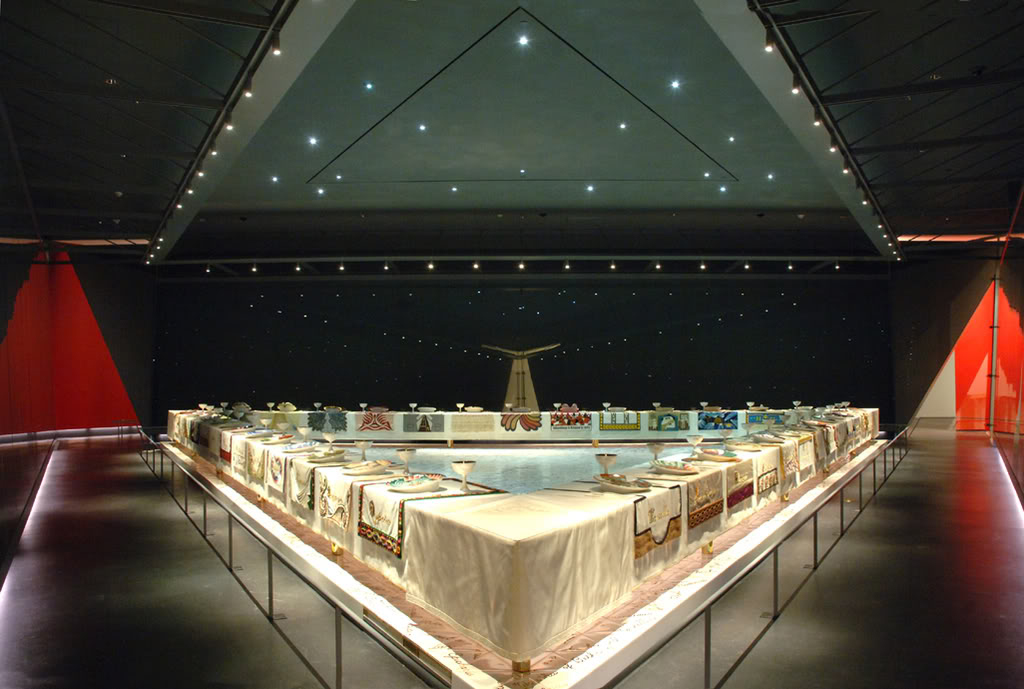
Judy Chicago, The Dinner Party, 1974-79

The reputation of the 1970s isn’t great. If you type ‘1970s the decade’ into its search box, Google helpfully suggests the additions ‘that taste forgot’ and ‘style forgot’. Thanks for that. In fairness, in all sorts of ways it was a pretty rubbish decade. But it was also a decade in which some pretty great art was made and one in which women used art as a political weapon as never before. Probably. I’m sure there are plenty of earlier examples, but there was a pretty significant connection between female artists and the emerging women’s movement. Feminist artists like Mary Kelly, Martha Rosler, Judy Chicago and others made work that challenged previous modes of representation and sought to celebrate women and the female body on their own terms. Inevitably, the results weren’t always pretty.
Continue reading

This solid flesh

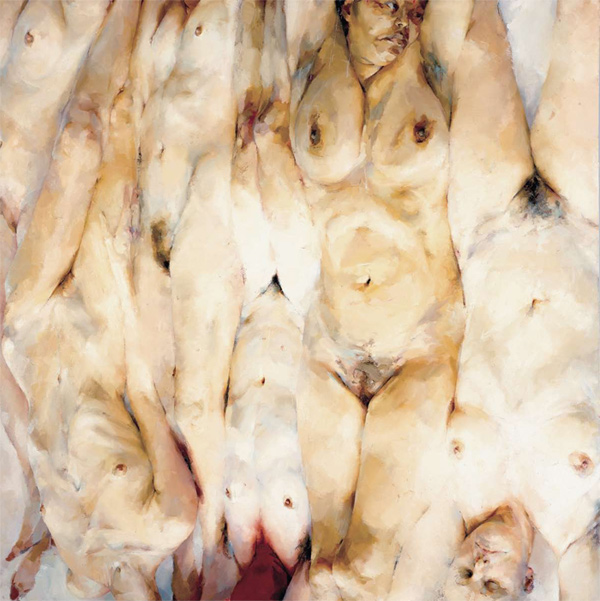
Jenny Saville, Shift, 1996-97

It was the chicken in Ron Mueck’s show at Hauser and Wirth that made me think of Jenny Saville. I realise that probably sounds crazy but the chicken skin put me in mind of Saville’s Shift, a vast painting (something like 3.3m x 3.3m, so able to dominate the space even in a sizeable gallery) showing a row of women squashed up against each other. It’s a painting I haven’t seen in many years but of all Saville’s work – and she’s a painter I like a lot – it’s the piece that’s always had the strongest hold over me. It’s partly that Jenny Saville paints flesh really well and partly that I like the way she makes me think about body image and the way we’re conditioned to see ourselves. These aren’t the idealised figures of art history or women’s magazines; they are women as women are. It turns out that painting the female nude and feminism aren’t mutually exclusive – however much a trip to almost any major art museum might make it seem that way – which is good to know.

Continue reading

Frozen moments

Ron Mueck, Drift, 2009

Ron Mueck, who started his working life making models for children’s television before turning his attention and transferring his skills to art, makes the world look strange and often grotesque. His hyper-real figures vary dramatically in scale, from vastly larger than life to positively diminutive; the one thing they never are is life-size. His exhibition at Hauser and Wirth – Mueck’s first solo show in London in over a decade according to the press release – contains just four works but managed to give me quite a lot to think about nonetheless.

Drift occupies on wall of an otherwise empty gallery. A man floats on a lilo on a sea of turquoise. Well, I say he floats. It’s hard to see it any other way but the sea of turquoise is the wall so the floating is imagined given that the man and his lilo are vertical. He seems bathed in sunlight; his hands hang over the sides of the airbed, as though trailing water. He looks relaxed though his eyes are invisible behind his sun glasses and his face is slightly stern.

Continue reading