Model behaviour

Kerry Stewart, This Girl Bends, 1996Kerry Stewart, This Girl Bends, 1996

Kerry Stewart’s children are older – in the main, we’re back to the adolescents of Rineke Dijkstra’s Beach Portraits – and less strange than the young kids Loretta Lux and Nicky Hoberman represent, but that doesn’t mean that all’s right with their world. Stewart works with sculpture and installation to create works that can in a way be seen as portraits. They involve people after all. In Stewart’s case the people are made from, variously, plaster or fibreglass and paint. There is a level of realism but also a strangeness that once again seems best explained in terms of the uncanny.

This Girl Bends presents us with a girl in a gravity-defying pose. Her eyes are open but staring, her clothes are ambiguous in their plainness: the collar suggests day wear but her trance-like state says sleepwalker more than it says concentration to me. I confess though that I’m not sure whether I’ve seen this work in real life and it wasn’t one of the works that brought Stewart to mind today; nonetheless, I really like the oddness of it  and would like to come across it in a gallery.
Continue reading

The sound of breaking glass

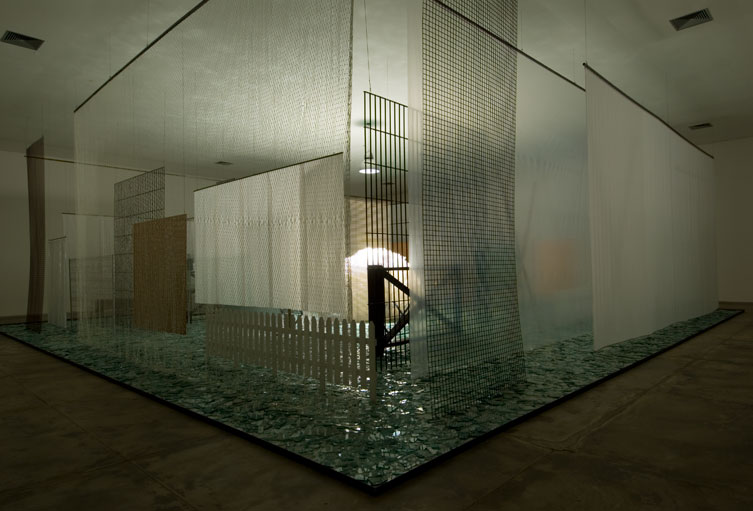
Cildo Meireles, Through, 1983-89/2008

Installation art can be risky. It’s just that usually the risks are more about whether the pieece will work and whether viewers will respond as one hopes rather than whether they’ll stumble on a floor of broken glass. But having risked his own freedom by making overtly political work while living in a military dictatorship, Cildo Meireles was never likely to be put off by something like a slight – and largely theoretical – risk of an audience member sustaining a minor injury. Unlike the harmless threat of the long shadows and caged-in feeling of being in a Mona Hatoum installation, Meireles’s Through does involve a level danger, albeit a low one.

Continue reading

In mid air

Cornelia Parker, Cold Dark Matter, 1991

It started with a shed. It was full of all the sort of stuff that somehow gets collected in a shed over time. Sheds are useful. They are places to keep things that we want but don’t quite have space for and this one was pretty full. Cornelia Parker started by putting the shed in a gallery – Chisenhale in east London – before moving it to a field and getting the British Army to blow it up.

Parker then carefully gathered up the pieces and suspended them in the gallery around a central light bulbas though time had frozen mid-explosion.

Continue reading

Sensory overload

Helen Chadwick, Cacao, 1994

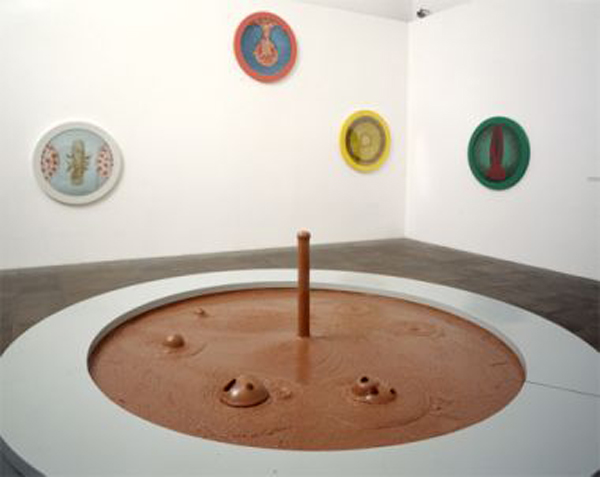
I guess I’m still thinking about chocolate – it is still Easter after all – but yesterday’s post also left the desire/disgust dichotomy firmly in my mind too so today’s post being about Helen Chadwich’s work might easily have been predicted. And where better to start than with Cacao, Chadwick’s 1994 chocolate fountain. At first sight the work looks like a mud bath of some sort and the spluttering as air bubbles through certainly sounds a lot like the bubbling mud of a hot spring. But things aren’t quite that simple. Firstly there’s the central column to consider: it’s hardly reminiscent of a decorative fountain with water falling prettily, indeed it appears deliberately and somewhat comically phallic. But it’s not really the way the work looks and sounds that I remember most vividly – though both are clear in my mind – it’s the heady smell of chocolate that fills the space. So much chocolate and none of it for eating! Ultimately then, this is a work that looks and sounds slightly unpleasant and has a smell that quickly becomes cloying, and yet I’ve always wanted to stay with it longer than is strictly necessary.

Continue reading

Artful eating

Janine Antoni, Gnaw, 1992

What better time than Easter Sunday to be thinking about chocolate. Lots of chocolate. And having posted about artists working with their own body the last couple of days, today I’m all about an artist who uses her body not as the source of the image but as the tool to make the work. In Gnaw, Janine Antoni gnawed away at a 600lb block of chocolate and another of lard, using the blocks as two parts of a three part installation. The work is a strange one. On the one hand chocolate is delicious, but lard?! Okay, so I’m a vegetarian, a block of lard is never going to be something I enjoy being faced with in a gallery or anywhere else, but I think disgust is a pretty universal response.

Continue reading

Body parts

John Coplans, Frieze, No.8, 2002

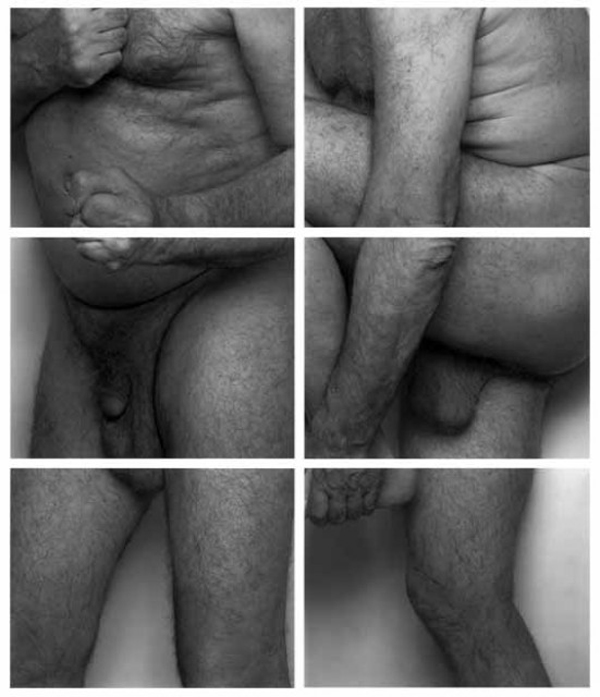
Thinking about the fragmented body in Gary Hill‘s Inasmuch As It Is Always Already Taking Place made me think about the self portraiture of John Coplans who repeatedly photographed his own – aging – body for (almost) the last two decades of his life. Several things interest me about Coplans’s work. Firstly, there’s the way they don’t conform to expectations of the nude in art. As the Guerrilla Girls have established, the nude is generally female and in an increasingly youth-centred culture the ageing body isn’t often the subject of attention. Here the focus is on the ordinary.

Continue reading

Boxes of tricks


Nam June Paik, TV is Kitsch, 1996

As we lose the analogue television signal, the impetus to get rid of old analogue televisions is even stronger. The cathode ray tube makes them bulky and heavy next to the sleek lines of plasma and LCD televisions and the need to have an external box to pick up a signal adds to the feeling that the time has come. But that same bulk that seems so annoying in the average living room is key to quite a lot of art from the last few decades. The box is part of what can blur the boundaries between moving image and sculpture. In the case if Nam June Paik’s TV is Kitsch it is the physical presence of the television casings that gives the work its form.

Continue reading

Make do and mend

Zoe Leonard, Strange Fruit (for David) (detail), 1992-97

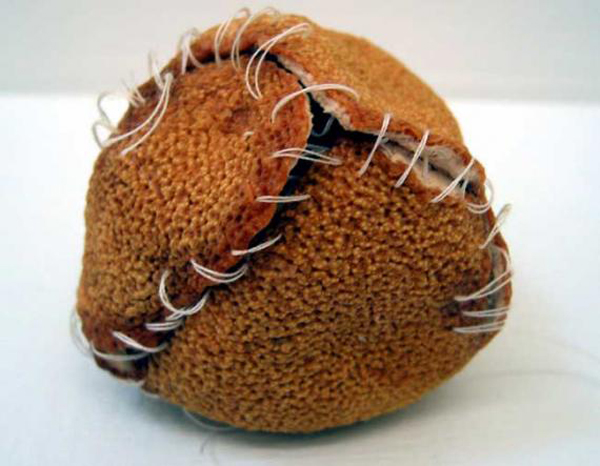
There is something sad and touching about emptied out fruit stitched back up in a futile attempt at mending. But there’s also something about it that amuses me in a way. I think in Zoe Leonard’s installation Strange Fruit (for David) the thing that both moves me and makes me smile is the scale of the thing. It feels like a point that could have been made with a few pieces has taken control and not let Leonard stop; the empty fruit are scattered liberally across the floor, filling the space. In total roughly three hundred pieces of fruit have had their peel or skin dried out and put back together with stitching or other forms of fixing or adornment.

Continue reading

A stitch in time

David Wojnarowicz, image from A Fire in My Belly, 1989

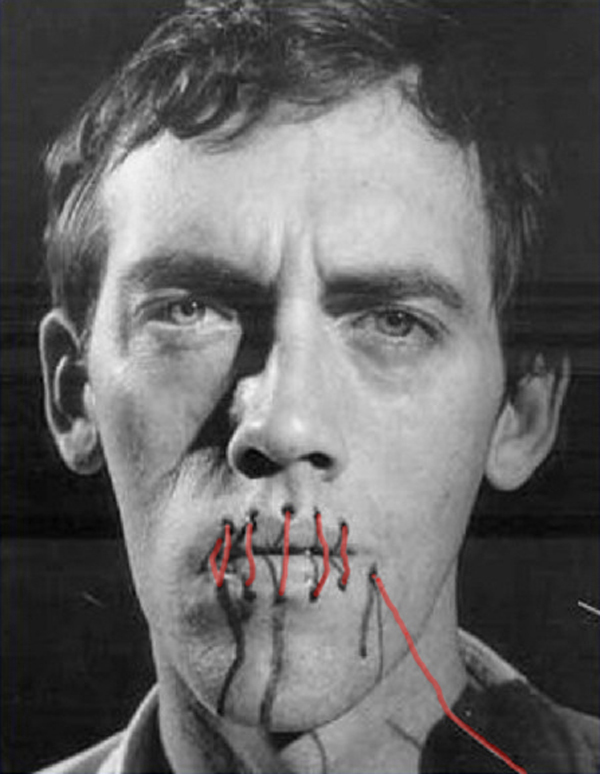
David Wojnarowicz is one of those artists. I find his work really interesting and immensely powerful but I haven’t seen very much of it in real life. One day I hope to get the chance to rectify that but in the meanwhile I’ll carry on looking at his work in reproduction. I like his approach to putting images – and often text – together in collages, prints and paintings but it’s his film work that interests me most, in part because it’s here that everything comes together.

And in terms of this blog and the way I let my attention move from one artist to the next by following the most literal of connections – I’m all about the unashamedly clunky segue after all – the use of read thread in his film A Fire in My Belly is more than a little convenient.

Continue reading

The trouble with language

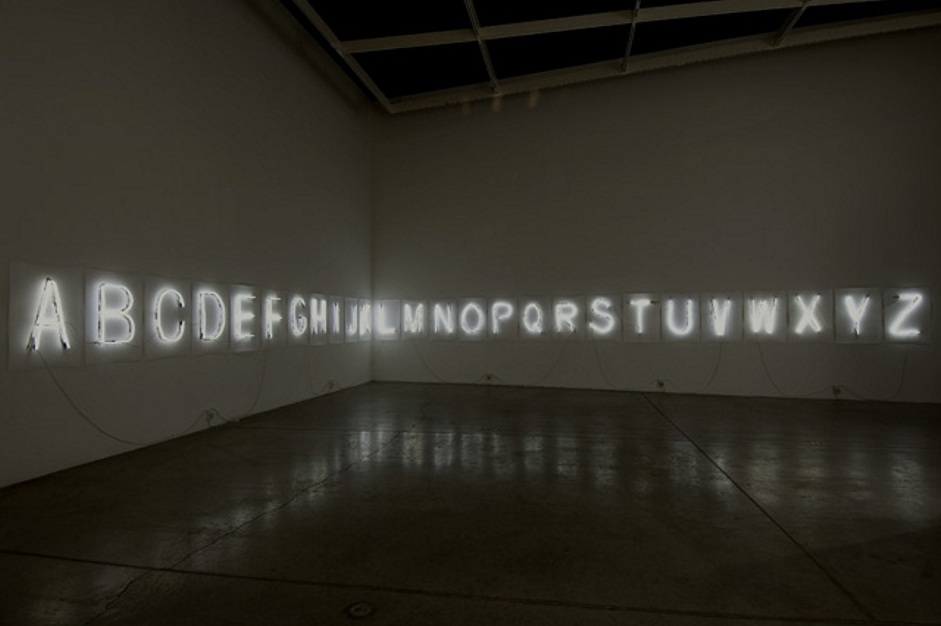
Fiona Banner, Every Word Unmade, 2007

Before moving on from text and language – at least temporarily, there’s more I want to write about at some point – it seems like a good idea to go back to the basic building blocks of text: letters and punctuation.  Typography is more usually the domain of designers but given that lots of artists have concerned themselves with language as a sign system, it’s no great surprise that some have also worked with its constituent parts.

In Every Word Unmade, Fiona Banner presents the alphabet as an opportunity for communication; the basic letterforms have the potential to become words.

Continue reading