Dystopian dreams

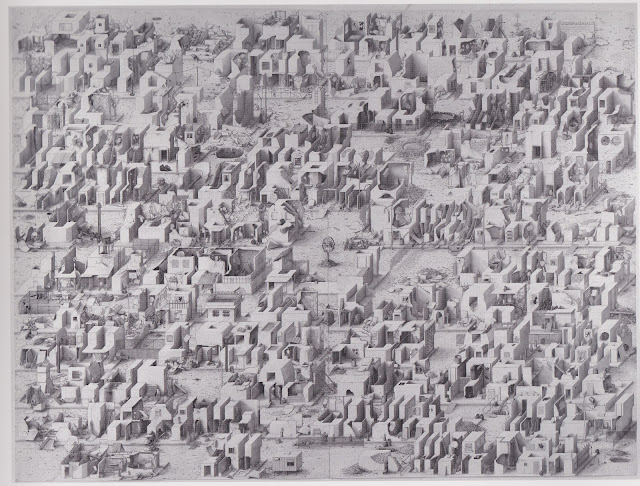
Paul Noble, Nobson Central, 1998-9

The world of Paul Noble is a strange one. His imagined city, Nobson Newtown, which he started constructing in the form of monumental drawings in the late 1990s, is a complex space. The houses are modernist boxes; the city includes open spaces and evidence of a degree of urban planning reminiscent of the utopian ideals of the garden cities and new towns of the early to mid twentieth century. Everything, surely, should be perfect?

Continue reading

The whole story

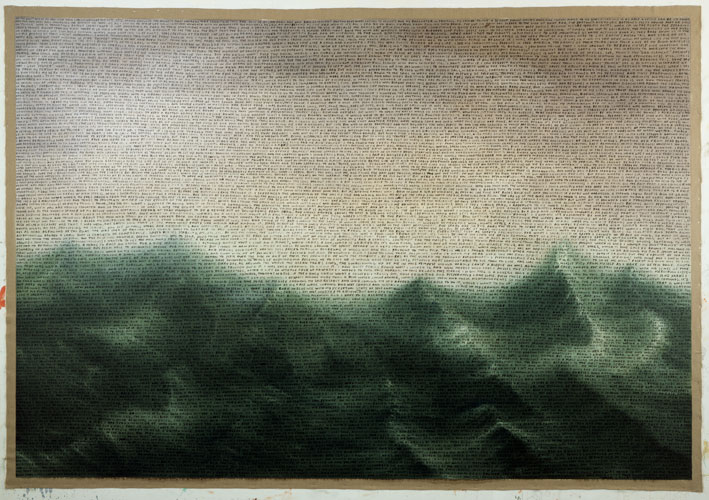
Fiona Banner, Apocalypse Now, 1997

Stories can be told in many different ways, words on the page and images on a cinema screen being two of the most common. It’s when the means of story-telling becomes words on a cinema screen that things start to get confusing. I’m not sure how easy it’d be to try to follow the story of Apocalypse Now from Banner’s piece of the same name, but the narrative is all there. It’s just that it’s there as a hand-written text on a page the size and shape of a cinema screen. And only yesterday there I was claiming Sean Landers choice of line length seemed excessive!

Continue reading

Hiding in plain sight

Sean Landers, Navel Gaze, 1995

If a picture paints a thousand words then what happens when the picture is words? Sean Landers uses painting as a way to tell stories but it’s not the picture part of the equation – when there is one, and more often than not there isn’t – that does the talking. It’s all those words.

I saw Landers’s work first in Young Americans at the Saatchi Gallery in, I think*, 1996. I remember being mesmerised by it. I made a very good attempt at reading the paintings but I think I failed. By the time you’re about three or four lines in it’s hard to get from the end of one line to the start of the next without skipping or re-reading so hoolding on to the thread of the narrative becomes troublesome.

Continue reading

It’s only words

John Baldessari, Everything is Purged from this Painting, 1968

Thinking about books becoming art yesterday made me ponder the use of text – one of the raw materials of books – as art. Language is key to the conceptual art of the 1960s, with the idea taking precedence over aesthetics. Inevitably the resulting work could be rather dry and hard to engage with, but this is far from universally true. John Baldessari’s text paintings work on several levels for me. Firstly, Baldessari confuses matters by rendering his text in paint on canvas. Secondly, the text is often funny, especially in the context of painting.

Continue reading