Just lying there

Maurizio Cattelan, All, 2008

Though not a sight one would ever hope to see, a row of bodies covered in sheets is easy enough to understand. The first thing that feels wrong here is the solidity of the sheets; the row of figures are marble statuary rather than fabric covered human remains. This realisation gives the figures a new familiarity, one rooted in religious representation.

Take a closer look though and all is not as it seems…

Continue reading

Beautiful decay

Anya Gallaccio, Beauty, 1991-2003

Flowers have a long history in art, not least in the history of pretty but clichéd painting. The flowers in Anya Gallaccio’s work aren’t painted though, nor sculpted. They are real, presented in panels and not altered – or, crucially, preserved – in any way.

Continue reading

Looking efficiency in the eye

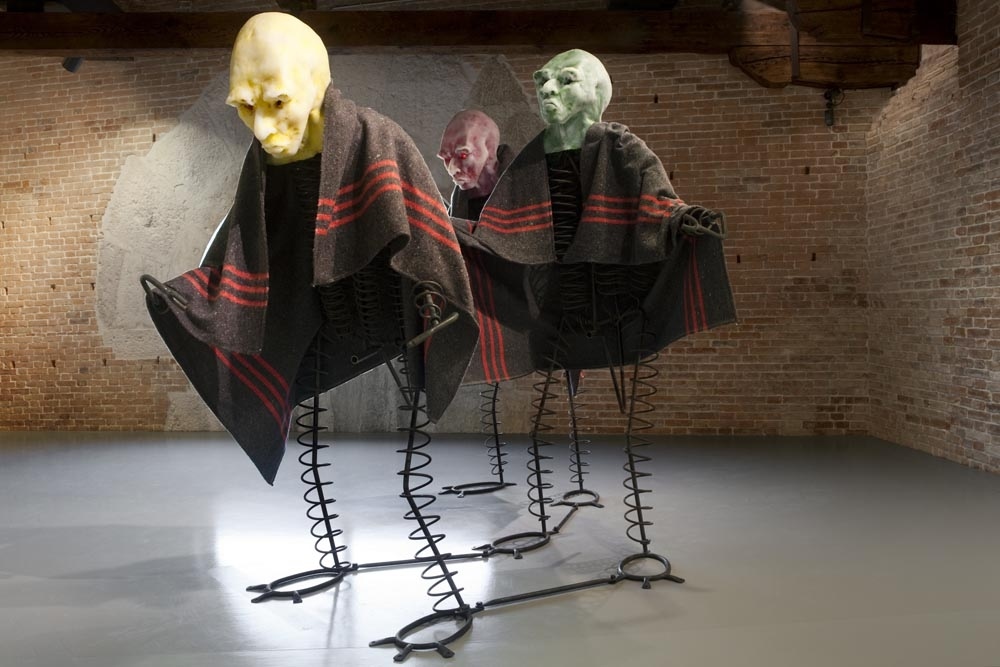
Thomas Schütte, The Efficiency Men, 2005

There is something slightly terrifying about Thomas Schütte’s The Efficency Men. The metal frame bodies are strange and the blankets round their shoulders give an air of pathos but ultimately it’s the eyes in their oversize heads that get me. Staring into the eyes of one of the figures isn’t at all comfortable.

Continue reading

Moving pictures

Juan Fontanive, Quicknesse, 2009

When we think of moving image art it’s usually film and video works that spring to mind first, but artists like to play and there’s more than one way to make an image move. One of the works I’ve enjoyed the most in recent years is Juan Fontanive’s Quicknesse, a simple flipbook device which traps a hummingbird in a loop of hovering. The sound of the work conjures a sense of agitation and urgency; the bird is beautiful, trapped in our gaze.

There is something extraordinary about this work. Whether it’s the simplicity of the device or the touching beauty of the image, in which the bird is isolated from its surroundings (the background of the image is painted out in white so that the bird floats), I’m not sure, but it has stayed with me since the first time I saw it. Effectively  this is stop motion animation as sculpture. Juan Fontanive has another London show opening at Riflemaker Gallery next month. Can’t wait.

Continue reading

Representing the real

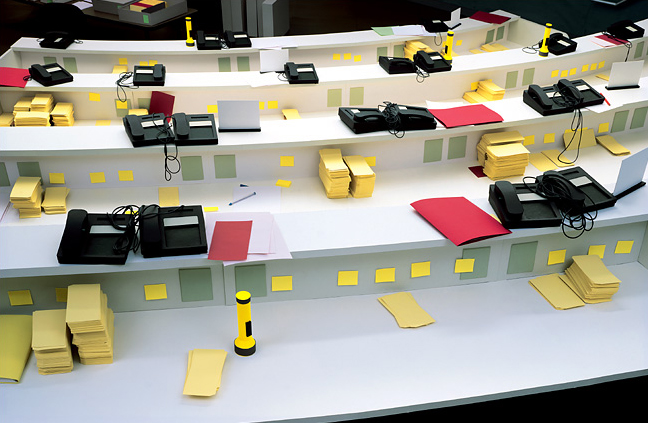
Thomas Demand, Poll, 2001

There are many ways to make a photograph. In photographic terms, Thomas Demand’s approach is very simple. The camera records the scene in as straightforward a manner as it can. But there is something odd – uncanny, perhaps – about the scene; all is not as it seems.

Continue reading

Past master

Maurizio Cattelan, Bidibidobidiboo, 1996

As a rule, I don’t have much time for taxidermy in art. Sometimes it works, but for me such instances are few and far between. But if anyone can get away with it, it’s Maurizio Cattelan; contrary to my own expectation, his use of taxidermy consistently wins me round.

Continue reading

Daily rituals

Hadrian Pigott, Instrument of Hygiene (Case 4), 1995

I’ve always been interested in the way we muddle through life and the daily routines most of us construct – at least, I don’t think it’s just me – to get through the day and feel vaguely in control of something, anything, however mundane. We are, by nature, creatures of habit to a greater or lesser extent. Before you know it, routines become rituals and it becomes unthinkable to break the sequence. One of the most ritualised aspects of daily life is often personal hygiene.

Continue reading

Making shit art

Wim Delvoye, drawing for Cloaca, 2000

Plenty of people think contemporary art is shit. And of course, some of it probably is. And sometimes when I’m talking to students about their work I’ll use the word crap, but I always mean it to be a positive (for example “this has a pleasingly crap aestheic”). But one, unusually bonkers (and I mean that in a good way too) work, Cloaca by the Belgian artist Wim Delvoye, is shit in a much more literal sense. Don’t read on if you’re squeamish (or about to have lunch)…

Continue reading

Recollections of Frieze

Pierre Huyghe, Recollection, 2011 (live marine ecosystem, glass tank, filtration system)

In these early days of the year, I want to think back to work I’ve seen in the last year to see what’s stayed with me. A good starting point for that is to think about the big stuff: the days when art overload is a significant threat. Days like Frieze Art Fair. I don’t always get to Frieze; some years I just can’t face it. The scale of the thing puts me off somewhat and I’m really not a fan of the art world en masse. It’s possible I’m just slightly allergic to art fairs. Art needs time and at Frieze the pressure to see everything can be overwhelming so last year I decided to browse in a really unsystematic way and just spend time with the things I chanced upon that interested me most. Perhaps inevitably that means that what I remember most clearly are some of the things that were tucked away in corners, works that could be seen in isolation rather than against the backdrop of the fair.

Continue reading

The art of destruction / The destruction of art

Ai Weiwei, Dropping a Han Dynasty Urn, 1995

To a greater or lesser extent, the destruction of the past is an on-going, universal project. Whether it’s demolishing old buildings to make space for new ones or cutting down woodland to accommodate agriculture on an industrial scale, we can’t ever really let things be. If we never destroyed anything, the world would be an even more weird, uncomfortable and overcrowded place but nonetheless there’s often more to our reluctance to let things go than simple nostalgia. In the last half century or thereabouts, China has witnessed wholesale destruction of its history in the name of both ideology – the Cultural Revolution – and, more recently, progress, as the past is razed to make room for the future. Nonetheless, Ai Weiwei’s destruction of ancient ceramics in the name of art might seem in some respects excessive. It certainly has the power to shock though perhaps one of the most surprising aspects is that the value of what one might assume to be priceless ancient artefacts such as a Neolithic urn dating from 5000-3000BC can be increased by the addition of a Coca-Cola logo.

Continue reading