Art on acid

Painting with hydrochloric acid on nylon, 1961

There are lots of ways to paint, as a quick wander through any major art museum will amply demonstrate. But there are those who change out understanding of art through their work, and Gustav Metzger is one such. Metzger’s notion of auto-destructive art, which he initially defined in 1959, was an interesting and highly-influential on which was rooted in the belief that Western society was failing (Metzger has been a Marxist all his adult life). The idea is that the work has the capacity to destroy itself or that it is destroyed by the actions of its creator.

Gustav Metzger: Auto-Destructive Art (1959)
Auto-destructive art is primarily a form of public art for industrial societies.
Self-destructive painting, sculpture and construction is a total unity of idea, site, form, colour, method, and timing of the disintegrative process.
Auto-destructive art can be created with natural forces, traditional art techniques and technological techniques.
The amplified sound of the auto-destructive process can be an element of the total conception.
The artist may collaborate with scientists, engineers.
Self-destructive art can be machine produced and factory assembled.
Auto-destructive paintings, sculptures and constructions have a life time varying from a few moments to twenty years. When the disintegrative process is complete the work is to be removed from the site and scrapped.
Continue reading

Projections of power

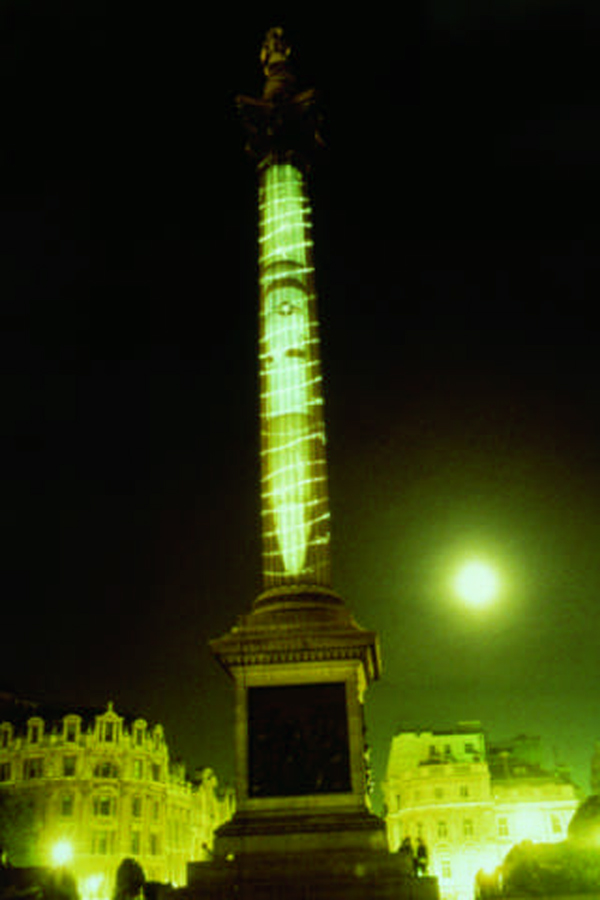
Krzysztof Wodiczko, City Projections – Nelson’s Column, 1985

Commissioned to make a projection onto Nelson’s Column in Trafalgar Sqaure for two nights in 1985, Krzysztof Wodiczko focused on the military aspects of the square and decided to project an image of a missile wrapped in barbed wire. But while in London for the event, Wodiczko realised that the square, as home of South Africa House, also played host to a longterm protest against the apartheid regime still very much in charge of South Africa and supported by then British Prime Minister, Margaret Thatcher.

Redirecting his projector, Wodiczko changed the image…

Continue reading

Truth and the power of words

Jenny Holzer, Truisms, 1977-9 displayed at Times Square, 1982

For Jenny Holzer the work lies in the words rather than the particular way in which they are disseminated. So her Truisms have been projected in public spaces, worn as T-shirts, placed on gallery walls, plaques, stickers and postcards and more. The art lies in getting the words out there. Of course there are aesthetic and conceptual decisions about how and where they appear but it is the text and the way the audience encounters it that drives these.

Among the means of display Holzer employs, several involve sites or approaches more usually associated with advertising automatically colouring our response to the messages. Holzer’s slogans often challenge the political status quo in some way, making this appropriation of public display mechanisms all the more interesting.

Continue reading

Everything and nothing at all

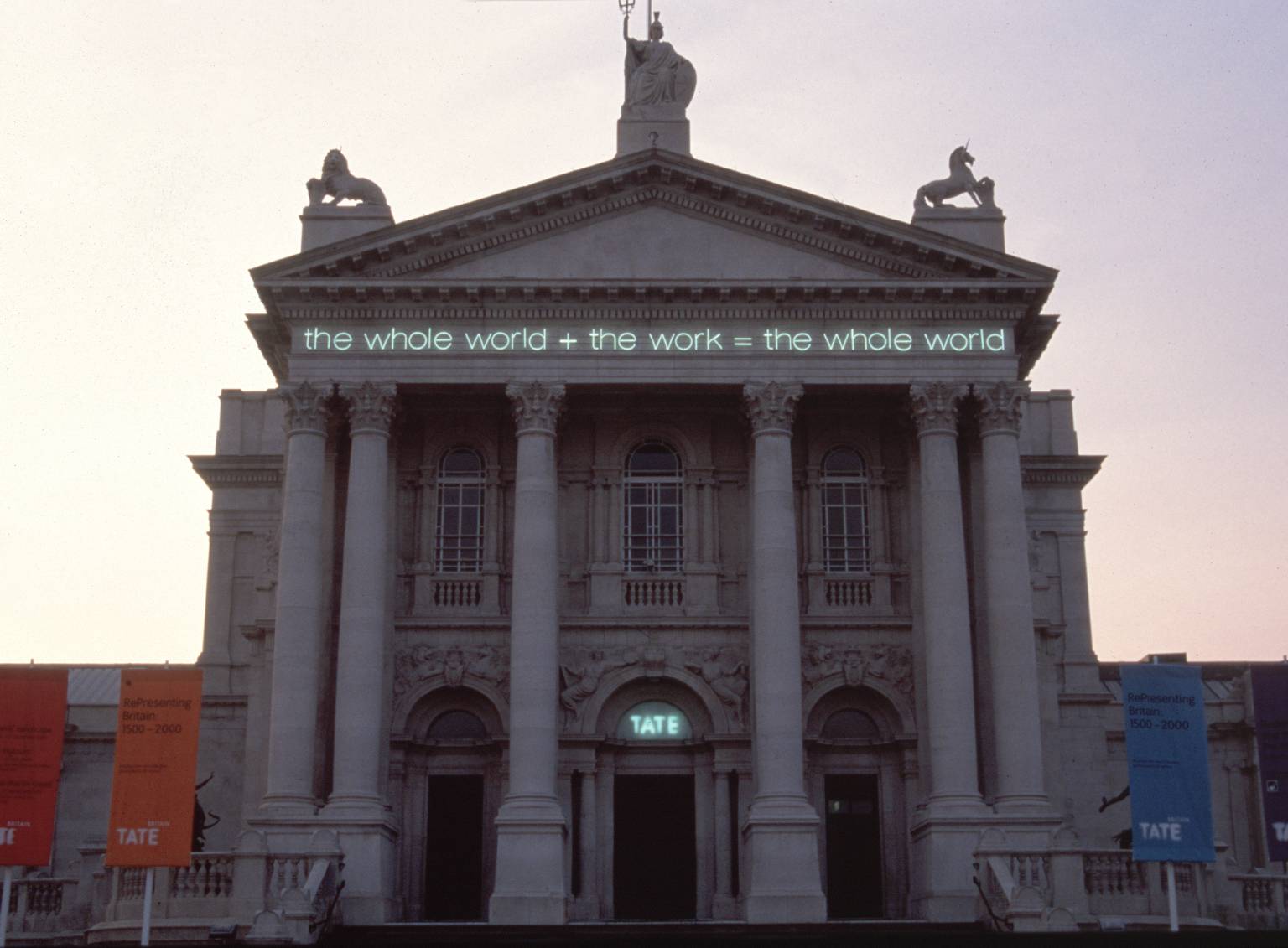
the whole world + the work = the whole worldMartin Creed, Work No. 232: the whole world + the work = the whole world, 2000

There are two ways to see this. Clearly if A + B = A then B = 0, so in Martin Creed’s equation the work can definitely be read as nothing at all. But is art really a big fat zero? And if it is, is the outside of a major art museum the place to say it? Well, let’s try again…

Continue reading

Women’s things

Guerrilla Girls, Do women have to be naked…?, 1989

As today is International Women’s Day, it seems like the right time to take a look at women’s place in the art world. It’s the twenty-first century, there are lots of women artists now, right? Well yes. Up to a point. Tacita Dean’s work is in the Turbine Hall of Tate Modern at the moment and the big exhibition is of the work of Yayoi Kusama. Perhaps all’s right with the world? Clearly, it wasn’t ever thus.

In 1989 the Guerrilla Girls, an anonymous group of women artists and the self-styled ‘conscience of the art world’, conducted an audit of the work on display on the Modern Art sections of the Metropolitan Museum in New York. The statistics really weren’t good. Only 5% of the artists were female but 85% of the nudes were. No matter how familiar we are with art history and the dominance of male artists, that’s still a pretty shocking figure, especially since the group had specifically restricted their attention to the modern art sections where things might be expected to be a bit less bad. Surely by now things have changed?

Continue reading

A horse, of course

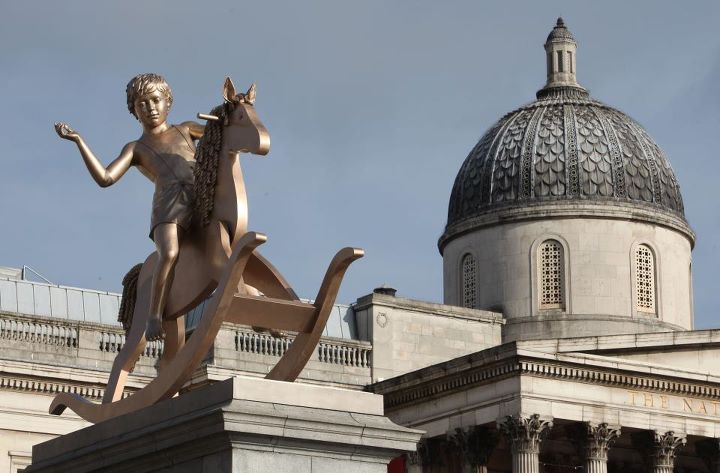
Elmgreen and Dragset, Powerless Structures Fig. 101, 2012

If, in a public square in a capital city, you have an empty plinth intended for a statue of a figure on a horse then what better to put on it than a statue of a figure on a horse? After testing a lot of alternatives on the fourth plinth in Trafalgar Square, the plinth that never quite got its statue, it should come as no surprise that the powers that be have yielded to the inevitable and installed the statue that was always meant to be there. Sort of.

Continue reading

Two towers

ColumnAnthony McCall, Column (Wind) (drawing, 2011)

As at the start of every year, there are things in the art calendar I’m really looking forward to and things I’ll go out of my way to avoid seeing. Oddly, this year the two things that immediately spring to mind are both public art commissions related to the forthcoming Olympics and both take the form of a tower of sorts. One – Anthony McCall’s Column – I’m ready to travel half the length of the country for despite knowing its ephemeral presence may disappear in some weathers. Sadly, unlike the last work I saw by the same artist, the other – Anish Kapoor’s Orbit – will be all too visible.

Continue reading