On the edge

Rineke Dijkstra, Kolobrzeg, Poland, July 26 1992, 1992

Staying with portraiture but today with a little more information that simply what the subject looks like, Rineke Dijksta’s Beach Portraits take a typological approach that suggests she  shares some influences with Thomas Ruff. Despite a consistency of approach, Dijkstra doesn’t seek to achieve the same level of neutrality at Thomas Ruff does with the Posrtraits series. Apart from the images I’m concentrating on here, the series includes pictures of boys and of groups of adolescents but in the interests of not ramblong on too much I’m limiting myself to looking at three of the pictures of girls.

Dijkstra’s Beach Portraits series is of adolescents standing facing the camera with the sea behind them. Despite the simplicity of this approach, each has a slightly different stance which suggests very different levels of confidence. The girl photographed in Kolobrzeg, Poland, July 26 1992 has a relaxed stance and her gaze seems to connect with the viewer. What I find most touching about this picture is the slightly ill-fitting swimsuit which looks as though it may be cut for a slightly more developed figure, damp at the bottom suggesting she’s just come out of the sea but hasn’t been swimming.
Continue reading

Skin deep

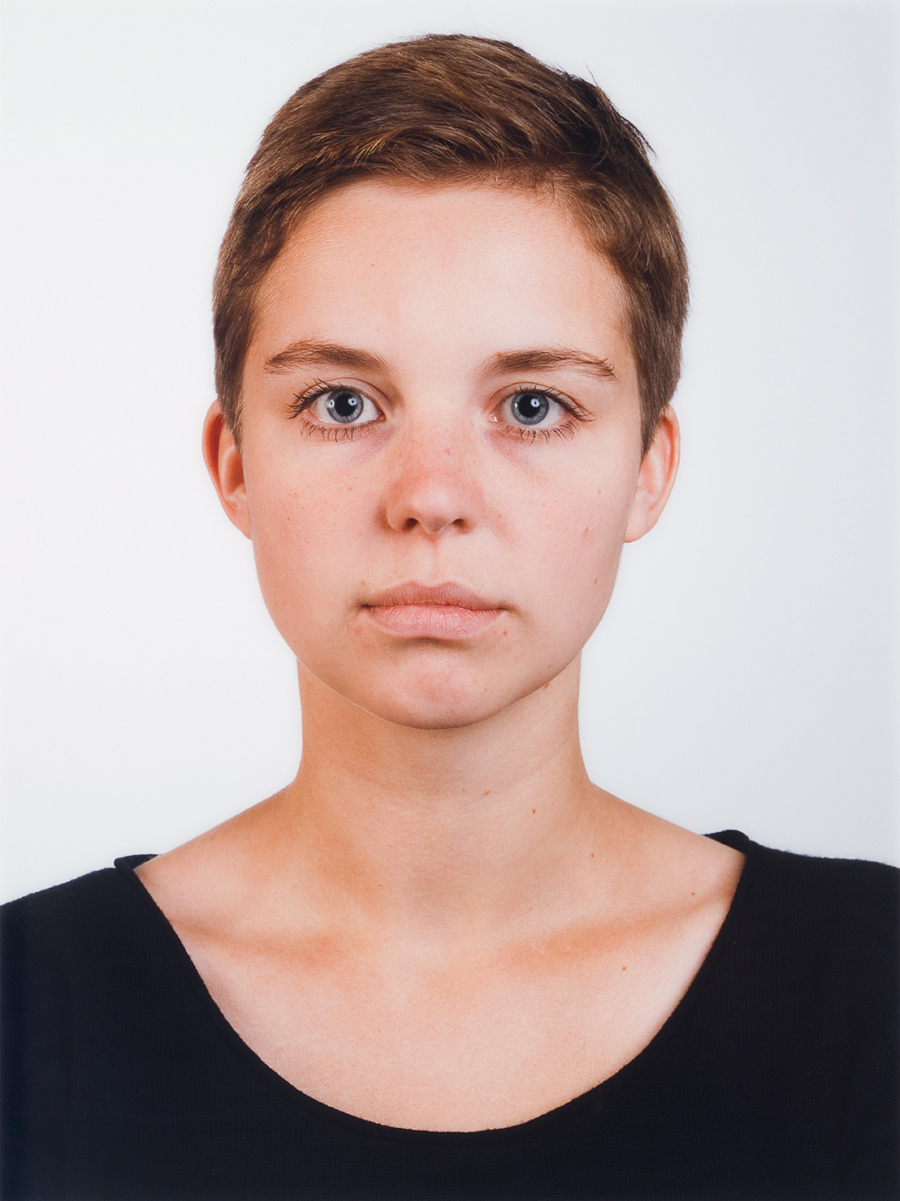
Thomas Ruff, Portrait (I. Graw), 1988

Having taken the slow route from the Bechers to portraiture it seems like a good time to ponder the more obvious forward jump, so today I’ve found myself thinking about Thomas Ruff’s Portraits, a body of work he started while still a student of Bernd Becher at the Kunstakademie Düsseldorf and has continued – in parallel with other work – ever since. Initially working in black and white, Ruff quickly moved to colour and made the series using a large format camera so that the faces are recorded in unrelenting detail. At their most simple, these are like passport photographs but for the eessential detail of scale: Ruff’s prints are around two metres tall.

Continue reading

Casting a long shadow

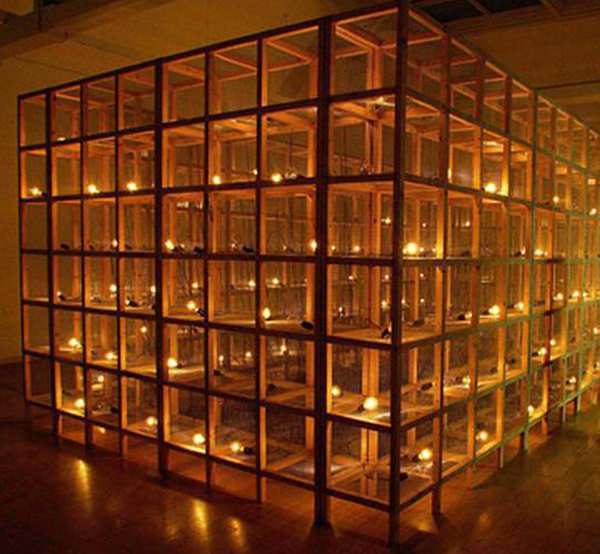
Mona Hatoum, Current Disturbance, 1996

The whimsy of Noble and Webster’s use of shadows is witty enough but ultimately – for me at least – the work is unsatisfyingly slight. I enjoy it well enough at the time but the work never really gets under my skin. But shadow is a powerful force and it’s one that Mona Hatoum uses to really good effect.

In installations like Current Disturbance – which I saw at the Whitchapel Gallery in 2010 – Hatoum uses shadow as a meaning force. The bare lightbulbs fade in and out and the crackle of an electric current gives a sinister edge to the changing light levels. The gridded structure – reminiscent of the cages occupied by battery hens perhaps – feels prison-like. The installation has an architectural feel, but if this is a city space it is a densely-populated and uncomfortable one.

Continue reading

Gathering, listing and smashing

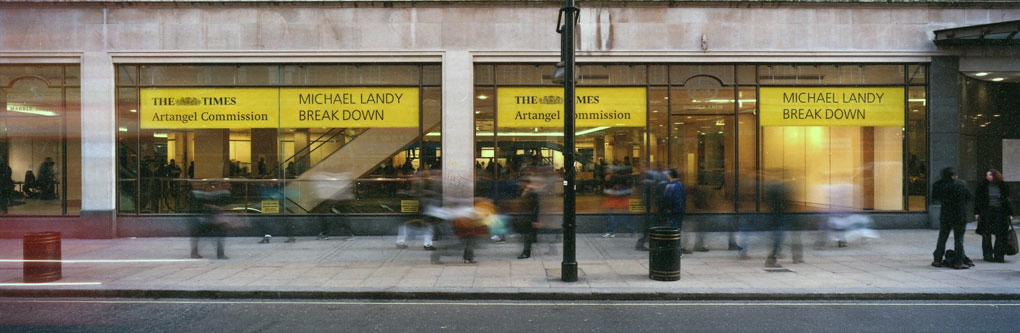
Michael Landy, Break Down, 2001

If I’m honest, I’m a bit of a hoarder. I know I really need to start throwing things out, but somehow I don’t get round to it. And being an artist gives me an extra excuse, or so I tell myself. I have all kinds of junk squirreled away as stuff I might sometime use to make work. Yeah, right. But however much I know I need a clear out and however much I like art that is driven by obsession – a lot, on both counts – I know I could never have made Break Down. The extremity of Michael Landy’s project fascinates and terrifies me in equal measure.

Continue reading

Body parts

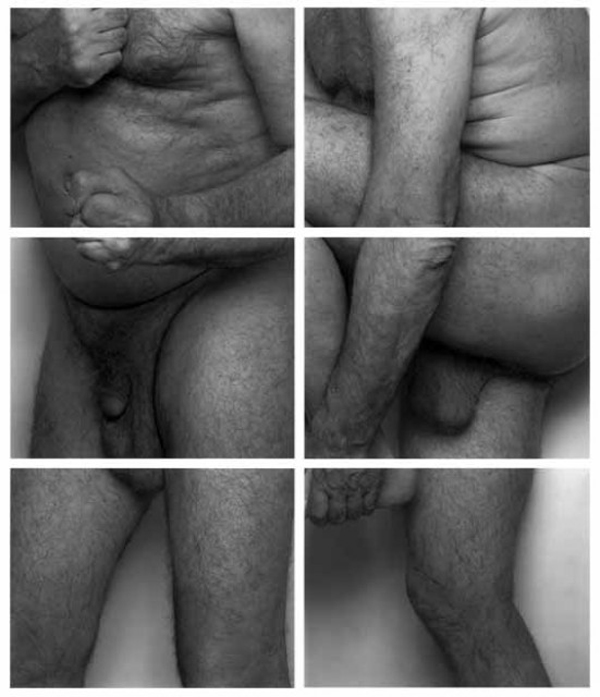
John Coplans, Frieze, No.8, 2002

Thinking about the fragmented body in Gary Hill‘s Inasmuch As It Is Always Already Taking Place made me think about the self portraiture of John Coplans who repeatedly photographed his own – aging – body for (almost) the last two decades of his life. Several things interest me about Coplans’s work. Firstly, there’s the way they don’t conform to expectations of the nude in art. As the Guerrilla Girls have established, the nude is generally female and in an increasingly youth-centred culture the ageing body isn’t often the subject of attention. Here the focus is on the ordinary.

Continue reading

Make do and mend

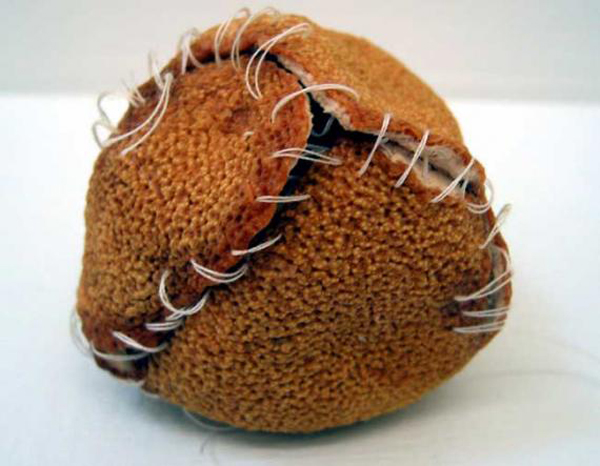
Zoe Leonard, Strange Fruit (for David) (detail), 1992-97

There is something sad and touching about emptied out fruit stitched back up in a futile attempt at mending. But there’s also something about it that amuses me in a way. I think in Zoe Leonard’s installation Strange Fruit (for David) the thing that both moves me and makes me smile is the scale of the thing. It feels like a point that could have been made with a few pieces has taken control and not let Leonard stop; the empty fruit are scattered liberally across the floor, filling the space. In total roughly three hundred pieces of fruit have had their peel or skin dried out and put back together with stitching or other forms of fixing or adornment.

Continue reading

A stitch in time

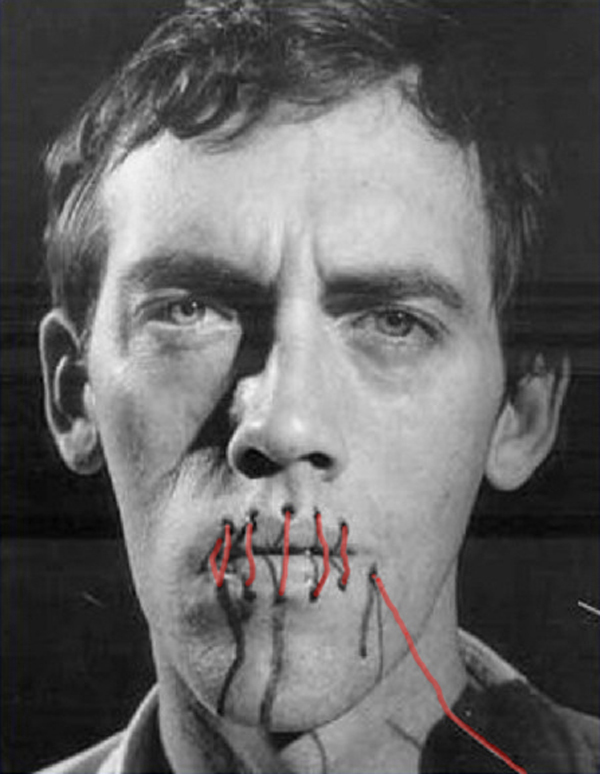
David Wojnarowicz, image from A Fire in My Belly, 1989

David Wojnarowicz is one of those artists. I find his work really interesting and immensely powerful but I haven’t seen very much of it in real life. One day I hope to get the chance to rectify that but in the meanwhile I’ll carry on looking at his work in reproduction. I like his approach to putting images – and often text – together in collages, prints and paintings but it’s his film work that interests me most, in part because it’s here that everything comes together.

And in terms of this blog and the way I let my attention move from one artist to the next by following the most literal of connections – I’m all about the unashamedly clunky segue after all – the use of read thread in his film A Fire in My Belly is more than a little convenient.

Continue reading

Hiding in plain sight

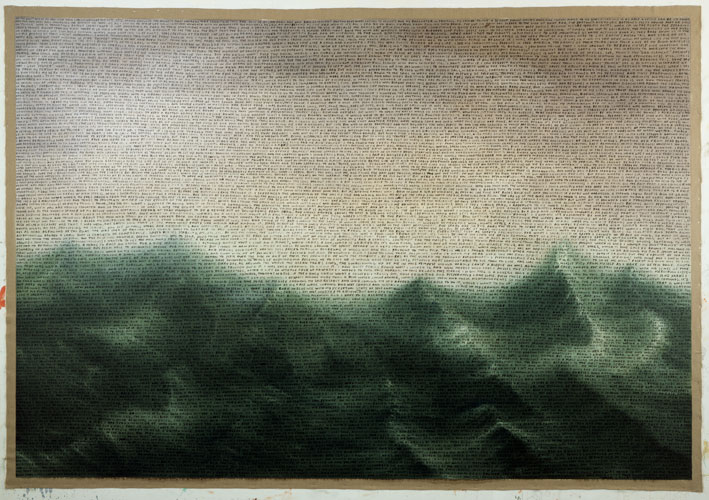
Sean Landers, Navel Gaze, 1995

If a picture paints a thousand words then what happens when the picture is words? Sean Landers uses painting as a way to tell stories but it’s not the picture part of the equation – when there is one, and more often than not there isn’t – that does the talking. It’s all those words.

I saw Landers’s work first in Young Americans at the Saatchi Gallery in, I think*, 1996. I remember being mesmerised by it. I made a very good attempt at reading the paintings but I think I failed. By the time you’re about three or four lines in it’s hard to get from the end of one line to the start of the next without skipping or re-reading so hoolding on to the thread of the narrative becomes troublesome.

Continue reading

Women’s things

Guerrilla Girls, Do women have to be naked…?, 1989

As today is International Women’s Day, it seems like the right time to take a look at women’s place in the art world. It’s the twenty-first century, there are lots of women artists now, right? Well yes. Up to a point. Tacita Dean’s work is in the Turbine Hall of Tate Modern at the moment and the big exhibition is of the work of Yayoi Kusama. Perhaps all’s right with the world? Clearly, it wasn’t ever thus.

In 1989 the Guerrilla Girls, an anonymous group of women artists and the self-styled ‘conscience of the art world’, conducted an audit of the work on display on the Modern Art sections of the Metropolitan Museum in New York. The statistics really weren’t good. Only 5% of the artists were female but 85% of the nudes were. No matter how familiar we are with art history and the dominance of male artists, that’s still a pretty shocking figure, especially since the group had specifically restricted their attention to the modern art sections where things might be expected to be a bit less bad. Surely by now things have changed?

Continue reading

Hairy story

Ellen Gallagher, DeLuxe, 2004-5

Significant highlights of my visit to MoMA were the connected exhibitions Print/Out and Printin’ that look at the way print is used in contemporary art. The latter, organised by artist Ellen Gallagher and Sarah Suzuki, Associate Curator in MoMa’s Department of Prints and Illustrated Books, is centred around Gallagher’s DeLuxe a grid of 60 frames each containing a collaged print based on adverts found in mid-twentieth century black lifestyle magazines and newspaper articles. DeLuxe is an extraordinary, fascinating work that demands, and rewards, close scrutiny. I am fascinated both by the adverts Gallgher has found and by her use materials – particularly plasticine  – in the collages.

Continue reading