Drawing sculpture in the dark

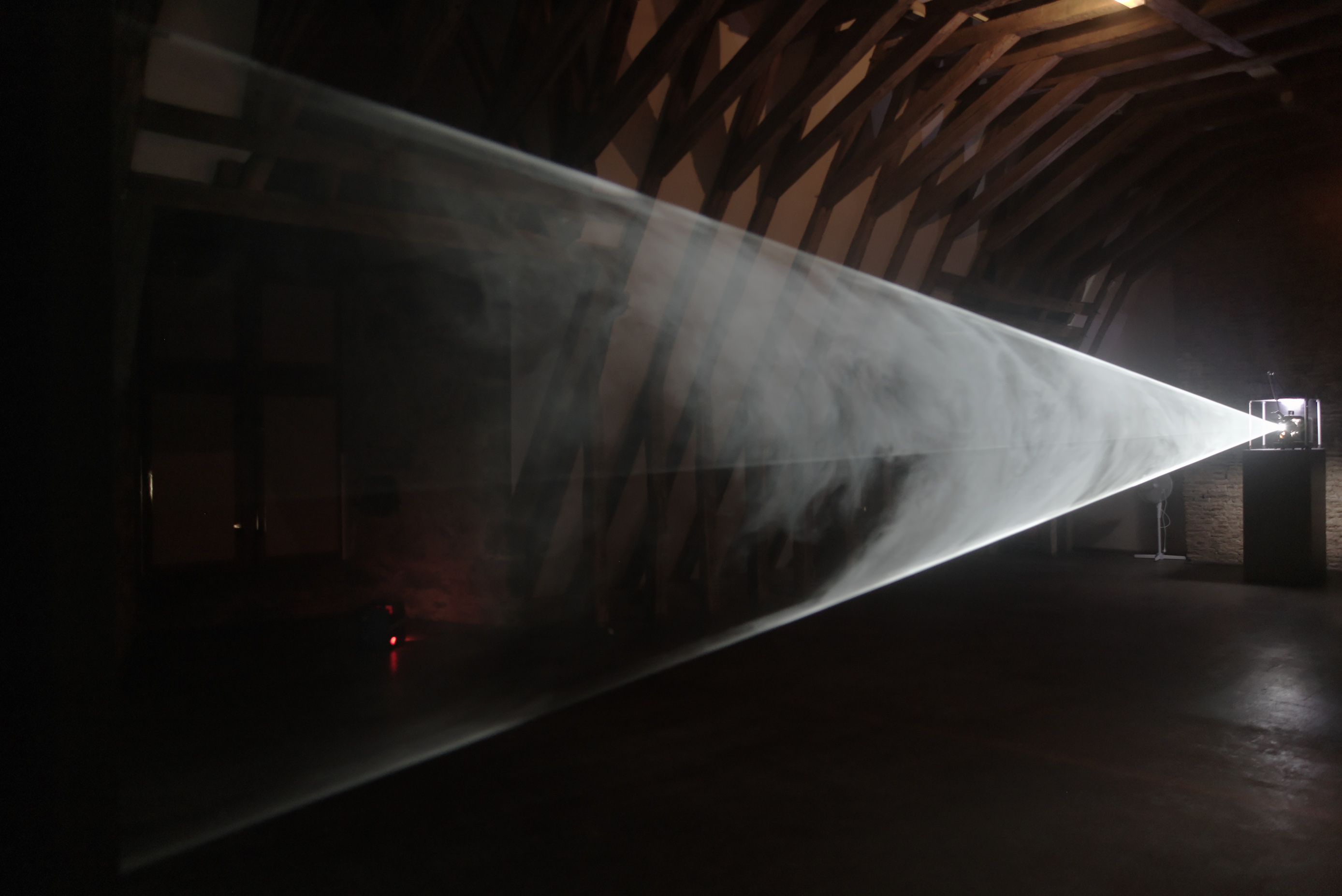
Anthony McCall, Line Describing a Cone, 1973

While I’m on the subject of almost non-existent sculpture, especially almost non-existent sculpture that might in some way be seen as drawing, it’s perhaps inevitable that Anthony McCall’s Solid Light Works should worm their way into my thoughts. I can remember the first time I saw Line Describing a Cone very clearly indeed. It’s just one of those works: astonishing, engaging, playful, uplifting even. There’s something about the way it plays tricks on both eye and mind. That first encounter was at an almost deserted Hayward Gallery – it was about two days before Christmas, which turns out to be a great time to see art almost in private – in the exhibition Eyes, Lies and Illusions which brought together a collection of magic lanterns, zoetropes and other optical devices with works by contemporary artists. It was a great show. And then, there was one final room just before the exit. When I went in it was empty and, my friend and me aside, it stayed that way for a good five minutes or so.
Continue reading

Dividing the space

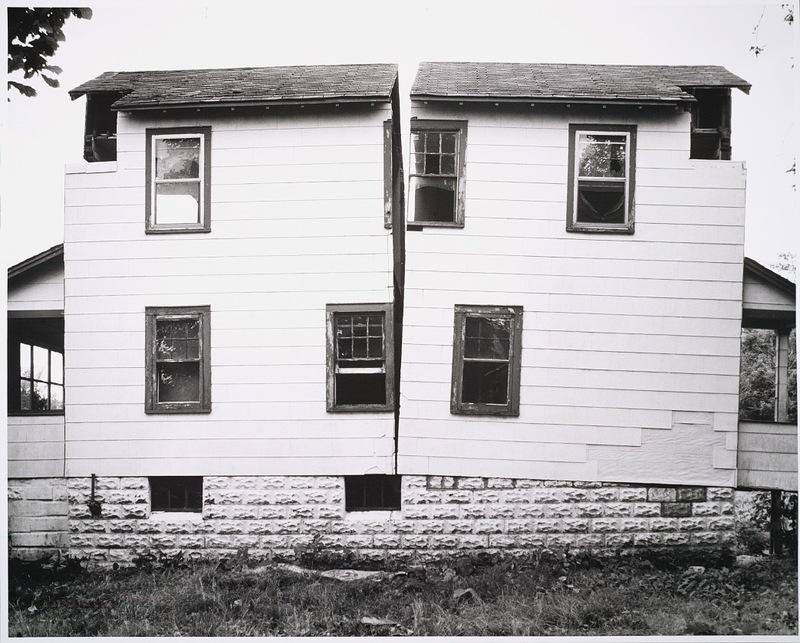
Gordon Matta-Clark, Splitting, 1974

One of my main preoccupations over the last couple of weeks while preparing for the end of year exhibition is how to divide up the space. Obviously for me this involves figuring out where the walls should go and what should go where to make the exhibition make as much sense as possible. But, you know, a bit of literal mindedness and it’s only a small leap from how to divide the studio to Gordon Matta-Clark and the chainsaw and sledgehammer approach to redefining architectural space.

The 1970s may have a lot to answer for in all sorts of ways, but some pretty ground-breaking – or in Matta-Clark’s case building-breaking – art was made then and it’s work that still resonates and that continues to influence subsequent generations of artists.

Continue reading

This exhibition does not do you justice

David Shrigley, Untitled, 2011

I like David Shrigley’s work. It makes me laugh. Why then did I approach his Hayward Gallery exhibition with a sense of dread? Well now, let’s see. Firstly, the strength of Shrigley’s work lies in its simplicity and that’s something that can get wearing when seen en masse. Secondly, the Hayward Gallery is a very big space even allowing for the fact that Shrigley is sharing it with Jeremy Deller’s Joy in People (which warrants a post of its own at the very least). Thirdly – and this one’s the big one – I’ve yet to see a Shrigley solo show I properly liked. Despite that tinge of dread I tried to stay hopeful. With my expectations low, surely a pleasant surprise was in order? Well, yes. And, more importantly, no…

Continue reading

Order and chaos

Kim Rugg, Ecstasy 7-7-7, 2008

For Kim Rugg, the chaos of a newspaper front page is something to be organised. I’m sure we’ve all seen publications we think could be better presented but few would go to Rugg’s lengths to create a different order out of the information on offer. Rugg painstakingly cuts up the page and reorganises the content according to her own system, so that here the letters in each section are in alphabetical order.

It’s easy to recognise the paper as the Guardian but harder to determine the news of the day and certainly impossible to make sense of it in any conventional way.

Continue reading

In a state of change

Sam Taylor Wood, Still Life, 2001

Looking at Jeanne Dunning’s mouldy still lives yesterday made me think about Sam Taylor Wood’s Still Life, a time-lapse video work in which a basket of fruit reminiscent of countless still life paintings gradually decays and is taken over by rather beautiful white mold. At first sight, shown on a plasma screen, the work mimics a painting and it takes time to realise that the fruit is gradually changing as it starts to rot. This is beautiful decay but it’s still hard not to feel a little repulsed by the outcome.

Continue reading

Stripped bare

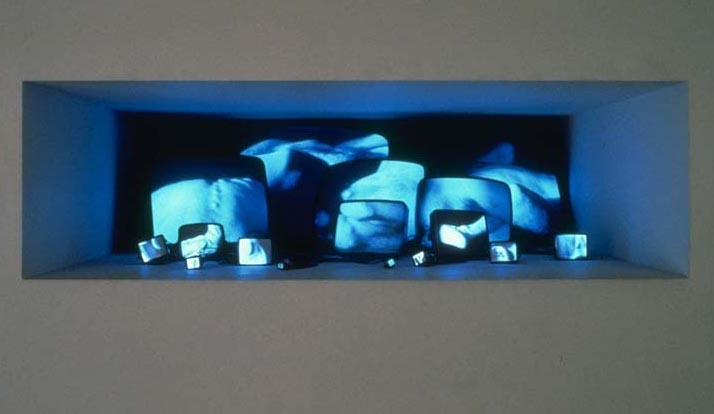
Gary Hill, Inasmuch As It Is Always Already Taking Place, 1990

Like Nam June Paik, Gary Hill often uses the physicality of the television as part of the work but for Hill the box is something to shed leaving the screen and the tube behind it to occupy the space. Multi-screen video works become installations in which the means of display takes on its own significance. Inasmuch As It Is Always Already Taking Place is, in a way, a self portrait, albeit a fragmented one and one which tells us little about Hill.

Continue reading

Boxes of tricks


Nam June Paik, TV is Kitsch, 1996

As we lose the analogue television signal, the impetus to get rid of old analogue televisions is even stronger. The cathode ray tube makes them bulky and heavy next to the sleek lines of plasma and LCD televisions and the need to have an external box to pick up a signal adds to the feeling that the time has come. But that same bulk that seems so annoying in the average living room is key to quite a lot of art from the last few decades. The box is part of what can blur the boundaries between moving image and sculpture. In the case if Nam June Paik’s TV is Kitsch it is the physical presence of the television casings that gives the work its form.

Continue reading

We interrupt this broadcast…

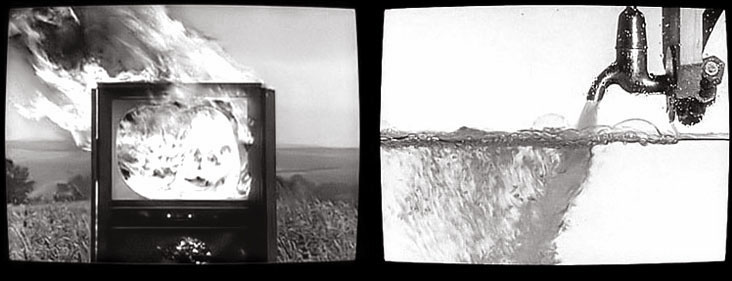
David Hall, Interruption piece and Tap piece from TV Interruptions (7 TV pieces), 1971

Art and television don’t have much of a relationship. There are programmes about art, of course, but even though video art is pretty common in galleries, there’s not much actual art on TV. To an extent, it was ever thus. But there are some interesting examples, and as the analogue switch-off approaches here in London, it seems like a good time to think about them, especially as the occasion is being marked at Ambika P3 with a timely exhibition of David Hall’s work.

Trained as a sculptor, David Hall turned his attention to experimental film at the start of the 1970s, ultimately becoming a pioneer artists’ film and video in Britain, and coining the phrase time-based media. In 1971, Hall was commissioned to make a series of works to be broadcast on Scottish television. This series of TV interruptions were broadcast unannounced and uncredited to what must have been a somewhat baffled audience.

Continue reading

A stitch in time

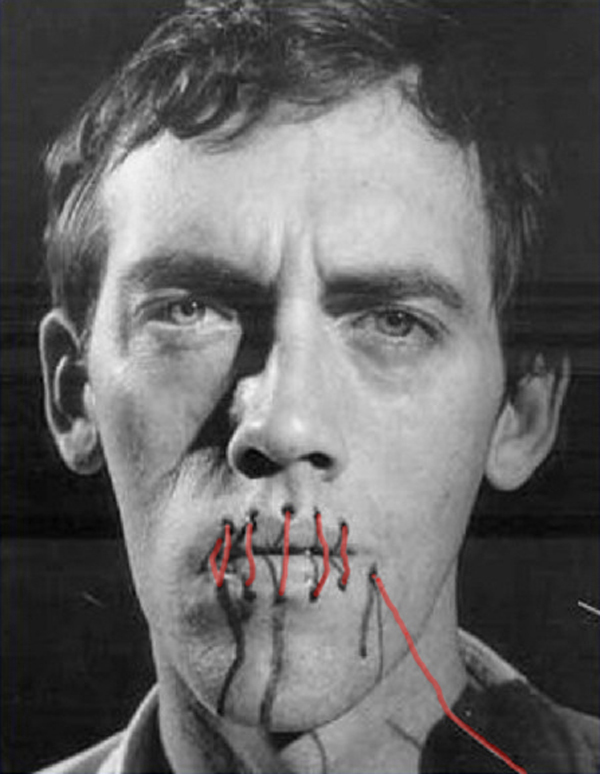
David Wojnarowicz, image from A Fire in My Belly, 1989

David Wojnarowicz is one of those artists. I find his work really interesting and immensely powerful but I haven’t seen very much of it in real life. One day I hope to get the chance to rectify that but in the meanwhile I’ll carry on looking at his work in reproduction. I like his approach to putting images – and often text – together in collages, prints and paintings but it’s his film work that interests me most, in part because it’s here that everything comes together.

And in terms of this blog and the way I let my attention move from one artist to the next by following the most literal of connections – I’m all about the unashamedly clunky segue after all – the use of read thread in his film A Fire in My Belly is more than a little convenient.

Continue reading

Repeat cycle

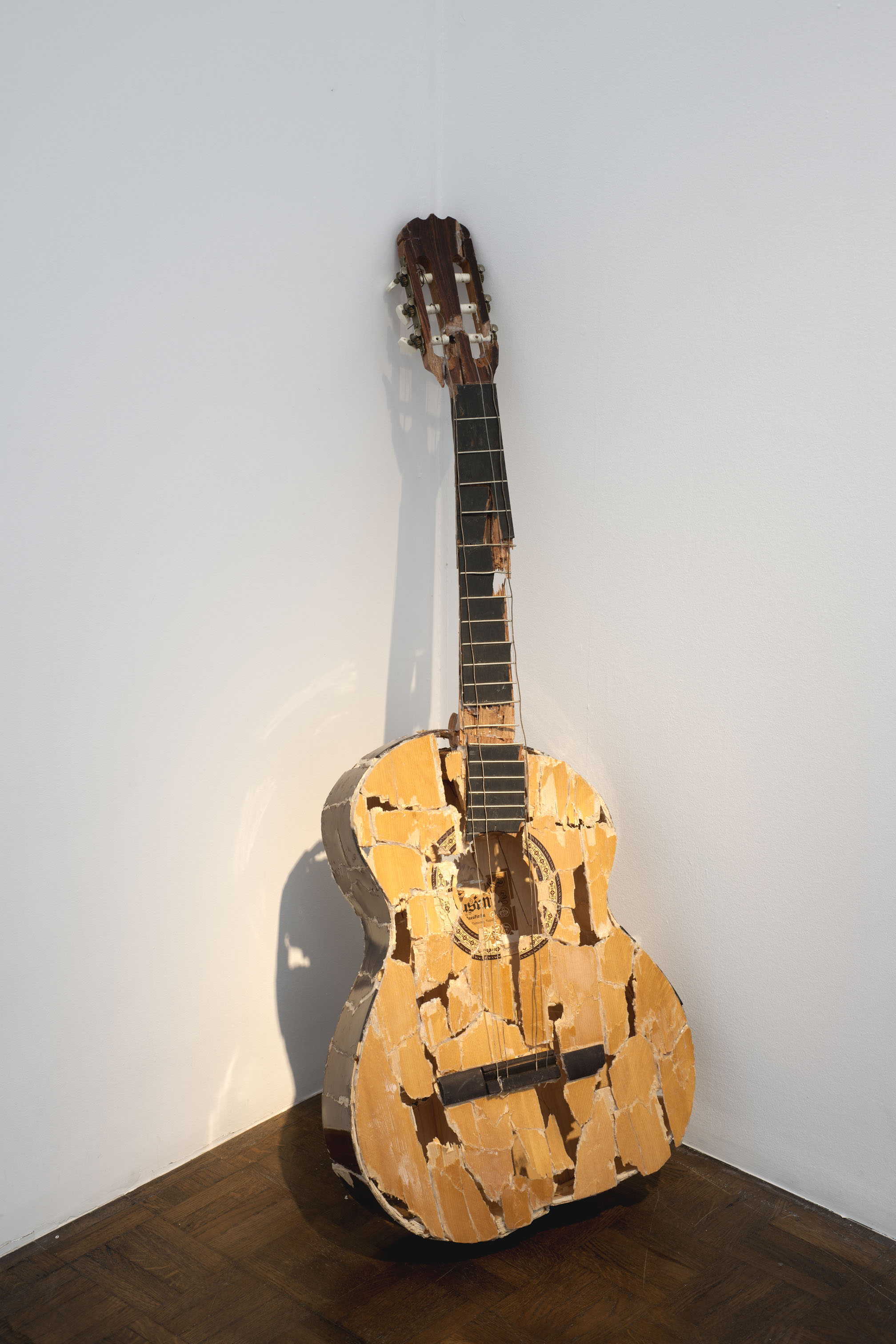
Sofia Hultén, Fuck It Up and Start Again, 2001 (one guitar smashed and mended 7 times

The idea of auto-destructive art may to a very large extent be of its time, something that fitted with other forms of protest – particularly the anti-nuclear movement – of the late 1950s and the 1960s, but its influences continue to be felt. And, of course, the idea of smashing guitars has long since gone from shocking indication of the state of young people and their music to rock cliché.

Continue reading