Unknown's avatar

About Ann Jones

London-based artist and educator who somehow seldom gets time to actually make any work, who writes about art, somewhat irregularly, at ImageObjectText.com and occasionally contributes to MostlyFilm.com – writing about art, mostly.

Expanded sculpture

Sebastian Errazuriz, Complete (Duchamp Series), 2005

If Duchamp’s readymades changed art, and it seems pretty clear that they did, it’s not surprising that artists still return not only to the idea of the readymade but also to Duchamp’s own work. Sebastian Errazuriz’s Complete (Duchamp Series) goes beyond Duchamp’s Bicycle Wheel to provide a more complete, though still fragmented, bicycle assemblage. The familiar bicycle wheel upturned and attached to a white painted stool is here. But here it’s accompanied by a second wheel, plus the handlebars and pedals.

Continue reading

Art world turned upside down

Marcel Duchamp, Bicycle Wheel, 1913 (authorised reproduction 1951, original lost)

The means of transport link is a bit tenuous here but I seem to have been writing about a lot of works that are in some way related to the idea of the readymade or assemblage so not mentioning Marcel Duchamp’s Bicycle Wheel would seem like a strange omission. This is a sculpture so simple it’s hard to see it as something that predated minimalism by several decades. Whenever I stop to really think about Duchamp and the idea of the readymade I’m astonished that it took just fifty years to get from the outrage that greeted Édouard Manet’s 1963 painting Le déjeurner sur l’herbe, often seen as heralding the start of Modern Art, to a bicycle wheel on a white stool being declared to be art. That it predated the formation of Dada, a movement with which Duchamp was associated, with its ideas of an anti-art in response to the horrors of the first world war also seems extraordinary.

Continue reading

Matching pairs

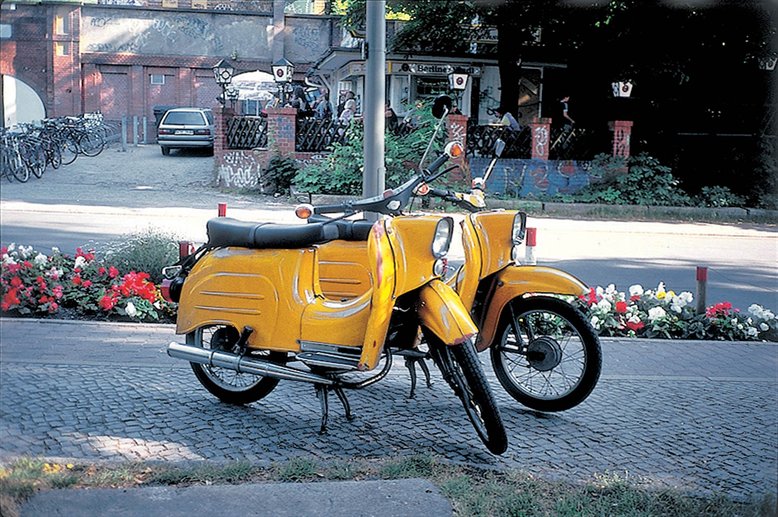
Gabriel Orozco, Until You Find Another Yellow Schwalbe, 1995

While I’m in on a bit of a ‘means of transport as art’ theme I really can’t ignore Gabriel Orozco’s Until You Find Another Yellow Schwalbe. Living in Berlin while on a DAAD residency in 1995, Orozco got around the city using a yellow Schwalbe scooter. These scooters, made in the former East Germany, were cheap and quite a common sight on the streets of Berlin. Whenever he saw a scooter like his parked, Orozco would pull up next to it and photograph the pair of scooters. He left a note on each of the scooters inviting the owner to bring it to a gathering outside the Neue Nationalgalerie on the anniversary of the reunification of Germany.

Continue reading

Drawing in space

Damián Ortega, Miracolo Italiano, 2005

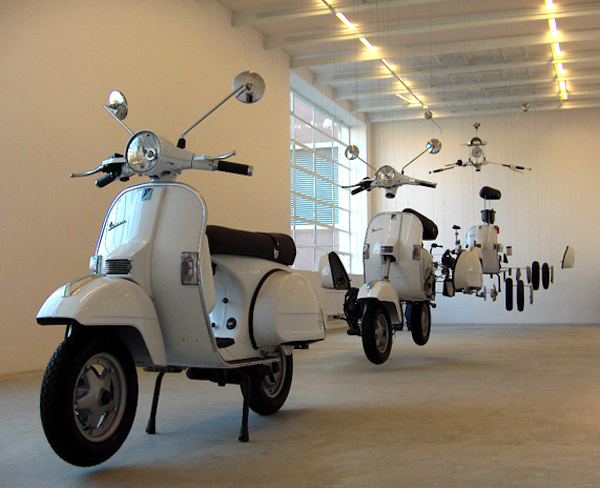
The VW Beetle is not the only vehicle Damián Ortega has used as art materials. In Miracolo Italiano Ortega presented three Vespa scooters in various states of wholeness. The scooter leading the parade is whole but the ones behind it are exploding out into the space, with the second one showing early signs of breaking up and the third one as fragmented as the Beetle in Cosmic Stuff. Like the Beetle, the Vespa is a twentieth century icon and Miracolo Italiano was made for an exhibition in it’s home city of Turin

Continue reading

Unmaking the readymade

Damián Ortega, Cosmic Thing, 2002

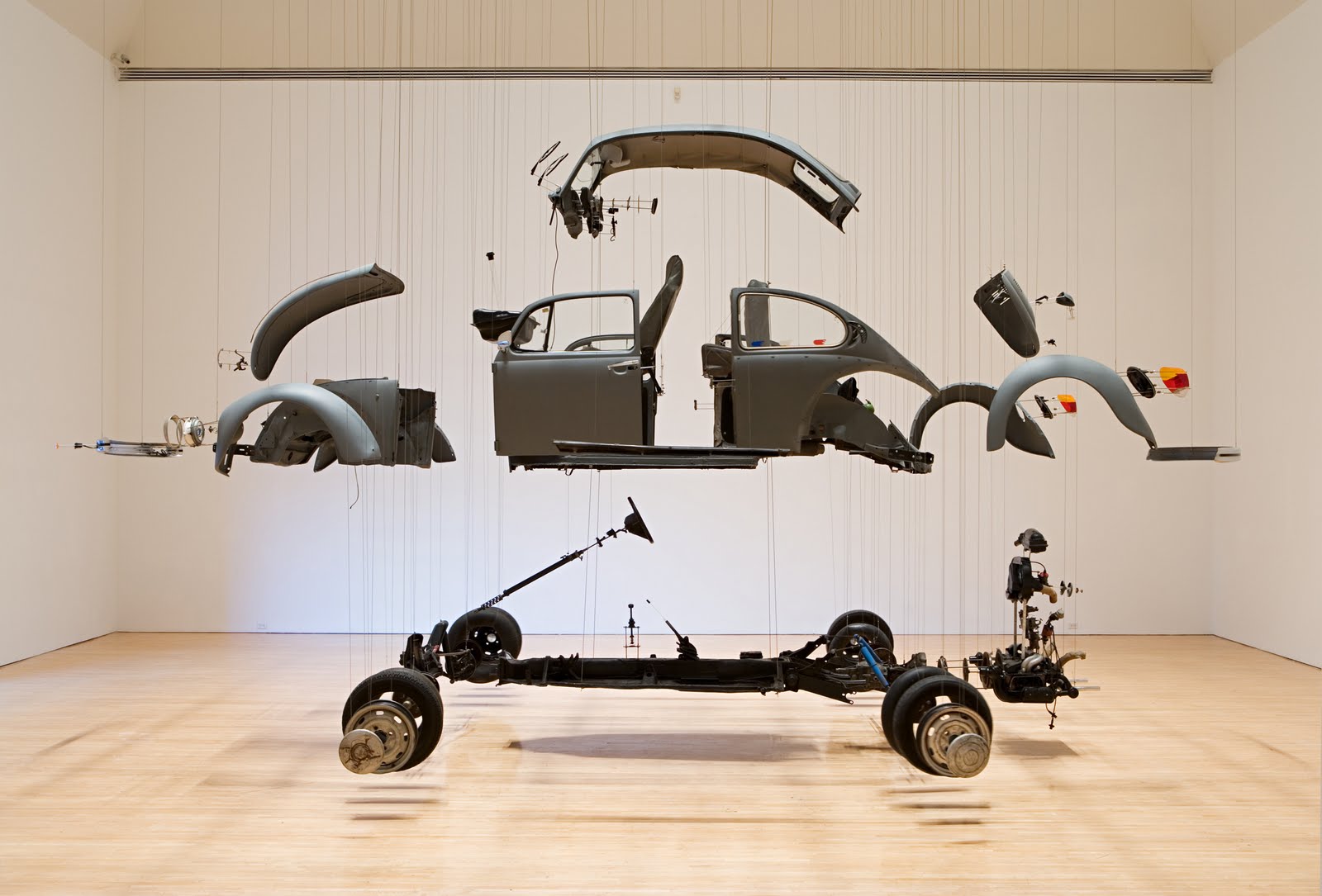
No car maintenance manual would be complete without an exploded view diagram or two, so it seems appropriate that it should be a car that Damián Ortega chose to break apart and display as a kind of three-dimensional diagrammatic representation of itself; indeed Ortega based the car’s deconstruction on the diagram in the car’s repair manual. The car in question in Ortega’s sculpture Cosmic Thing is a 1989 VW Beetle. The Beetle is one of the Seen from the side – or the front, albeit to a lesser extent, as the picture after the jump will show – the car is immediately recognisable and the work seems like a drawing in many ways.

Continue reading

Cut and shut

Gabriel Orozco, La DS, 1993

One of the things to avoid when buying a car is getting a cut and shut – a car that’s effectively been made from two wrecks, generally joining the front of one car and the back of another – but Gabriel Orozco’s La DS s a cut up car of quite a different nature. The first thing you notice about La DS is that it’s a readymade in the very specific form of a Citroën DS; but it’s immediately also apparent that something isn’t quite right. This is car, but not as we know it. It seems somehow longer than it should be. In reality, it’s not stretched; the proportions are wrong because the car has been slimmed down in an unexpected way. Orozco took a Citroën DS and removed the middle section making the familiar form even sleeker. Of course removing a section two foot wide (or thereabouts) from the middle of a car does have its drawbacks. It looks beautiful but La DS can’t be driven so turns heads only in the gallery.

Continue reading

Time travelling

Mark Wallinger, Time and Relative Dimensions in Space, 2001

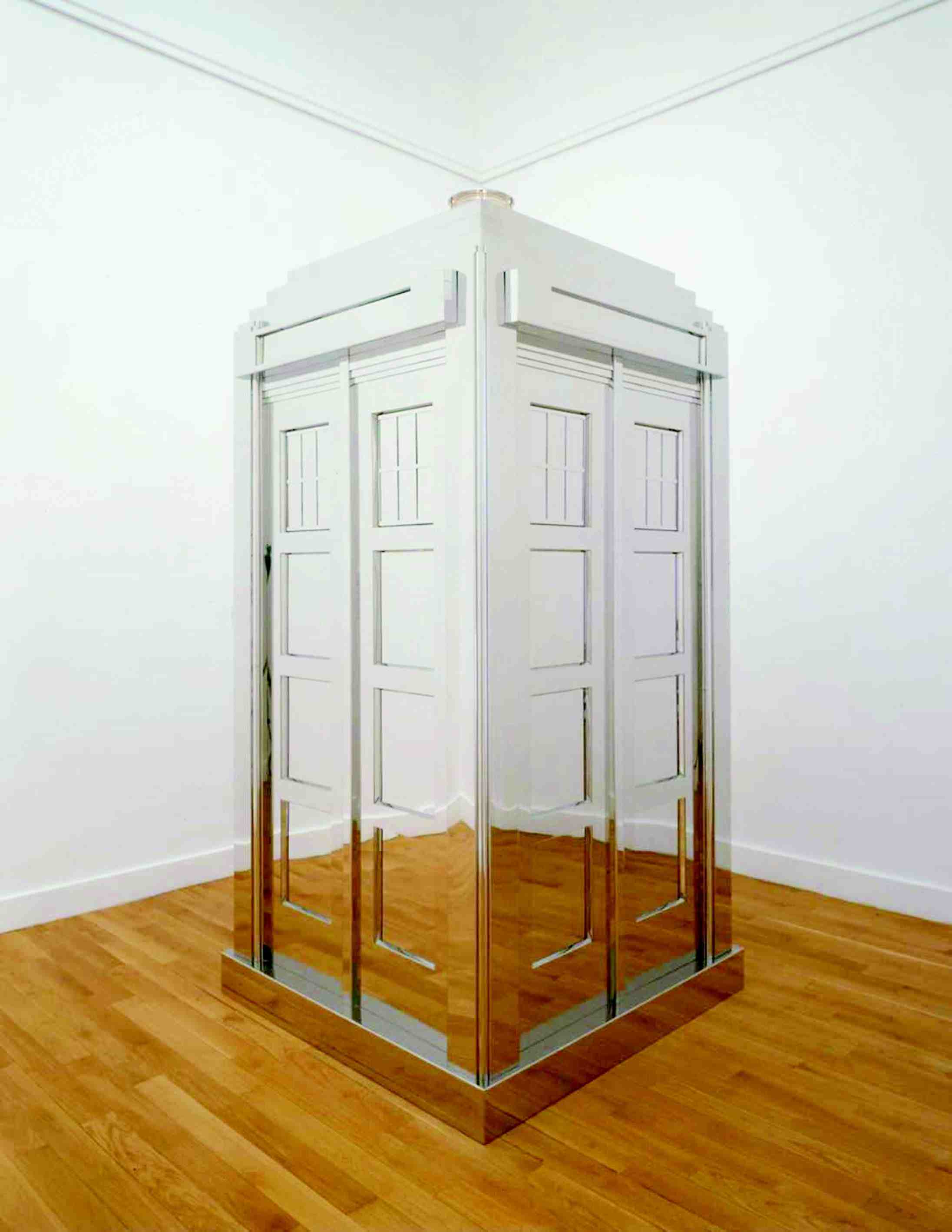
It was the title of George Shaw’s painting of a phone box – The Time Machine – that brought Mark Wallinger’s Time and Relative Dimensions in Space to mind. The work is a replica of a police box with a mirrored surface. Police boxes really don’t exist any more so we only really recognise them in the form of Dr Who’s TARDIS. The nature of the tardis is that is appears from nowhere and can disappear in an equally incomprehensible manner.  Whereas the tardis is either there or not there, Wallinger’s box seems to be simultaneously there and not there.

Continue reading

Memory bank

George Shaw, Scenes from the Passion: The Swing, 2002-3

The landscapes in George Shaw’s paintings all conceal stories but in this case the narratives are Shaw’s own childhood memories. For the series Scenes from the Passion, Shaw worked from photographs taken within a half mile radius of the house he grew up in. The area is unremarkable and, in Shaw’s paintings, unpopulated. There is a bleakness here but also perhaps a sense of anticipation. Though the area is very specifically the territory of Shaw’s childhood in a way it feels like the paintings depict a kind of everytown. There are certainly scenes here that I can match against my own suburban London upbringing.

Continue reading

Every picture hides a story

Mats Bergsmeden, from the series Border Line, 2004–12

The pictures in Mats Bergsmeden’s series Border Line are very beautiful landscape photographs. Most seem like idyllic places, indeed my immediate thought was of the pastoral idyll of landscape painting and this seems to be Bergsmeden’s intention, with the specific reference of the landscape tradition in European painting during the Age of Enlightenment. Some of the pictures are of places where man’s intervention is limited to controlling nature but in some there are signs of the built environment and industry. Though all the images are unpopulated, in some we seem to be approaching signs of human activity; there is a sense that we are on the outside looking in. It would be possible to appreciate these as beautiful landscape photographs without reading anything more into them, but that would be to completely miss the point.

Continue reading

The reassembled object

Simon Starling, Shedboatshed (Mobile Architecture no. 2), 2005

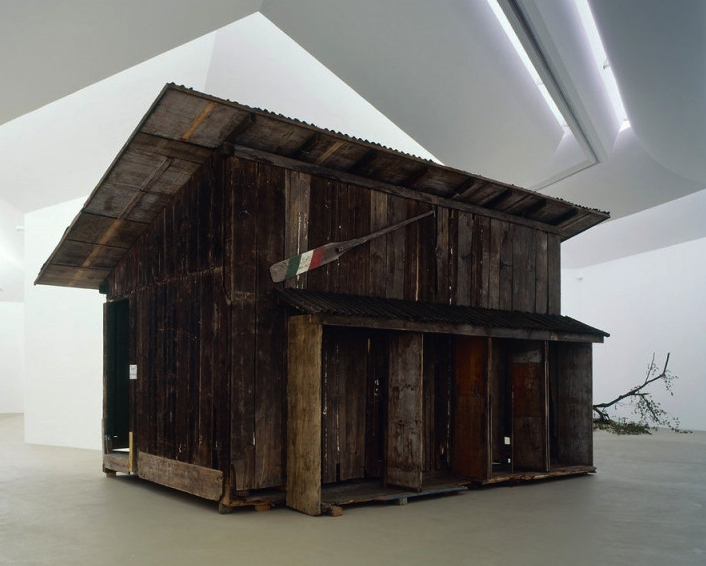
At first sight, Simon Starling’s Shedboatshed (Mobile Architecture no. 2) appears to be a readymade. It’s an old shed. It looks a bit the worse for wear, but age will do that to a shed. Things aren’t quite a simple as they appear though and the first clue’s in the title.

Shedboatshed is a shed. Shedboatshed started out as a shed. But it hasn’t always been a shed. Starling turned an old shed, which he’d found in the banks of the Rhine, into a boat which he then used to get to Basel, carrying the unused parts of the shed in the boat. On arrival, the shed was reassembled and exhibited in the Kunstmuseum Basel and later that year in Tate Britain as part of the Turner Prize exhibition, which Starling won.

Continue reading