A simple state of change

Hans Haacke, Wide White Flow, 1967

Looking at Hans Haache’s Floating Sphere yesterday made me think about another work of Haacke’s that surprised me when I came across it at Paula Cooper Gallery in New York a few years ago (February 2008, fact fans). I’d gone to the show because I was in New York with students and at least one Chelsea gallery day is kind of compulsory and because I really like Hans Haacke’s work but haven’t seen nearly as much of it as I’d like in real life; as on any visit to New York, there wasn’t time to see everything I wanted to, but this was always going to be high enough on my list to make the cut. My previous knowledge of Haacke’s work was in the main of more politically driven works and of a drier, more conceptual approach.

I fully expected to be interested and absorbed. Being bowled over by the beauty of the work came as a complete surprise.
Continue reading

Keepie Uppie

Damien Hirst, The Battle Between Good and Evil, 2007

Without wishing to seem obsessed with either Damien Hirst, the titling of work or the programme at White Cube’s Bermondsey space, having written about Hirst’s paintings (terrible) and Nauman’s films (great) the completist in me thinks it worth writing about Hirst’s installation in 9 x 9 x 9, the final gallery space in the Bermondsey building.

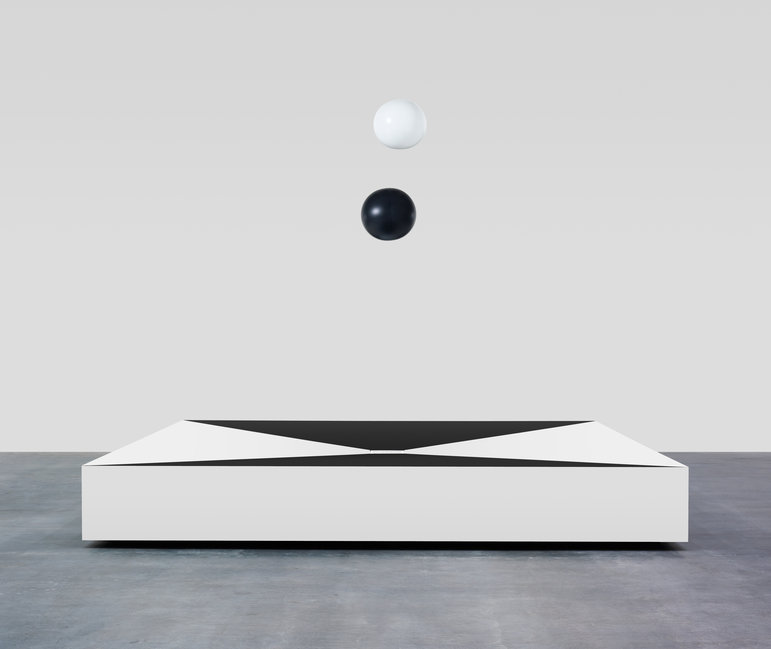
The work takes the form of two beach balls – one black, one white – floating above a black and white square basis, held aloft presumably by a fan within the base. This is a playful work but my enjoyment of it was offset by wondering firstly how it would look in colours that said beach ball more assertively and secondly by wondering how it would look all in white. As it happens, on both counts, Google is my friend here.

Continue reading

Memory and pain

Doris Salcedo, A Flor de Piel, 2011-12

Probably best known in London for Shibboleth – the crack in the floor of the Turbine Hall at Tate Modern – Doris Salcedo is an artist with an extraordinary ability to take the most ordinary objects and materials and turn them into moving and often highly political works. Her current exhibition at White Cube, Mason’s yard contains just two works. Nonetheless it gave me a lot to think about and, time permitting, I’d like to go back.

In the upstairs space, A Flor de Piel looks more like flayed skin than rose petals. The piece is a large-scale blanket of what must amount to many, many thousands of petals and stitches which the press release describes – much better than I can – as ‘a shroud composed of sutured rose petals’. That word sutured seems apt. There is a sense of the bodily in its skin-like appearance and also a feeling of a surgical mending rather than a more domestic sewing together (though of course the two essentially amount to the same act).

Continue reading

Dirty work

Mark Dion, Tate Thames Dig, 1999

In 1999 the process of transforming what had once been Bankside Powerstation into Tate Modern was well underway. Tate had long since needed more space in which to show its two collections – the national collections of British Art and of Modern Art (here considered to be post-1900) – and the new space was eagerly anticipated. The collections would at last get their own spaces, each museum facing the Thames one from Millbank on the northern bank, the other from Bankside, further east and on the southern bank of the river.

In anticipation of the new space, Mark Dion adopted the role of archaeologist to create the installation Tate Thames Dig, initially shown in the Art Now room at what was then known as the Tate Gallery (now Tate Britain).

Continue reading

Drawing sculpture in the dark

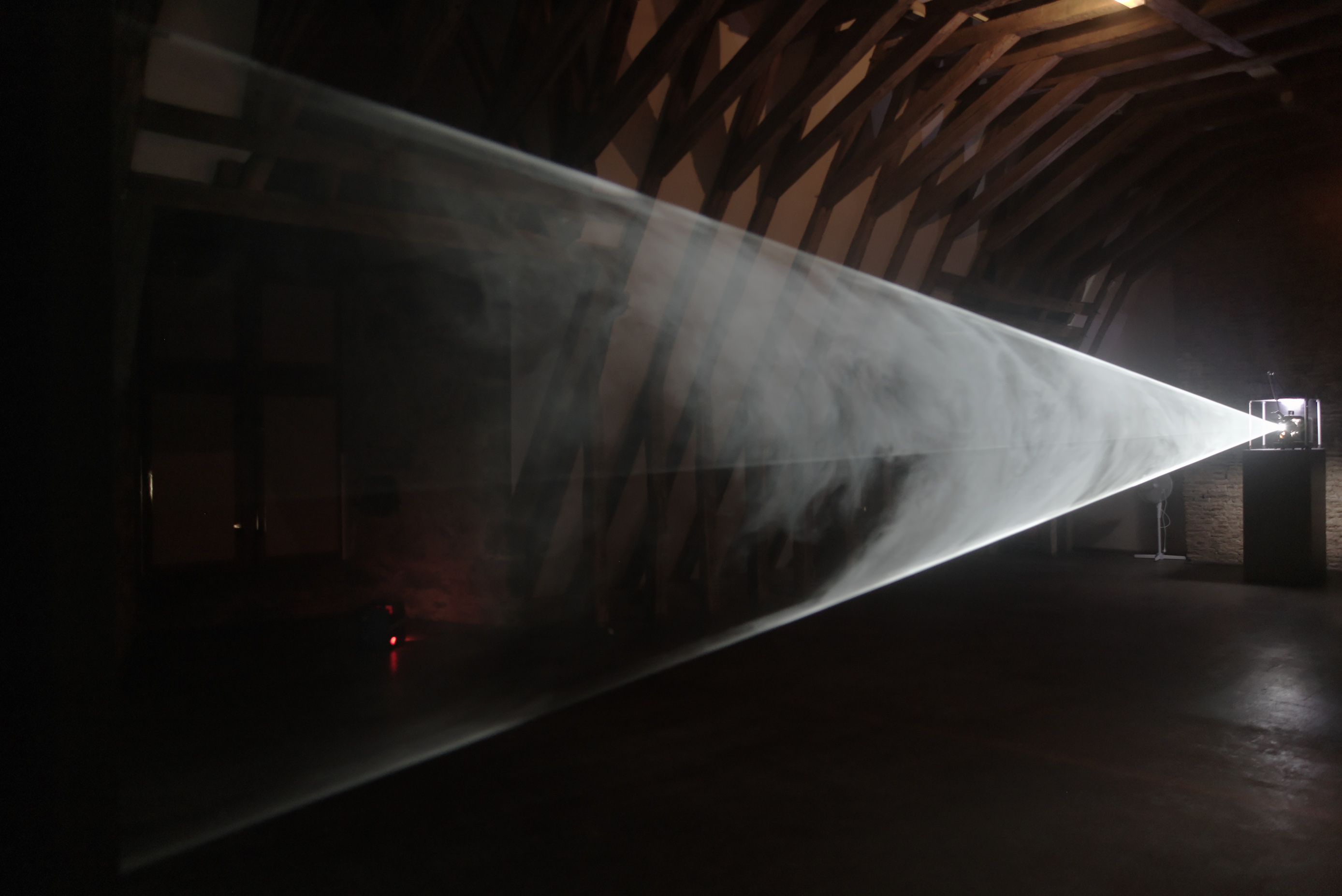
Anthony McCall, Line Describing a Cone, 1973

While I’m on the subject of almost non-existent sculpture, especially almost non-existent sculpture that might in some way be seen as drawing, it’s perhaps inevitable that Anthony McCall’s Solid Light Works should worm their way into my thoughts. I can remember the first time I saw Line Describing a Cone very clearly indeed. It’s just one of those works: astonishing, engaging, playful, uplifting even. There’s something about the way it plays tricks on both eye and mind. That first encounter was at an almost deserted Hayward Gallery – it was about two days before Christmas, which turns out to be a great time to see art almost in private – in the exhibition Eyes, Lies and Illusions which brought together a collection of magic lanterns, zoetropes and other optical devices with works by contemporary artists. It was a great show. And then, there was one final room just before the exit. When I went in it was empty and, my friend and me aside, it stayed that way for a good five minutes or so.

Continue reading

Dividing lines

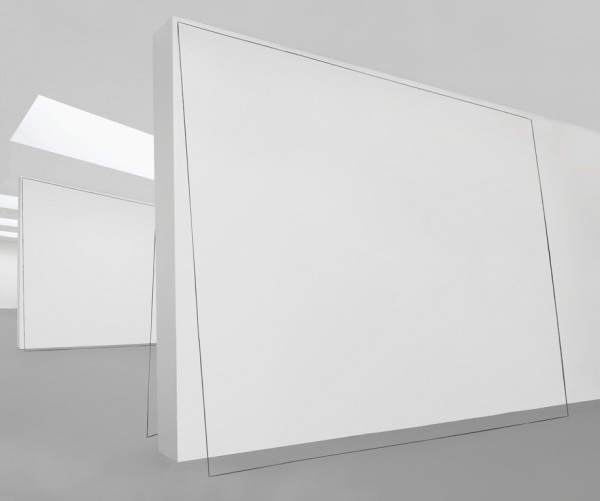
Fred Sandback, Untitled (no. 48, Three Leaning Planes, from 133 Proposals for the Heiner Friedrich Gallery), 1969

I think it’s pretty clear by now that I quite like a bit of visual confusion and that I have a bit of a soft spot for the large scale minimal sculpture made in particular by American artists in the 1960s and ’70s (and later), which means Fred Sandback is definitely right there on my like list (even if I do have a tendency to forget his name from time to time, possibly, for some weird reason, I don’t expect artists to be called Fred).

This is sculpture at its simplest. Sandback makes works that divide the space or rest against a wall. At first glance, it usually looks like there are large sheets of glass either creating barriers in the space or resting against the walls. but all is not as it seems..

Continue reading

Same difference

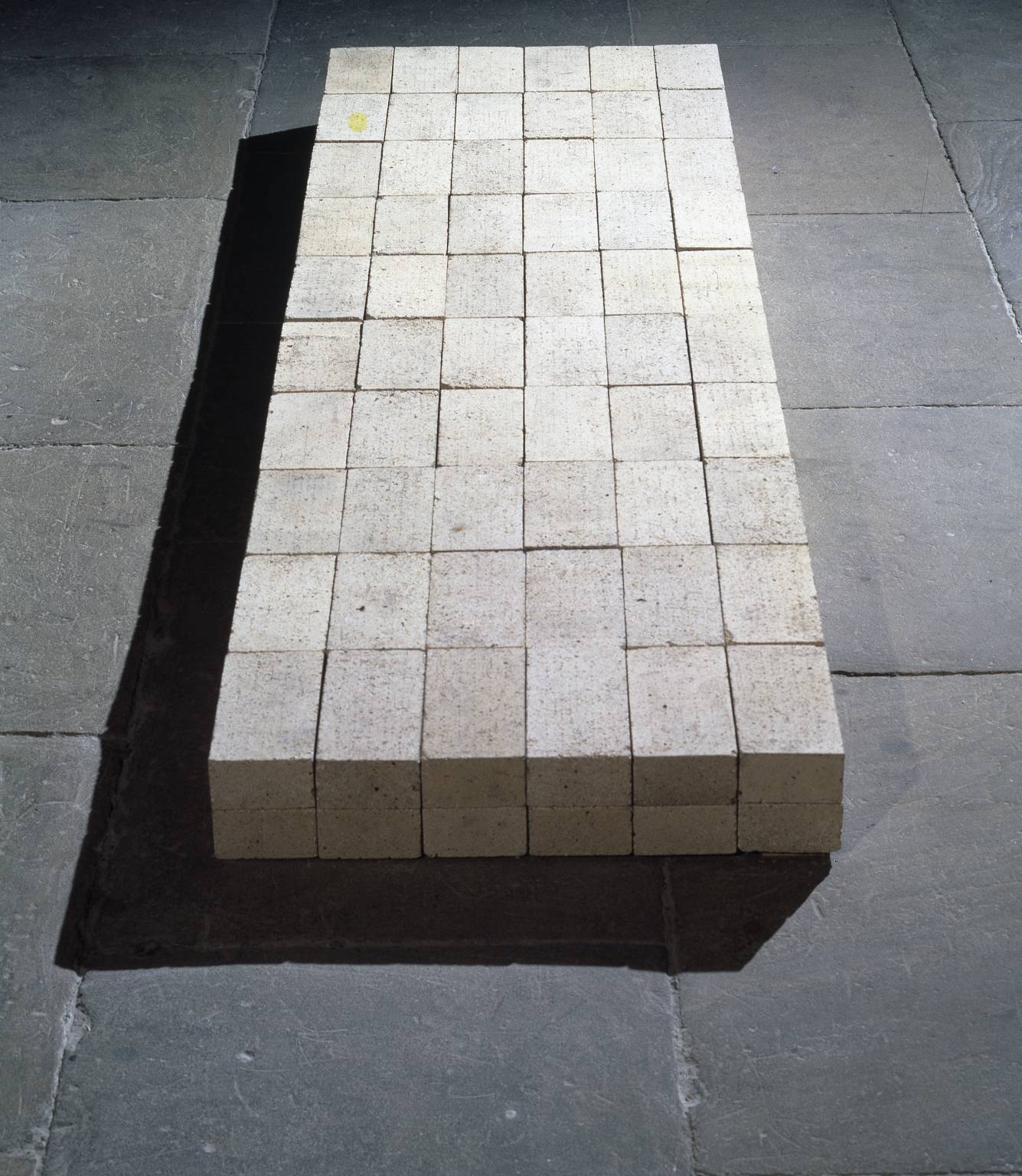
Carl Andre, Equivalent VIII, 1966-69

When it comes down to it, one pile of bricks is pretty much like another. At least, that’s the way things work in Carl Andre’s Equivalent series. Each of the eight sculptures in the series consists of 120 bricks laid out on the floor two layers deep. Though each is laid out in a different arrangement, as each contains the same number of the same type of bricks, each occupies the same volume of space and can therefore be seen as equivalent.

Equivalent VIII, bought by the Tate in 1972, is described as 2 high x 6 header x 10 stretcher; in other words the bricks are in two layers each six bricks wide by ten bricks long. The work is probably more commonly known as the bricks, or perhaps the pile of bricks, and has long been one of the most controversial artworks held by a British art museum.

Continue reading

Boxed in

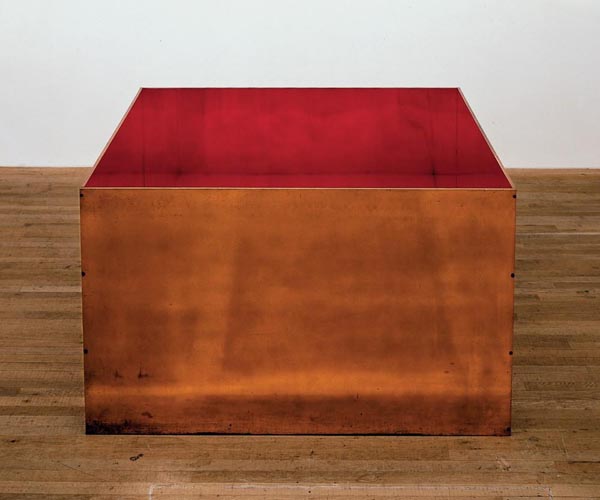
Donald Judd, Untitled, 1972

Though historically sculpture might have been rooted in the figurative and decorative, clearly from the point at which Marcel Duchamp declared readymade objects to be art, all bets were off about what could become sculpture and how and why this might happen. And, along with readymade objects, industrial materials and processes have long been legitimate territory for artists. Like other artists broadly known as minimalists – though it was a term he rejected – Donald Judd focused his attention on the inherent qualities of his materials which he used in a simple, straightforward way making ambiguous works that act as sculpture but often seem, in some way, closer to functional objects.

Continue reading

Nerves of steel

Richard Serra, Fernando Pessoa, 2007

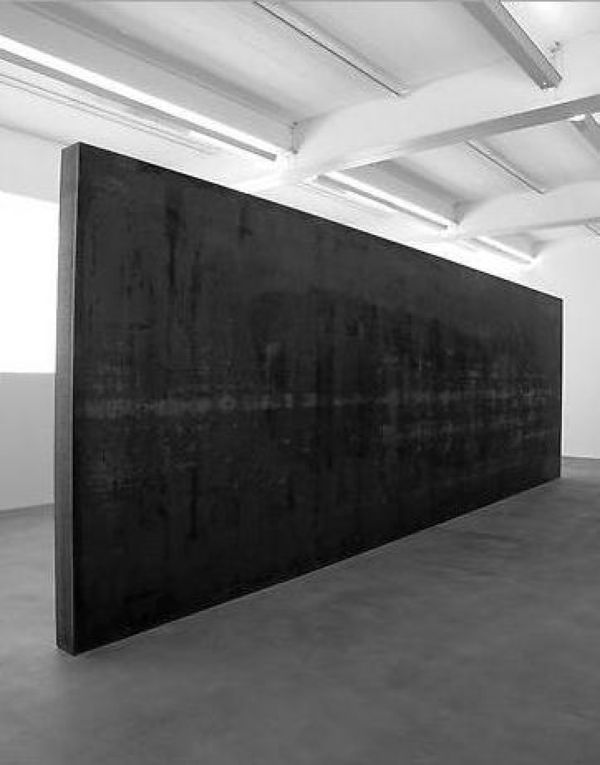
Richard Serra’s sculptures scare me. Well, sort of. When I stop to think about the weight of steel and the way they just stand there minding their own business but capable of crushing anything in their path should they choose to fall, then they scare me. Mostly I just kind of marvel at the scale of them and at the quiet way they hold their immense power in check.

Though I really liked everything in Serra’s exhibition at Gagosian in London in 2008, ultimately for me it was all about two works. The first of these, Fernando Pessoa, is a simple wall of steel. It just stands there, unsupported. The wall is ten inches thick, any less and it would be at risk of toppling over. As it is, it just looks like it could fall. It’s an extraordinary presence in the space, bisecting the room but becoming almost nothing when seen end on.

Continue reading

Down to earth

Anish Kapoor, Vertigo and Non-Object (Pole), both 2008

On one level, this is probably the most inappropriately titled post I’ve written. Anish Kapoor’s work is, in my view at least, usually very far from down to earth. At its best, Kapoor’s work is extraordinary; it can redefine the space it occupies and disorientate, baffle and sometimes entertain its viewers. But – with the notable exception of the quietly beautiful, and easily overlooked, pregnant wall pieces – subtle it ain’t. Pompous, yes. Excessive, certainly. Subtle, not so much.

To start with the entertaining, by bringing strangely distorting mirrored surfaces into the gallery space, Kapoor entices his audience to pose and play. This is art crossed with the funfair in the form of the hall of mirrors and it’s hard not to be beguiled by the result. Moving backwards and forwards before the mirrors, we might get fatter and thinner or be turned upside down. The results aren’t exactly profound but they are both beautiful and good fun.

Continue reading