Small world

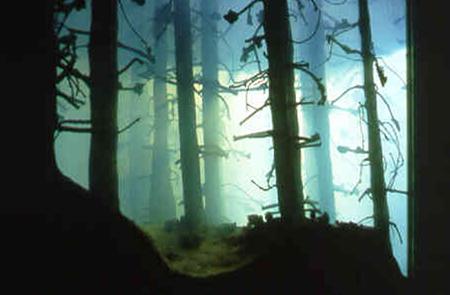
Mariele Neudecker, I don’t know how I resisted the urge to run, 1998

There is something oddly strange about the way the light streams through the trees in Mariele Neudecker’s I don’t know how I resisted the urge to run. But for the uneven ground of the forest floor, I think I’d want to run too. The trees are bare and though their trunks are healthily tall and straight their branches are short and spindly. That all is not well here is reinforced by the eeriness of the atmosphere; the scene is permeated by a slightly toxic-looking fog

Continue reading

Size isn’t everything

Anselm Kiefer, Dat rosa miel apibus, 2010-11

There is something extraordinary about Anselm Kiefer’s paintings. The surfaces aren’t quite like anyone else’s and the scale of the work means that standing before one I always feel part of the picture space. The paintings in Kiefer’s exhibition Il Mistero delle Cattedrali at White Cube Bermondsey are less heavily textured than some of his work but the surfaces are still rough and often salty.

Continue reading

Just lying there

Maurizio Cattelan, All, 2008

Though not a sight one would ever hope to see, a row of bodies covered in sheets is easy enough to understand. The first thing that feels wrong here is the solidity of the sheets; the row of figures are marble statuary rather than fabric covered human remains. This realisation gives the figures a new familiarity, one rooted in religious representation.

Take a closer look though and all is not as it seems…

Continue reading

Looking efficiency in the eye

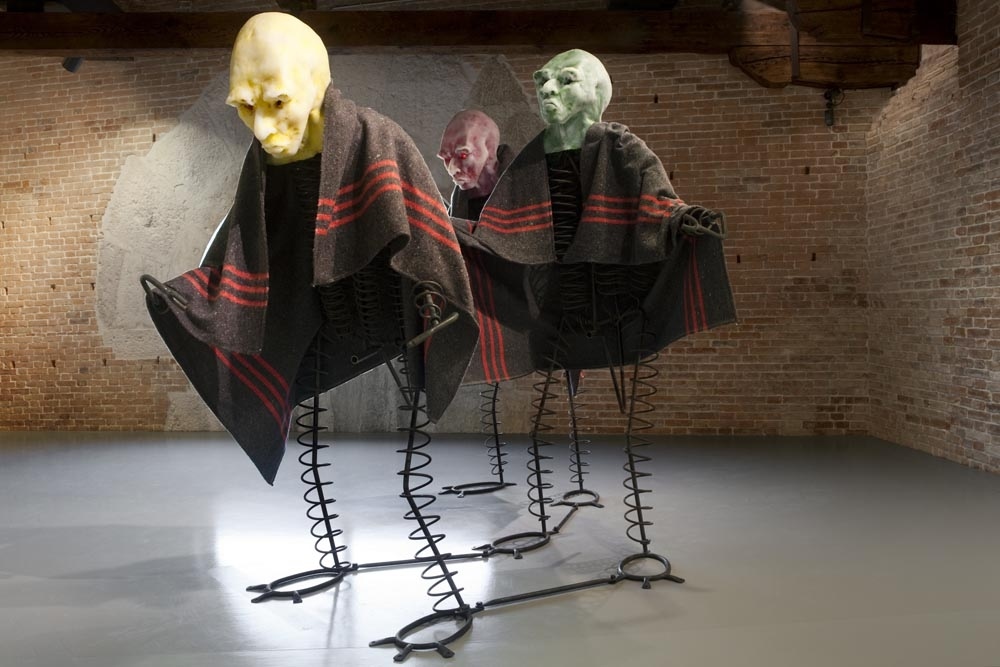
Thomas Schütte, The Efficiency Men, 2005

There is something slightly terrifying about Thomas Schütte’s The Efficency Men. The metal frame bodies are strange and the blankets round their shoulders give an air of pathos but ultimately it’s the eyes in their oversize heads that get me. Staring into the eyes of one of the figures isn’t at all comfortable.

Continue reading

Moving pictures

Juan Fontanive, Quicknesse, 2009

When we think of moving image art it’s usually film and video works that spring to mind first, but artists like to play and there’s more than one way to make an image move. One of the works I’ve enjoyed the most in recent years is Juan Fontanive’s Quicknesse, a simple flipbook device which traps a hummingbird in a loop of hovering. The sound of the work conjures a sense of agitation and urgency; the bird is beautiful, trapped in our gaze.

There is something extraordinary about this work. Whether it’s the simplicity of the device or the touching beauty of the image, in which the bird is isolated from its surroundings (the background of the image is painted out in white so that the bird floats), I’m not sure, but it has stayed with me since the first time I saw it. Effectively  this is stop motion animation as sculpture. Juan Fontanive has another London show opening at Riflemaker Gallery next month. Can’t wait.

Continue reading

Watching the sky

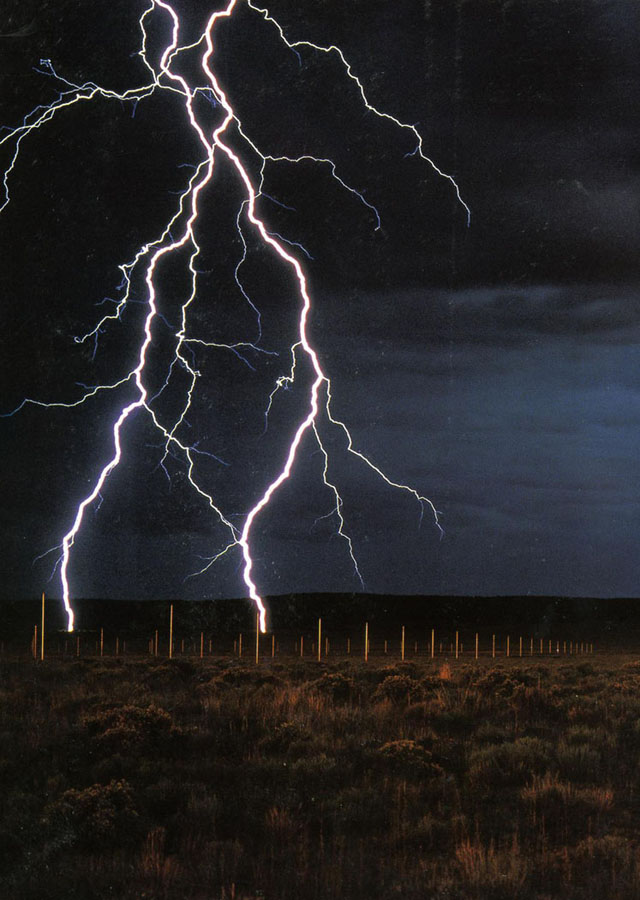
Walter De Maria, The Lightning Field, 1977

The list of art works I really want to see is quite a long one, but somewhere towards the top – and part of an as yet imaginary art holiday that includes other pieces of American land art  – is Walter de Maria’s The Lightning Field. In the middle of nowhere, about three hours drive from Albuquerque, The Lightning Field is, um, basically a field. With, if you’re very lucky (and most who visit it won’t be), some lightning.

Continue reading

Representing the real

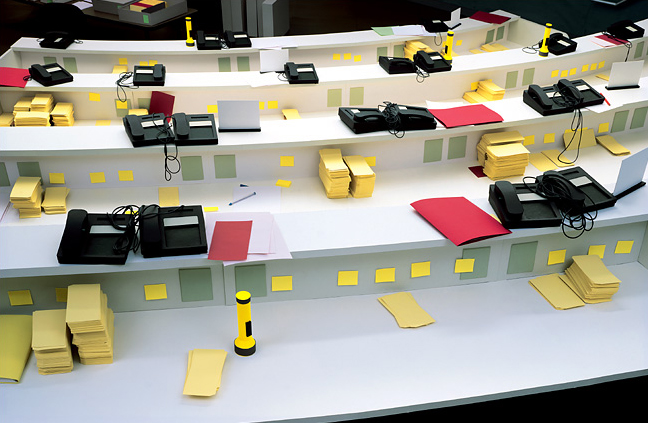
Thomas Demand, Poll, 2001

There are many ways to make a photograph. In photographic terms, Thomas Demand’s approach is very simple. The camera records the scene in as straightforward a manner as it can. But there is something odd – uncanny, perhaps – about the scene; all is not as it seems.

Continue reading

Past master

Maurizio Cattelan, Bidibidobidiboo, 1996

As a rule, I don’t have much time for taxidermy in art. Sometimes it works, but for me such instances are few and far between. But if anyone can get away with it, it’s Maurizio Cattelan; contrary to my own expectation, his use of taxidermy consistently wins me round.

Continue reading

Daily rituals

Hadrian Pigott, Instrument of Hygiene (Case 4), 1995

I’ve always been interested in the way we muddle through life and the daily routines most of us construct – at least, I don’t think it’s just me – to get through the day and feel vaguely in control of something, anything, however mundane. We are, by nature, creatures of habit to a greater or lesser extent. Before you know it, routines become rituals and it becomes unthinkable to break the sequence. One of the most ritualised aspects of daily life is often personal hygiene.

Continue reading