Webs of deceit

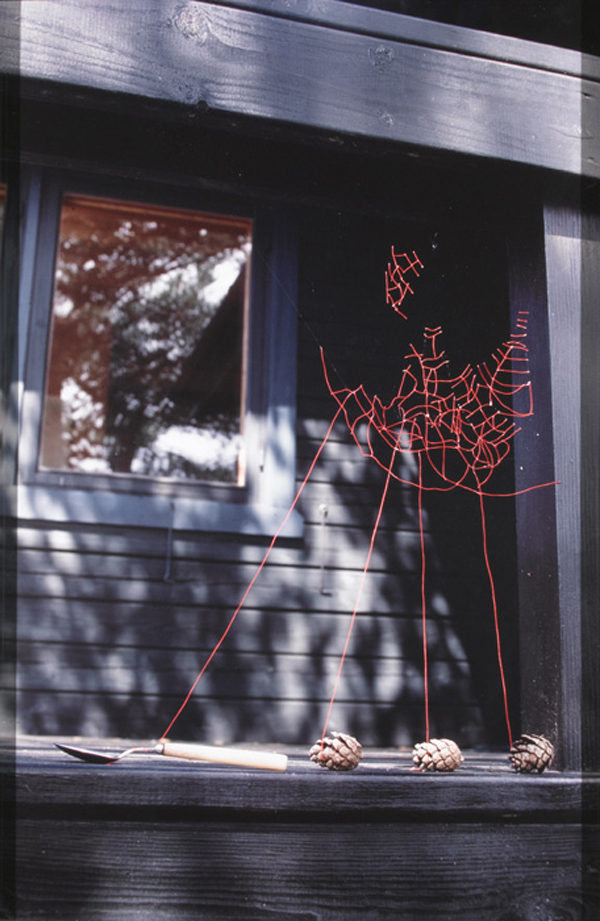
Nina Katchadourian, Mended Spiderweb #14 (Spoon Patch), 1998

I confess to not much liking spiders. If they stayed outdoors I’d feel a lot more benevolent towards them, but when they come inside and scurry about like they own the place they make me distinctly edgy. But even I acknowledge that they do make very beautiful webs. In her Mended Spiderweb series – part of a large body of work called Uninvited collaborations with nature – Nina Katchadourian has helped out by patching up damaged spiders’ webs with fine red thread. The results are not only very beautiful, they are also unexpectedly interesting.

Continue reading

Art on acid

Painting with hydrochloric acid on nylon, 1961

There are lots of ways to paint, as a quick wander through any major art museum will amply demonstrate. But there are those who change out understanding of art through their work, and Gustav Metzger is one such. Metzger’s notion of auto-destructive art, which he initially defined in 1959, was an interesting and highly-influential on which was rooted in the belief that Western society was failing (Metzger has been a Marxist all his adult life). The idea is that the work has the capacity to destroy itself or that it is destroyed by the actions of its creator.

Gustav Metzger: Auto-Destructive Art (1959)
Auto-destructive art is primarily a form of public art for industrial societies.
Self-destructive painting, sculpture and construction is a total unity of idea, site, form, colour, method, and timing of the disintegrative process.
Auto-destructive art can be created with natural forces, traditional art techniques and technological techniques.
The amplified sound of the auto-destructive process can be an element of the total conception.
The artist may collaborate with scientists, engineers.
Self-destructive art can be machine produced and factory assembled.
Auto-destructive paintings, sculptures and constructions have a life time varying from a few moments to twenty years. When the disintegrative process is complete the work is to be removed from the site and scrapped.

Continue reading

A breed apart

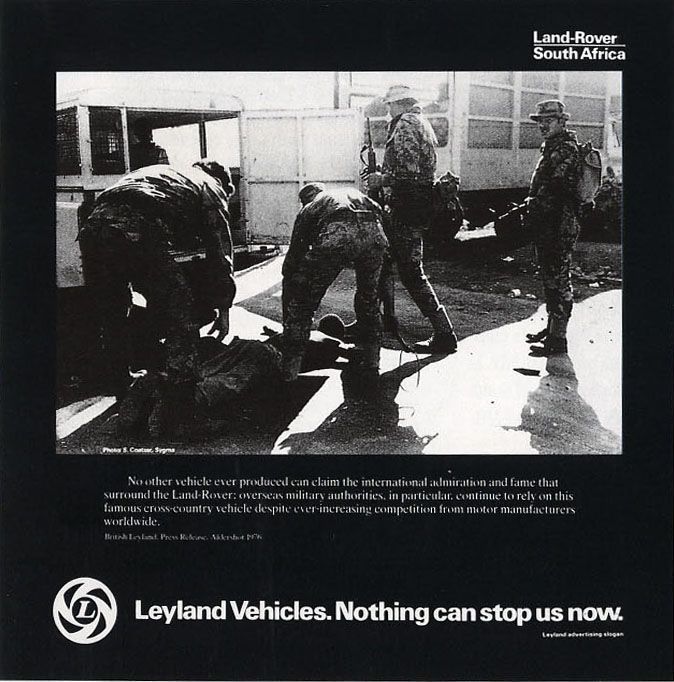
Hans Haacke, from the series A Breed Apart, 1978

Although this work has been in the back of my mind for a while, it isn’t the Hans Haacke piece I expected to write about first but somehow it seems like an appropriate way to follow on from Krzysztof Wodiczko‘s projection onto South Africa House and earlier posts about art, text and advertising.

Hans Haacke’s work most often critiques the power relationships within the art world – specifically the symbiotic relationship between museums and their corporate sponsors – but wider issues around institutional systems and corporate responsibility are also regularly subject to his critical gaze. Haacke’s commitment to exposing corruption and other dubious corporate practices is absolute and as a result his work is uncompromising even though he operates from within the art world he seeks to demystify.

Continue reading

Projections of power

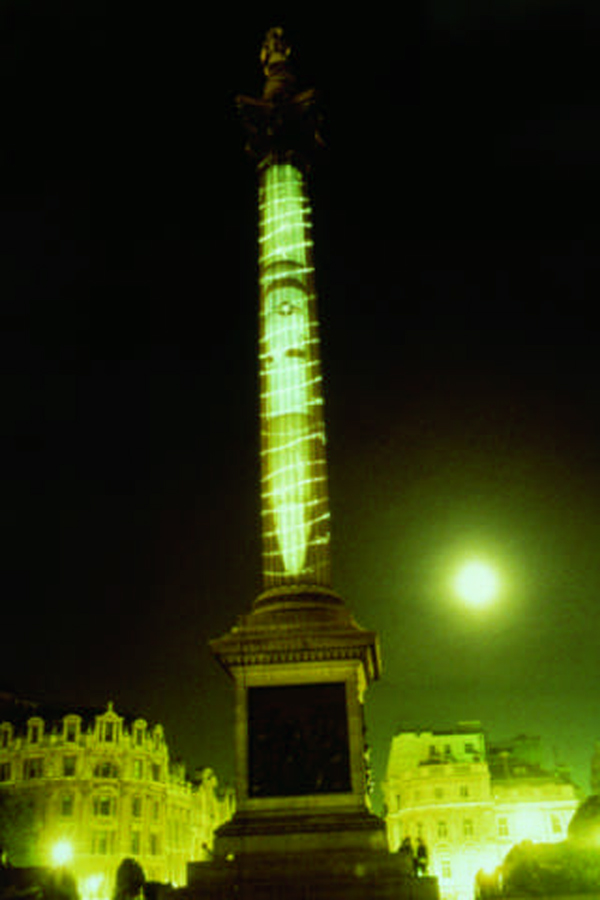
Krzysztof Wodiczko, City Projections – Nelson’s Column, 1985

Commissioned to make a projection onto Nelson’s Column in Trafalgar Sqaure for two nights in 1985, Krzysztof Wodiczko focused on the military aspects of the square and decided to project an image of a missile wrapped in barbed wire. But while in London for the event, Wodiczko realised that the square, as home of South Africa House, also played host to a longterm protest against the apartheid regime still very much in charge of South Africa and supported by then British Prime Minister, Margaret Thatcher.

Redirecting his projector, Wodiczko changed the image…

Continue reading

Selling a message

Barbara Kruger, Untitled (It’s a small world), 1990

If art reflects and comments on the world around us then it’s not surprising that it also has the potential to change minds. There are lots of artists whose work engages with political issues with the aim of helping bring about social change. And while I’m on a text theme it makes sense to think about some of those who use text directly to get their message across.

Barbara Kruger’s work draws on her own background in design and particularly in the magazine business. In her work, Kruger combines black and white photographs – often from magazines that promote the lifestyle she critiques – combined with text on a red ground. It’s a simple formula but it’s also a powerful one.

Continue reading

Through the trees

Peter Doig, Concrete Cabin, 1994Peter Doig, Concrete Cabin, 1994

Thinking about houses in the middle of nowhere for the previous post started me thinking about a couple of Peter Doig paintings and in particular what gives them a very different feeling to Michael Raedecker’s landscapes. The most obvious difference is in the time of day depicted; these are daytime scenes which makes for a very different feel. And they’re straightforward paintings, whereas part of the strangeness in Raedecker’s scenes comes from  the use of stitch in the paintings. But, of course, it’s more than that.

Continue reading

Street scenes

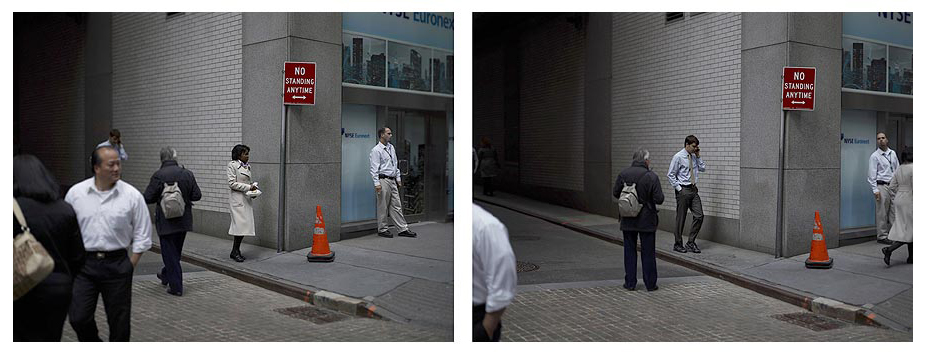
Paul Graham, Wall Street 19th April 2010, 12.46.55 pm, 2010

Though my preference is almost always for what might best be termed fine art practices, when it comes to Paul Graham’s work it’s generally been his documentary work that has interested me most and, though his work looks great in galleries, books like Beyond Caring and Troubled Land have moved me more. It’s not that I don’t like Graham’s later work – certainly I found a lot to like in his 2011 Whitechapel Gallery exhibition – it’s just that the books he produced in the 1980s seem exceptional. With this in mind, I approached his exhibition at The Pace Gallery as someone who needed to be won over.

Continue reading

Reimaginings

Dionisio González, Nova Ipiranga III, 2004

My knowledge of the favelas of Brazil is somewhat limited. I imagine them as shanty towns similar to those in other parts of the world with buildings made from whatever is available and built in a ramshackle way. From Dioinisio Gonzáles’s digitally manipulated photographs that looks to be a good guess. Sort of.

Continue reading

New York stories: pictures of Gotham

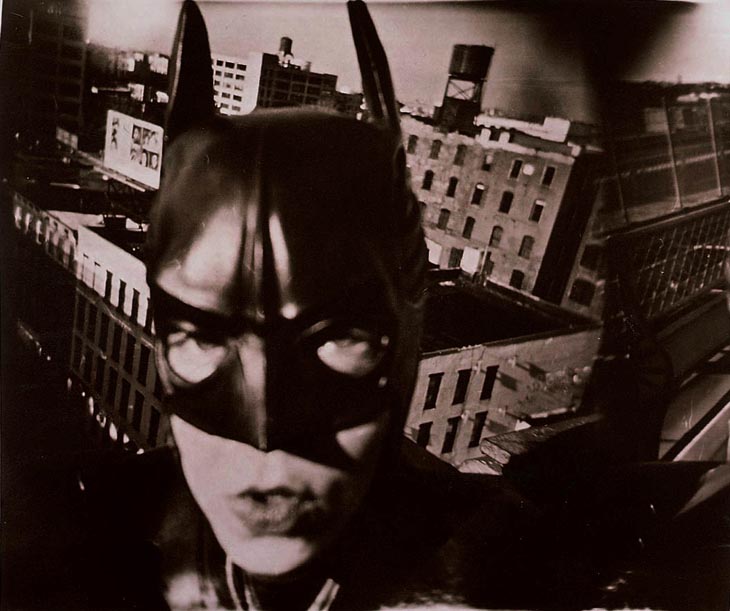
Katia Liebmann, Gotham City, 1997

One of the aspects I enjoy the most when visiting New York is the city’s familiarity from film and television. No matter how often I visit – not often enough and never for long enough – the connection with the movies won’t ever completely fade. New York has played itself and pretended to be other, often imaginary, places. It’s great backdrop after all. Katia Liebmann’s 1997 series Gotham City uses New York as a backdrop to a series of masked self-portraits.

Continue reading

New York stories: tales from the city

Nan Goldin, Nan One Month after Being Battered, 1984

Nan Goldin’s pictures from the late 1970s and 1980s provide a unique record of a slice of New York life at a time when hedonism was giving way to tragedy. The body of work she titled The Ballad of Sexual Dependency focuses on those who hung out around the Bowery where a hard-drug subculture met an emerging gay scene.

As a student in Boston, Goldin had shown her work in the form of Cibachrome colour prints; moving to New York she switched to showing work as slide shows often with a soundtrack and shown in clubs. The pictures were made using available light and most have a snapshot aesthetic. They document sexuality, drug use, domesticity and the sometimes violent relationships of Goldin and those she hung out with.

Continue reading