Small sculptural conundrums

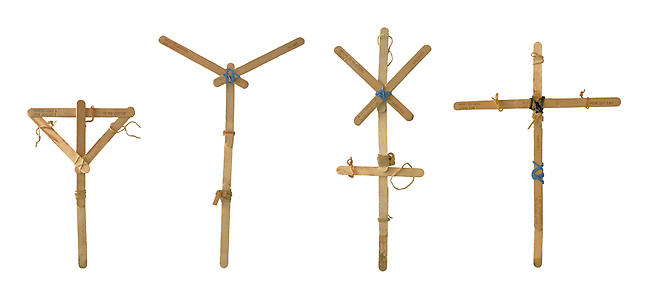
Marcus Coates, Crucifixes for Various Amphibians, 2000

It was flicking though a book at the Grizedale Arts installation at Frieze Art Fair that alerted me to the existence of Marcus Coates’s Crucifixes for Various Amphibians, a simple but intriguing work made of lolly sticks, elastic bands and paper clips. At a time of year when I often get students to make work from a limited range of basic materials – with lolly sticks a popular choice – this was a real find. I’m always happy to come across work that backs up my assertion that art can be made of anything but what makes this work especially pleasing is quite how much Coates has managed to say with a couple of dozen lolly sticks and a few elastic bands and paper clips.
Continue reading

Dust to dust

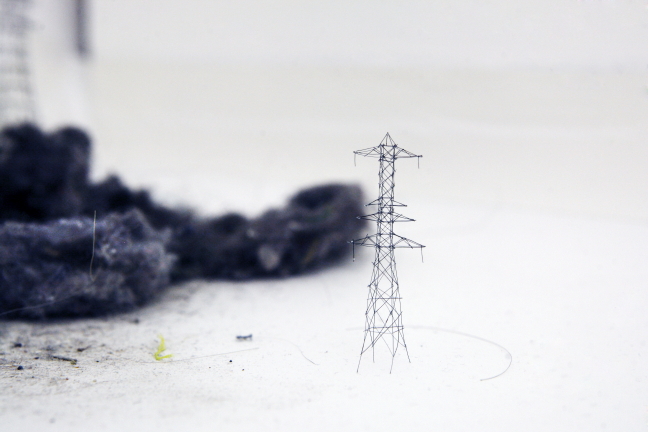
Takahiro Iwasaki, Out of Disorder, 2011; Cornerhouse Manchester (image: WeAreTape)

Takahiro Iwasaki, Out of Disorder (hair), 2011

It was a random conversation about the Cornerhouse in Manchester that reminded me about Takahiro Iwasaki’s work, which I saw there last year in the exhibition Constellations, and as some of it involves the use of hair this seems like as good a time to write about it as any what with hair being my preoccupation of the week. It was noticing that Constellations included the work of Katie Paterson and Felix Gonzalez-Torres that put it firmly on my list of things I needed to see during a very brief trip to Manchester last summer and though they didn’t disappoint, it was Iwasaki’s work that charmed me the most when I got there. Out of Disorder is a tiny, fragile world of constructions made of and emerging from the stuff of our daily lives. In some cases the stuff in question is dust and hair found in the space which become mountains and pylons.

Continue reading

Delicacy and disgust

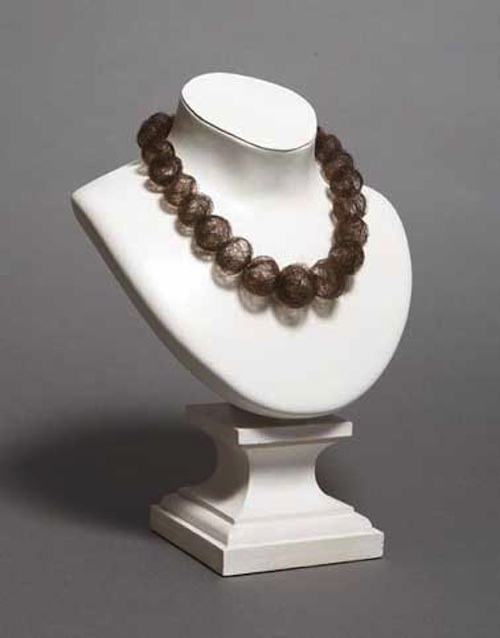
Mona Hatoum, Hair Necklace, 1995

At first glance, especially through the window of an expensive jewellery shop*, Mona Hatoum’s Hair Necklace might appear to be delicate beads made of spun metal thread. A closer look – or knowing the name of the piece – would immediately give the game away though and this delicately beautiful necklace would immediately become somewhat less appealing. A single string of beads as a necklace isn’t exactly unusual. And the idea of carrying a lock of a loved one’s hair in a necklace, specifically a locket, is hardly new. Combine the two ideas though and you get something rather less commonplace and much more interesting. Hatoum’s hairball beads are undeniably beautiful. There is an extraordinary filigree delicacy to them. Nonetheless, those odd stray ends disturb. And the realisation that this is hair – real hair – inevitably offsets the aesthetic appeal.

Continue reading

Night and day

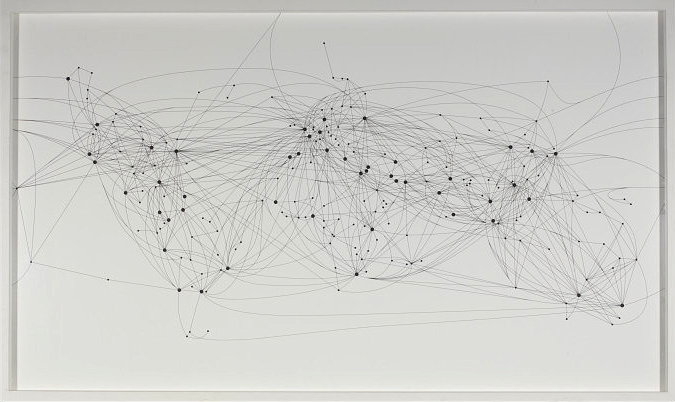
Langlands and Bell, Air Routes of the World (Day), 2001

Air travel baffles me a bit. I sort of get the physics of the thing (not really, that baffles me too, but I get that it works) and rationally I know that everything’s really tightly controlled and monitored but looking up at the vapour trails on a clear day or watching planes coming in to land at Heathrow what I really don’t get is how the planes avoid each other so consistently. In a way, I suppose the sky is bigger than it looks but even so… The vapour trails don’t lie: that’s some complex dance going on above us.

In the hands of Langlands and Bell, air routes become a map of the world that effectively talks of global communication rather than geography. Mapping the world – or a section of it – according to where planes fly shows which cities are of global importance but with a few oddities in the mix in the form of hub airports which countless people pass through en route to somewhere else.

Continue reading

Sailing nowhere

Yinka Shonibare, Nelson's Ship in a Bottle, 2010

Yinka Shonibare MBE, Nelson’s Ship in a Bottle, 2010

Vehicles? Mention of the fourth plinth? Those who have been paying attention could probably have predicted Yinka Shonibare’s Nelson’s Ship in a Bottle as the subject of my next post. And here it is. (Those now thinking the next one will be about Elmgreen and Dragset’s haven’t been paying attention quite long enough though; I’ve written about that already.) I’ve liked quite a few of the works commissioned for the fourth plinth – the plinth in the North West corner of Trafalgar Square in London originally intended to host some general or other on a horse, I think – but Sonibare’s is definitely one of the ones that I enjoyed the most. It’s the sort of work I couldn’t resist going to have another look at when I was nearby, the sort of work that unfailingly made me smile even on the greyest day.

Continue reading

Standing in memory

David Černý, Quo Vadis, 1990

Though David Černý’s work may at first seem to be all about the visual joke, his sculptures often do make a political point. Given the artist’s reluctance to talk about his work and what his intended meaning for it might be, it can require a bit of knowledge and/or research to get to the heart of the matter. For me a case in point is the sculpture Quo Vadis, a Trabant on legs, that I encountered quite by accident in Prague. (Had I done my research before visiting Prague I might have planned a walk through the city to find more of  Černý’s public sculptures; as it is, well, maybe I’ll get back there and follow the Černý sculpture trail at some point.) Anyway, while a bit lost, I ended up looking through a fence into the garden of the German Embassy, intrigued by the sight of a car on legs. That the car in question was a Trabant – a cheaply produced East German car, with a fibreglass body – was a clue.

Continue reading

Softly, softly

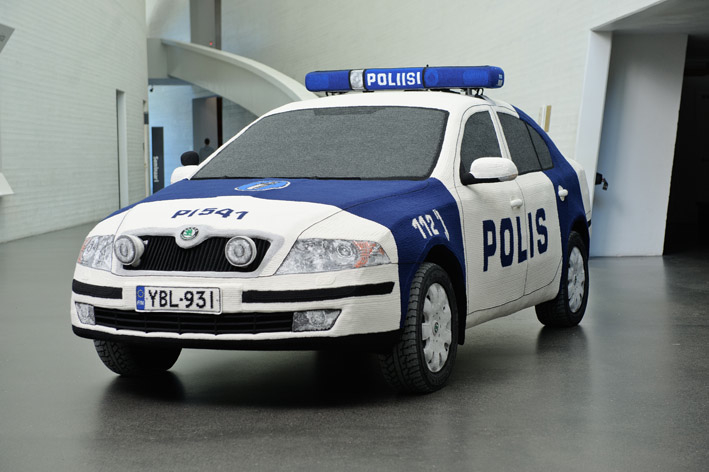
Kaija Papu, PI541, 2012

A police car is an unusual sight in an art gallery. Well, let’s face it, cars and indoors don’t really go together and though cars do feature in museums from time to time it’s still a little surprising to see one right there in the foyer but that’s the case at Kiasma in Helsinki at the moment. The police car in question is just by the cloakroom. There’s one of those museum ropes round it so it’s clearly art rather than the police answering a call somewhat over-zealously. Get a bit closer and it’s apparent that the police car is unusual in other ways too.  I’m not thinking of the fact that it’s a Skoda. That’s fair enough. But police cars are almost never knitted.

Continue reading

Exercise bus

David Černý, London Booster, 2012

Though not the first thing that’ll spring to mind when we look back at the summer of 2012, bus-based art has been a bit of a theme this year. Okay, that’s a slight exaggeration but I’ve seen two examples which is approximately two more than usual. While Richard Wilson’s Hang on a minute lads, I’ve got a great idea… played on our fondness for nostalgia by referencing a film that tends to be thought of with a smile, David Černý’s London Booster played to our fondness for proper London buses, albeit by suggestion rather than authenticity, since – bus pedant alert – London Booster is built around a Bristol Lodekka rather than a Routemaster (I’d like it known that I’m not enough of a bus geek to have know that without the aid of Google; all I knew was that the bus wasn’t an RM).

Continue reading

A bumpy ride

Richard Wilson, Hang On A Minute Lads, I’ve Got A Great Idea…, 2012

As a starting point for sculpture, the last line of The Italian Job might not seem like an obvious, sensible or even remotely workable choice but then Richard Wilson isn’t an artist to let a little thing like impracticality get in the way of a good idea. So, how better to join in the flag-waving of this summer than by balancing a replica of a red, white and blue coach over the edge of the roof of an iconic seaside building? Having written about this summer’s bus-based art a while ago for MostlyFilm, I hadn’t intended to post about this here but a spate of transport related posts have brought it back to mind and you can never have too much sunny, smile-inducing art. Well, you probably can, but let’s plough on regardless.

Continue reading

Expanded sculpture

Sebastian Errazuriz, Complete (Duchamp Series), 2005

If Duchamp’s readymades changed art, and it seems pretty clear that they did, it’s not surprising that artists still return not only to the idea of the readymade but also to Duchamp’s own work. Sebastian Errazuriz’s Complete (Duchamp Series) goes beyond Duchamp’s Bicycle Wheel to provide a more complete, though still fragmented, bicycle assemblage. The familiar bicycle wheel upturned and attached to a white painted stool is here. But here it’s accompanied by a second wheel, plus the handlebars and pedals.

Continue reading