Everyday art

Jeremy Deller, Open Bedroom, 1993 (reconstruction)

Like David Shrigley, Jeremy Deller is an artist whose work doesnt always fit easily into the gallery space. Unlike Shrigley though, when his work is brought together as an exhibiton it exceeds expectations. Joy in People at the Hayward Gallery is a show that is much more than the sum of its parts. And there are some pretty great parts.

In 1993, while others were holding open studios, Deller staged Open Bedroom, his first exhibition, in his parents’ house while they were on holiday. The work, his teenage bedroom presented as art, is reconstructed here as the route into both the show and the head of the artist. We get to open drawers and cupboards and explore the ideas, images and objects that fascinated the young Deller. It’s a great start and a useful grounding for a show that picks up these enthusiasms and makes them art.
Continue reading

A stitch in time

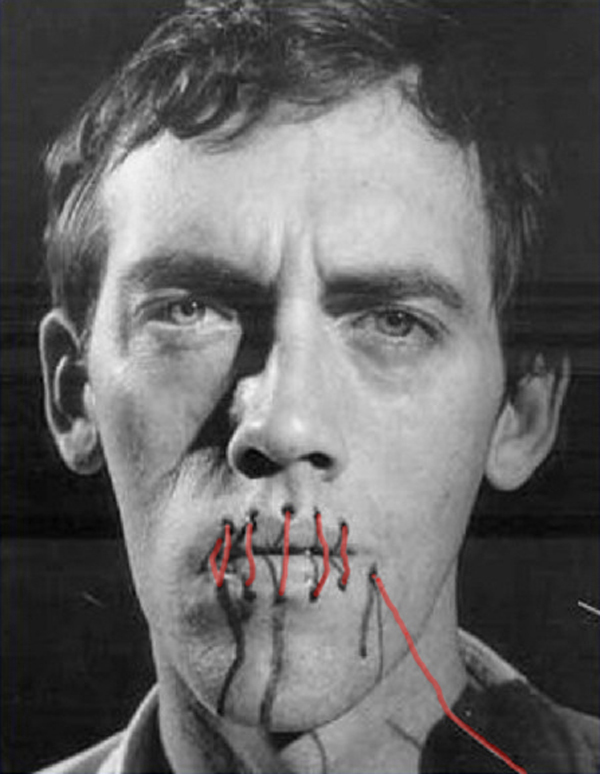
David Wojnarowicz, image from A Fire in My Belly, 1989

David Wojnarowicz is one of those artists. I find his work really interesting and immensely powerful but I haven’t seen very much of it in real life. One day I hope to get the chance to rectify that but in the meanwhile I’ll carry on looking at his work in reproduction. I like his approach to putting images – and often text – together in collages, prints and paintings but it’s his film work that interests me most, in part because it’s here that everything comes together.

And in terms of this blog and the way I let my attention move from one artist to the next by following the most literal of connections – I’m all about the unashamedly clunky segue after all – the use of read thread in his film A Fire in My Belly is more than a little convenient.

Continue reading

A breed apart

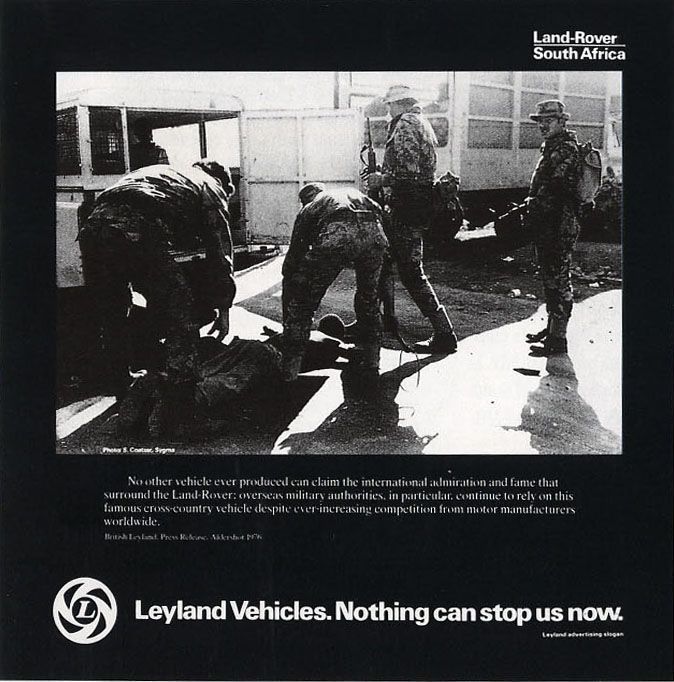
Hans Haacke, from the series A Breed Apart, 1978

Although this work has been in the back of my mind for a while, it isn’t the Hans Haacke piece I expected to write about first but somehow it seems like an appropriate way to follow on from Krzysztof Wodiczko‘s projection onto South Africa House and earlier posts about art, text and advertising.

Hans Haacke’s work most often critiques the power relationships within the art world – specifically the symbiotic relationship between museums and their corporate sponsors – but wider issues around institutional systems and corporate responsibility are also regularly subject to his critical gaze. Haacke’s commitment to exposing corruption and other dubious corporate practices is absolute and as a result his work is uncompromising even though he operates from within the art world he seeks to demystify.

Continue reading

Projections of power

Krzysztof Wodiczko, City Projections – Nelson’s Column, 1985

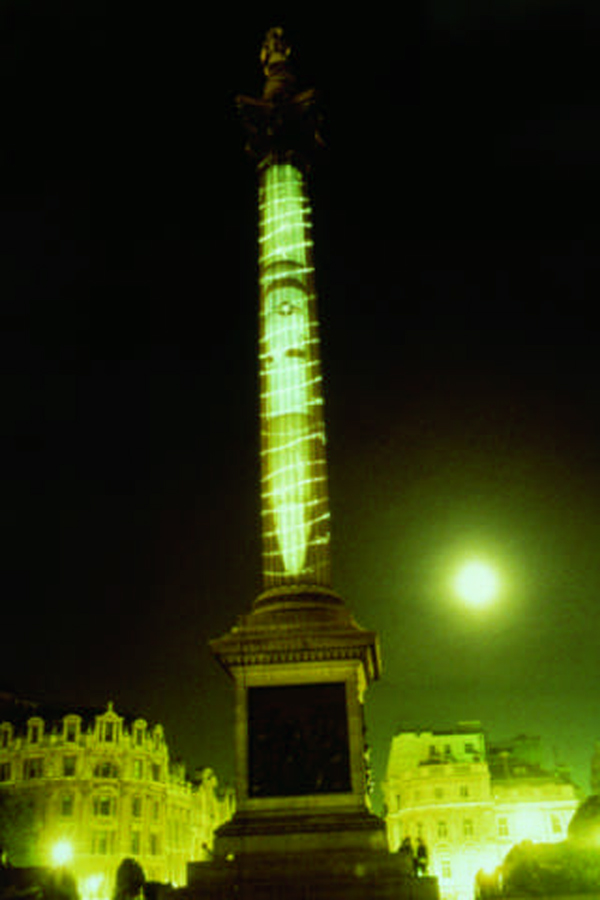
Commissioned to make a projection onto Nelson’s Column in Trafalgar Sqaure for two nights in 1985, Krzysztof Wodiczko focused on the military aspects of the square and decided to project an image of a missile wrapped in barbed wire. But while in London for the event, Wodiczko realised that the square, as home of South Africa House, also played host to a longterm protest against the apartheid regime still very much in charge of South Africa and supported by then British Prime Minister, Margaret Thatcher.

Redirecting his projector, Wodiczko changed the image…

Continue reading

Selling a message

Barbara Kruger, Untitled (It’s a small world), 1990

If art reflects and comments on the world around us then it’s not surprising that it also has the potential to change minds. There are lots of artists whose work engages with political issues with the aim of helping bring about social change. And while I’m on a text theme it makes sense to think about some of those who use text directly to get their message across.

Barbara Kruger’s work draws on her own background in design and particularly in the magazine business. In her work, Kruger combines black and white photographs – often from magazines that promote the lifestyle she critiques – combined with text on a red ground. It’s a simple formula but it’s also a powerful one.

Continue reading

Women’s things

Guerrilla Girls, Do women have to be naked…?, 1989

As today is International Women’s Day, it seems like the right time to take a look at women’s place in the art world. It’s the twenty-first century, there are lots of women artists now, right? Well yes. Up to a point. Tacita Dean’s work is in the Turbine Hall of Tate Modern at the moment and the big exhibition is of the work of Yayoi Kusama. Perhaps all’s right with the world? Clearly, it wasn’t ever thus.

In 1989 the Guerrilla Girls, an anonymous group of women artists and the self-styled ‘conscience of the art world’, conducted an audit of the work on display on the Modern Art sections of the Metropolitan Museum in New York. The statistics really weren’t good. Only 5% of the artists were female but 85% of the nudes were. No matter how familiar we are with art history and the dominance of male artists, that’s still a pretty shocking figure, especially since the group had specifically restricted their attention to the modern art sections where things might be expected to be a bit less bad. Surely by now things have changed?

Continue reading

Laughter and pain

Adel Abdessemed, Mémoire (still), 2012

I should have known from the start that there would be more to Adel Abdessemed’s Mémoire than was apparent at first glance. After all, his work is never quite as it seems and there is almost always a degree of violence and pain somewhere in the work. But watching Mémoire, my first response was laughter. This was a baboon spelling words out on an magnetic whiteboard. Maybe if I watched long enough it would start writing Shakespeare. Isn’t that what monkeys are meant to do given time?

Continue reading

Hairy story

Ellen Gallagher, DeLuxe, 2004-5

Significant highlights of my visit to MoMA were the connected exhibitions Print/Out and Printin’ that look at the way print is used in contemporary art. The latter, organised by artist Ellen Gallagher and Sarah Suzuki, Associate Curator in MoMa’s Department of Prints and Illustrated Books, is centred around Gallagher’s DeLuxe a grid of 60 frames each containing a collaged print based on adverts found in mid-twentieth century black lifestyle magazines and newspaper articles. DeLuxe is an extraordinary, fascinating work that demands, and rewards, close scrutiny. I am fascinated both by the adverts Gallgher has found and by her use materials – particularly plasticine  – in the collages.

Continue reading

Using the system to challenge the system

Cildo Meireles, Insertions into Ideological Circuits, 1970

Fundamental to my view of art is the idea that it can come from anywhere and be made of anything and for me a great example of that is the work made by the Brazilian artist Cildo Meireles in the early 1970s, specifically his Insertions into Ideologoical Circuits an example of which is shown here.

For this work, Meireles used the return and refill system operated at that time for soda bottles. Meireles would doctor Coca Cola bottles, adding messages that were all but invisible on the empty bottle but which appeared when the bottle was filled with the conveniently dark liquid. The bottles would them be returned into the system, refilled with coke and distributed to shops.

Continue reading

Representing the real

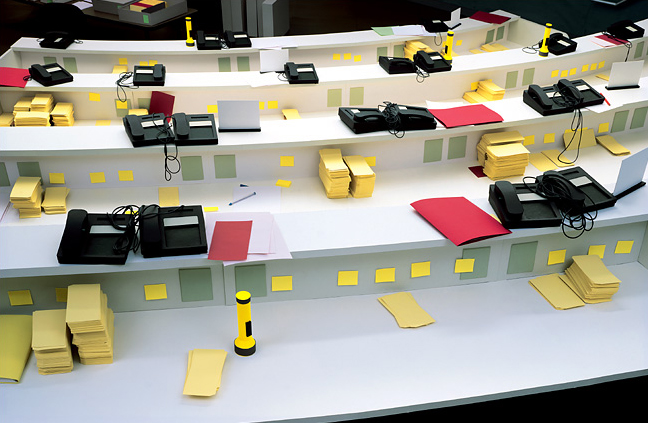
Thomas Demand, Poll, 2001

There are many ways to make a photograph. In photographic terms, Thomas Demand’s approach is very simple. The camera records the scene in as straightforward a manner as it can. But there is something odd – uncanny, perhaps – about the scene; all is not as it seems.

Continue reading