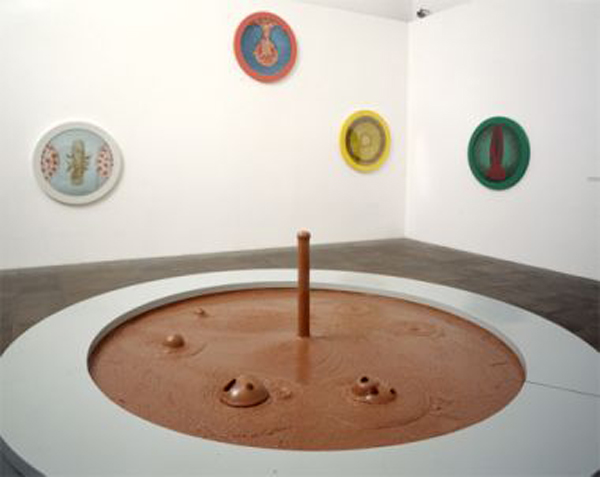
I guess I’m still thinking about chocolate – it is still Easter after all – but yesterday’s post also left the desire/disgust dichotomy firmly in my mind too so today’s post being about Helen Chadwich’s work might easily have been predicted. And where better to start than with Cacao, Chadwick’s 1994 chocolate fountain. At first sight the work looks like a mud bath of some sort and the spluttering as air bubbles through certainly sounds a lot like the bubbling mud of a hot spring. But things aren’t quite that simple. Firstly there’s the central column to consider: it’s hardly reminiscent of a decorative fountain with water falling prettily, indeed it appears deliberately and somewhat comically phallic. But it’s not really the way the work looks and sounds that I remember most vividly – though both are clear in my mind – it’s the heady smell of chocolate that fills the space. So much chocolate and none of it for eating! Ultimately then, this is a work that looks and sounds slightly unpleasant and has a smell that quickly becomes cloying, and yet I’ve always wanted to stay with it longer than is strictly necessary.
Category Archives: Photography
Body parts
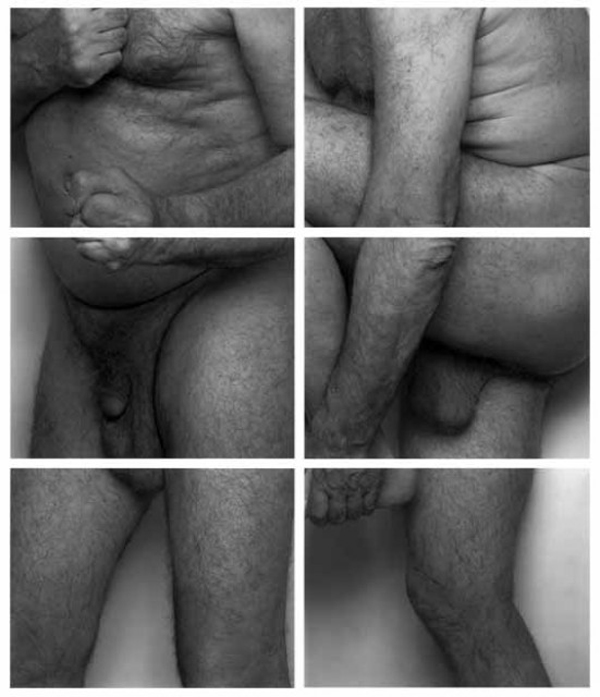
John Coplans, Frieze, No.8, 2002
Thinking about the fragmented body in Gary Hill‘s Inasmuch As It Is Always Already Taking Place made me think about the self portraiture of John Coplans who repeatedly photographed his own – aging – body for (almost) the last two decades of his life. Several things interest me about Coplans’s work. Firstly, there’s the way they don’t conform to expectations of the nude in art. As the Guerrilla Girls have established, the nude is generally female and in an increasingly youth-centred culture the ageing body isn’t often the subject of attention. Here the focus is on the ordinary.
A stitch in time
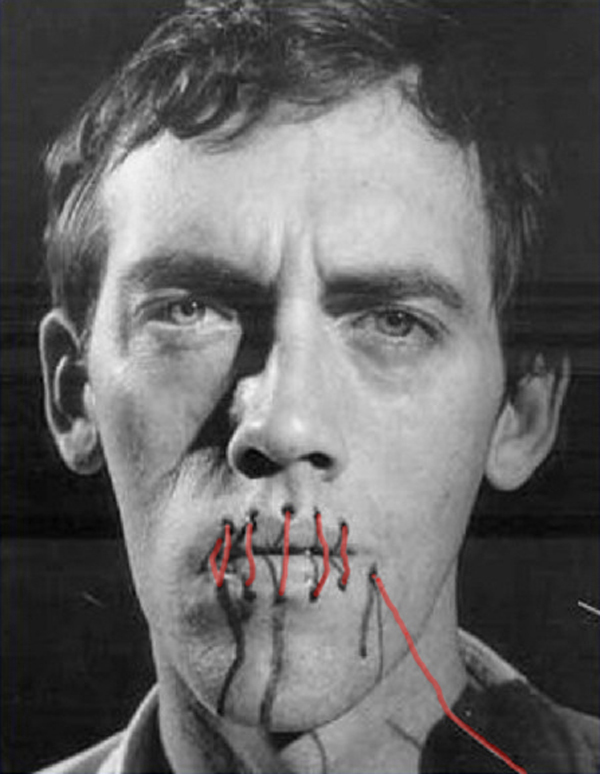
David Wojnarowicz, image from A Fire in My Belly, 1989
David Wojnarowicz is one of those artists. I find his work really interesting and immensely powerful but I haven’t seen very much of it in real life. One day I hope to get the chance to rectify that but in the meanwhile I’ll carry on looking at his work in reproduction. I like his approach to putting images – and often text – together in collages, prints and paintings but it’s his film work that interests me most, in part because it’s here that everything comes together.
And in terms of this blog and the way I let my attention move from one artist to the next by following the most literal of connections – I’m all about the unashamedly clunky segue after all – the use of read thread in his film A Fire in My Belly is more than a little convenient.
Webs of deceit
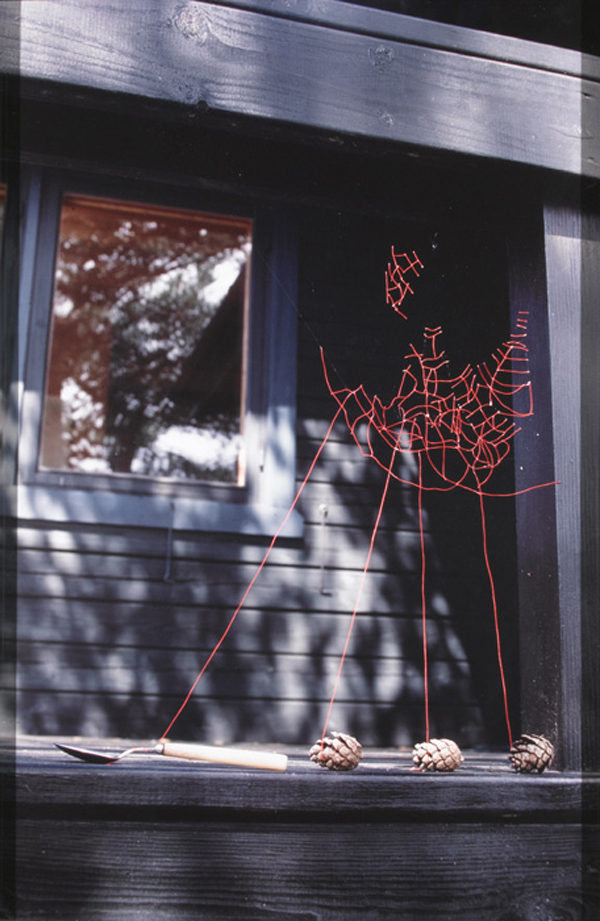
Nina Katchadourian, Mended Spiderweb #14 (Spoon Patch), 1998
I confess to not much liking spiders. If they stayed outdoors I’d feel a lot more benevolent towards them, but when they come inside and scurry about like they own the place they make me distinctly edgy. But even I acknowledge that they do make very beautiful webs. In her Mended Spiderweb series – part of a large body of work called Uninvited collaborations with nature – Nina Katchadourian has helped out by patching up damaged spiders’ webs with fine red thread. The results are not only very beautiful, they are also unexpectedly interesting.
Art on acid
Painting with hydrochloric acid on nylon, 1961
There are lots of ways to paint, as a quick wander through any major art museum will amply demonstrate. But there are those who change out understanding of art through their work, and Gustav Metzger is one such. Metzger’s notion of auto-destructive art, which he initially defined in 1959, was an interesting and highly-influential on which was rooted in the belief that Western society was failing (Metzger has been a Marxist all his adult life). The idea is that the work has the capacity to destroy itself or that it is destroyed by the actions of its creator.
Gustav Metzger: Auto-Destructive Art (1959)
Auto-destructive art is primarily a form of public art for industrial societies.
Self-destructive painting, sculpture and construction is a total unity of idea, site, form, colour, method, and timing of the disintegrative process.
Auto-destructive art can be created with natural forces, traditional art techniques and technological techniques.
The amplified sound of the auto-destructive process can be an element of the total conception.
The artist may collaborate with scientists, engineers.
Self-destructive art can be machine produced and factory assembled.
Auto-destructive paintings, sculptures and constructions have a life time varying from a few moments to twenty years. When the disintegrative process is complete the work is to be removed from the site and scrapped.
A breed apart
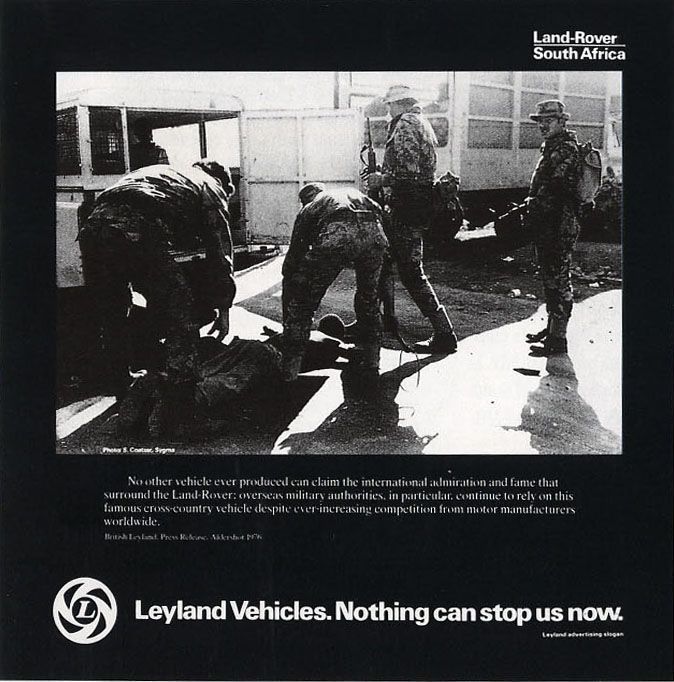
Hans Haacke, from the series A Breed Apart, 1978
Although this work has been in the back of my mind for a while, it isn’t the Hans Haacke piece I expected to write about first but somehow it seems like an appropriate way to follow on from Krzysztof Wodiczko‘s projection onto South Africa House and earlier posts about art, text and advertising.
Hans Haacke’s work most often critiques the power relationships within the art world – specifically the symbiotic relationship between museums and their corporate sponsors – but wider issues around institutional systems and corporate responsibility are also regularly subject to his critical gaze. Haacke’s commitment to exposing corruption and other dubious corporate practices is absolute and as a result his work is uncompromising even though he operates from within the art world he seeks to demystify.
Projections of power
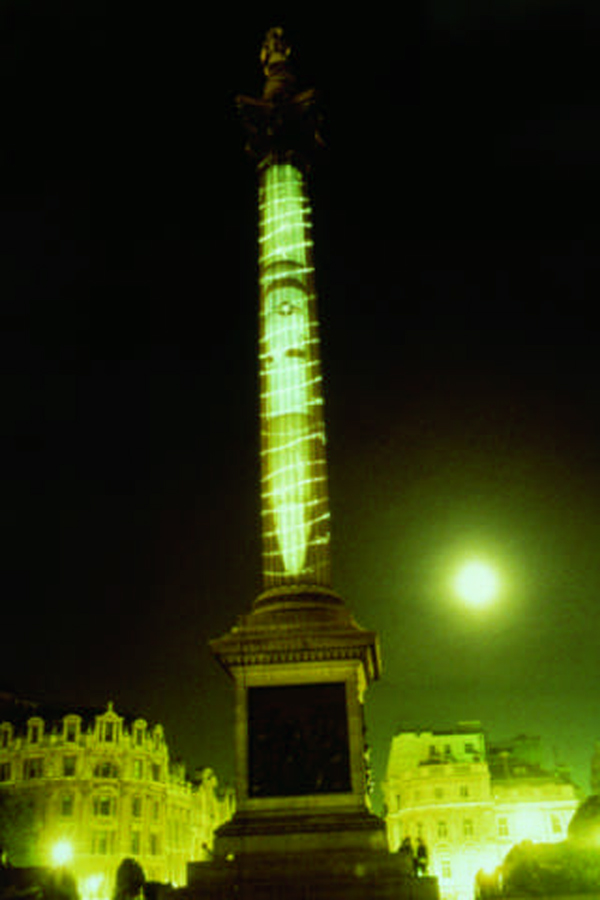
Krzysztof Wodiczko, City Projections – Nelson’s Column, 1985
Commissioned to make a projection onto Nelson’s Column in Trafalgar Sqaure for two nights in 1985, Krzysztof Wodiczko focused on the military aspects of the square and decided to project an image of a missile wrapped in barbed wire. But while in London for the event, Wodiczko realised that the square, as home of South Africa House, also played host to a longterm protest against the apartheid regime still very much in charge of South Africa and supported by then British Prime Minister, Margaret Thatcher.
Redirecting his projector, Wodiczko changed the image…
Selling a message
Barbara Kruger, Untitled (It’s a small world), 1990
If art reflects and comments on the world around us then it’s not surprising that it also has the potential to change minds. There are lots of artists whose work engages with political issues with the aim of helping bring about social change. And while I’m on a text theme it makes sense to think about some of those who use text directly to get their message across.
Barbara Kruger’s work draws on her own background in design and particularly in the magazine business. In her work, Kruger combines black and white photographs – often from magazines that promote the lifestyle she critiques – combined with text on a red ground. It’s a simple formula but it’s also a powerful one.
Through the trees
Peter Doig, Concrete Cabin, 1994
Thinking about houses in the middle of nowhere for the previous post started me thinking about a couple of Peter Doig paintings and in particular what gives them a very different feeling to Michael Raedecker’s landscapes. The most obvious difference is in the time of day depicted; these are daytime scenes which makes for a very different feel. And they’re straightforward paintings, whereas part of the strangeness in Raedecker’s scenes comes from the use of stitch in the paintings. But, of course, it’s more than that.
Like a sex machine
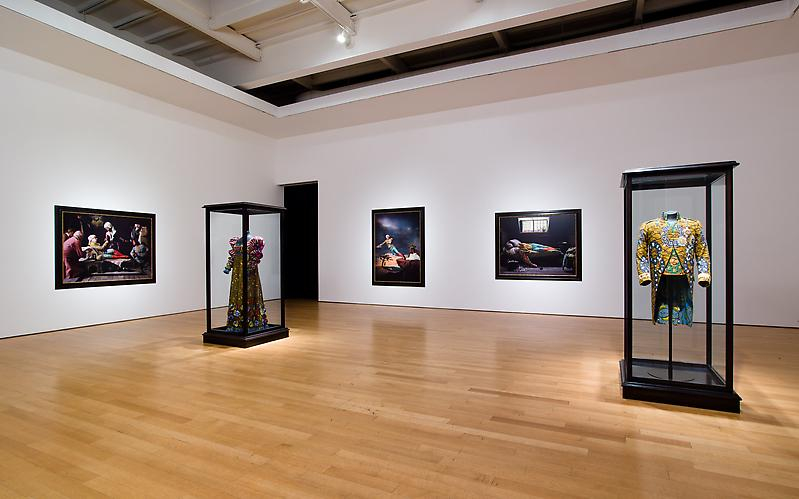
Yinka Shonibare MBE, Addio del Passato at James Cohan Gallery
The key characteristic of Yinka Shonibare’s work is his use of Dutch wax fabric. Based on Indonesian batik fabrics but manufactured in Europe by the Dutch, who then exported it to West Africa when it failed to catch on in the Netherlands, and bought by Shonibare from Brixton market in London, the fabric has connotations of colonialism, post-colonialism and the movement of cultures thereby engendered and of the multi-culturalism of contemporary London. Thus it neatly connects the different aspects Shonibare’s own background as a British-born, Nigerian-raised Londoner and has allowed him to build a practice that is simultaneously coherent and diverse and both serious and playful. These complexities and contradictions are reinforced by Shonibare’s adoption of the letters MBE after his name when he was given the honour in 2005: an artist whose work could be seen as commenting on empire accepted and uses an honour that makes him a Member of the Most Excellent Order of the British Empire.
It’s not surprising then the work in Shonibare’s exhibition Addio del Passato at James Cohan Gallery is by turns beautiful and fascinating and very, very funny. Equally unsurprising perhaps is that the work I especially want to write about is all of these things. And also really rather rude…