Time and tide

Low Tide Wanderings installationThomas Schütte, Low Tide Wanderings, 2001 (installed in Print/Out at MoMA, 2011)

In 2001, with digital practices becoming increasingly widespread in the visual arts, Thomas Schütte decided to use very traditional, analogue image-making as a way of keeping a visual diary. Rather than drawing in sketchbooks, as he usually would, Schütte adopted the more labour-intensive approach of etching. He subsequently produced an edition of 139 prints, one of which is included in the Print/Off at MoMA.

Reading someone else’s diary, a decade after the event, isn’t necessarily that interesting and in part the fascination of this work lies in the installation rather than the images. The prints are suspended on lines criss-crossed through the gallery just above head height (if, like me, you’re quite short).

Continue reading

Laughter and pain

Adel Abdessemed, Mémoire (still), 2012

I should have known from the start that there would be more to Adel Abdessemed’s Mémoire than was apparent at first glance. After all, his work is never quite as it seems and there is almost always a degree of violence and pain somewhere in the work. But watching Mémoire, my first response was laughter. This was a baboon spelling words out on an magnetic whiteboard. Maybe if I watched long enough it would start writing Shakespeare. Isn’t that what monkeys are meant to do given time?

Continue reading

Nothing to see here

Robert Rauschenberg, White Painting (Three Panel), 1951

After yesterday’s pile of shit, today is perhaps a day for a bit of breathing space: art with nothing to look at. It stands to reason: if there’s nothing to see, there’s nothing to get squeamish about.

Continue reading

Drawing and the process of looking

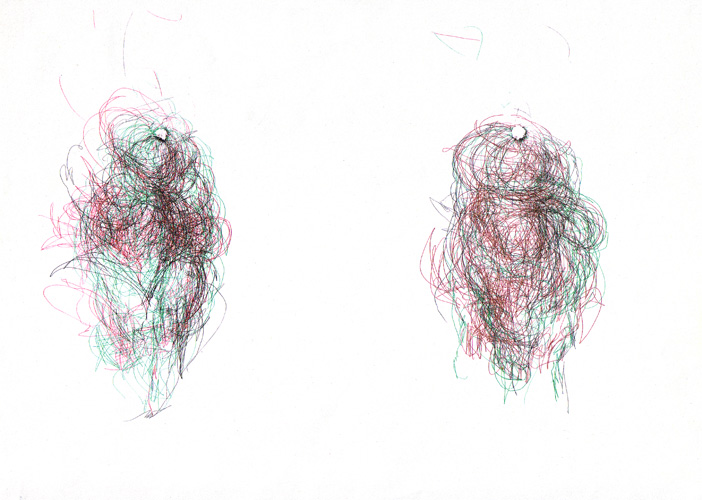
Claude Heath, Venus of Willendorf (detail), 1995

Drawing and looking are inextricably linked but just as there is more than one way to draw there is more that one way to look. If the aim is to get as close as possible to recording what something looks like, a camera will generally do a better job but drawing can bring something extra to the equation. It might be about making a representation that’s more expressive, or one that offers multiple viewpoints simultaneously or a version of how something feels for instance.

Continue reading