Unknown's avatar

About Ann Jones

London-based artist and educator who somehow seldom gets time to actually make any work, who writes about art, somewhat irregularly, at ImageObjectText.com and occasionally contributes to MostlyFilm.com – writing about art, mostly.

All the fun of the fair

Frieze Art Fair, London – October 2012, Regent's Park

Frieze Art Fair, London

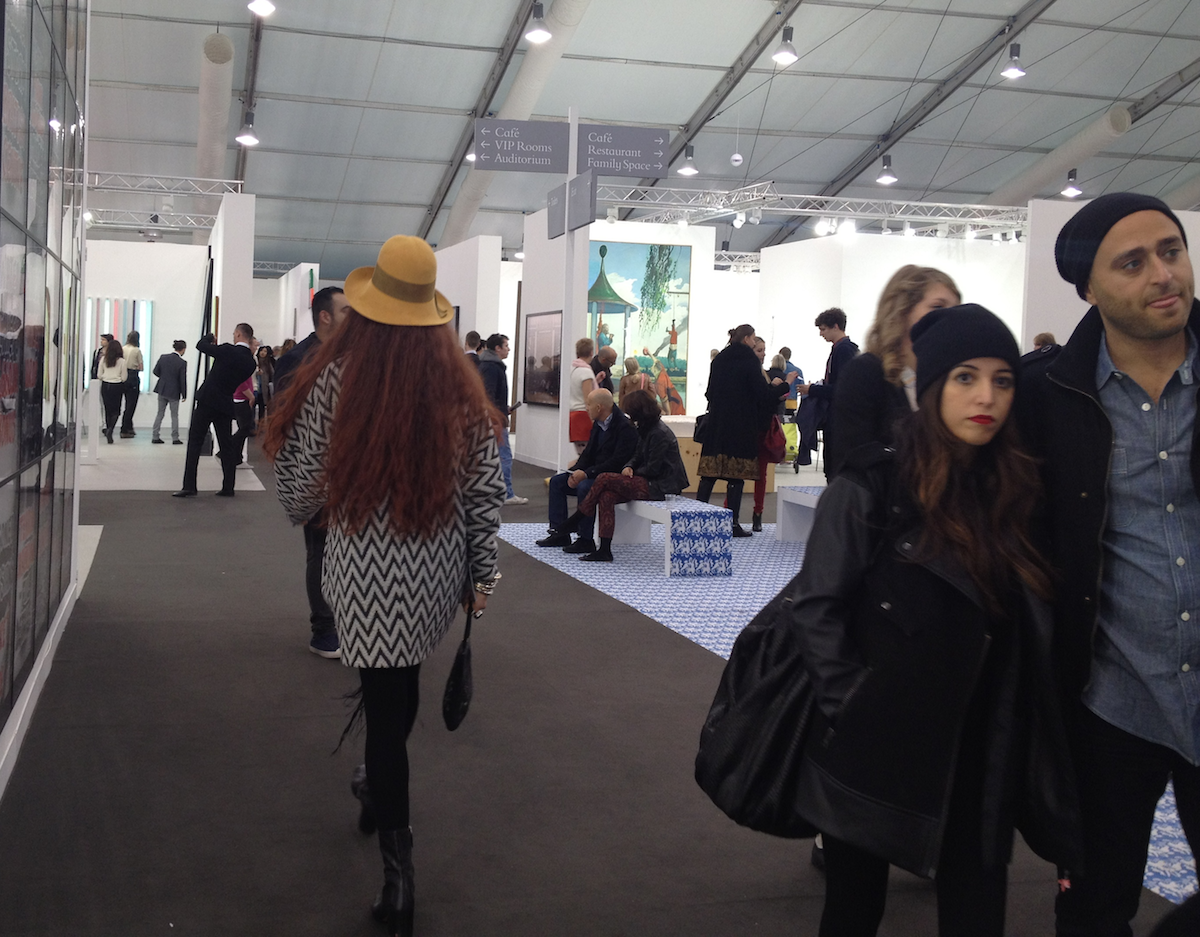
Art fairs are exhausting. There’s no avoiding the fact that gathering that much art in one place is never going to lead to an especially relaxed viewing experience. But then that’s also what makes art fairs a great chance to see a lot of art in a short space of time. So, in an optimistic frame of mind and my most sensible shoes I headed to Frieze Art Fair in Regent’s Park. As if one art fair wasn’t enough, this year Frieze has grown a second space and a new entity, Frieze Masters, for art made before the year 2,000. In the interests of keeping art overload to reasonable levels I find I need to take things a day, and a fair, at a time, so Frieze Masters will have to wait. As it happens, so will the sculpture garden. Somehow, despite good intentions, once I get in the tent that houses Frieze, I seem unable to leave until required to do so at the end of the day. Having seen more art in a day than I normally would in a month – and by any standards, I see a lot of art – still I leave with the feeling that I have barely scratched the surface.
Continue reading

Lift music

Lift arriving at Level 2

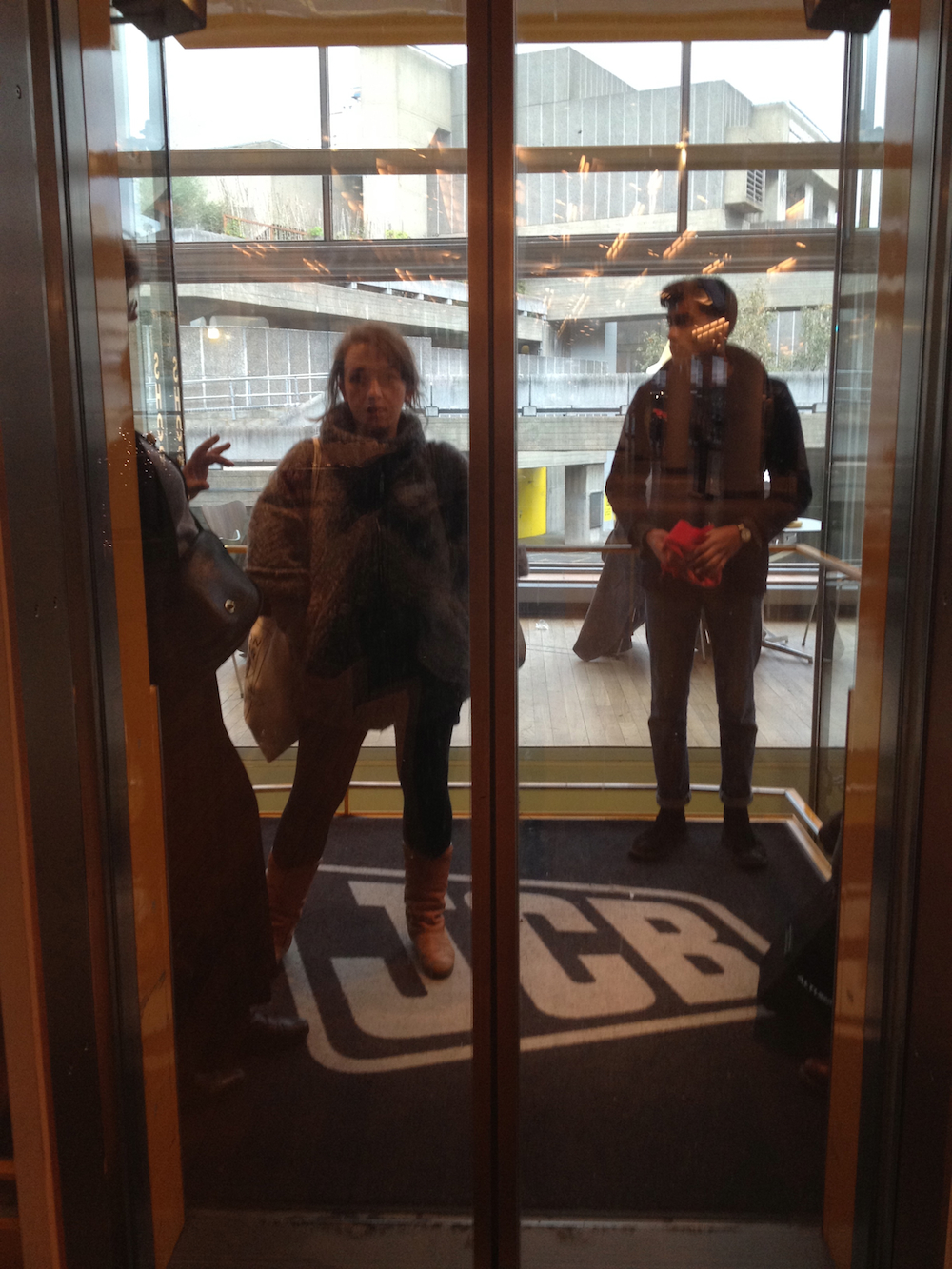
The lift in the Royal Festival Hall is my favourite lift by a country mile and though in all respects it’s a perfectly nice, if a little ordinary, lift, it’s not about the lift’s appearance or the views of the Southbank afforded by a journey in it, good though those are. No, this lift contains art.

Continue reading

In painful pursuit of beauty

Marina Abramovic, Art Must be Beautiful, 1975

Marina Abramović, Art Must Be Beautiful, 1975

The female nude is an all too familiar figure in the history of Western art. There is a lot that is troubling about representations of the female form in art and the notion of beauty as an essential facet of art. Seen in the context of this, Marina Abramović’s Art Must Be Beautiful is an intriguing work. Abramović is seen brushing and combing her hair, repeatedly and with an intensity that makes the performance – or the video documentation of it – really hard to watch at times. Abramović accompanies the often violent hair brushing with a mantra ‘art must be beautiful, artist must be beautiful’. The notion that art must – or at least, should – be beautiful remains a quite widely held belief albeit one that has been widely challenged over the last hundred and fifty years or so.

Continue reading

Obvious entrapment

Chiharu Shiota, After the Dream, 2009

The idea of entrapment in a web is one it’s hard to explore without establishing more than a passing relationship with cliché. Though Alice Anderson’s anarchic loop of tangled dolls’ hair won me round – mainly by its refusal to stay contained within the gallery – sadly Chiharu Shiota’s After the Dream just doesn’t quite do it for me. Though I like the way Shiota uses thread to confuse my understanding of the space, I’m less taken with the entrapment of the white dresses within the web of thread. There is, arguably, the suggestion of spectral figures but really the reference of wedding dresses trapped within a web that might surprise even Miss Havisham seems that bit too obvious.

Continue reading

A tangled web

Alice Anderson, Time Reversal, 2010

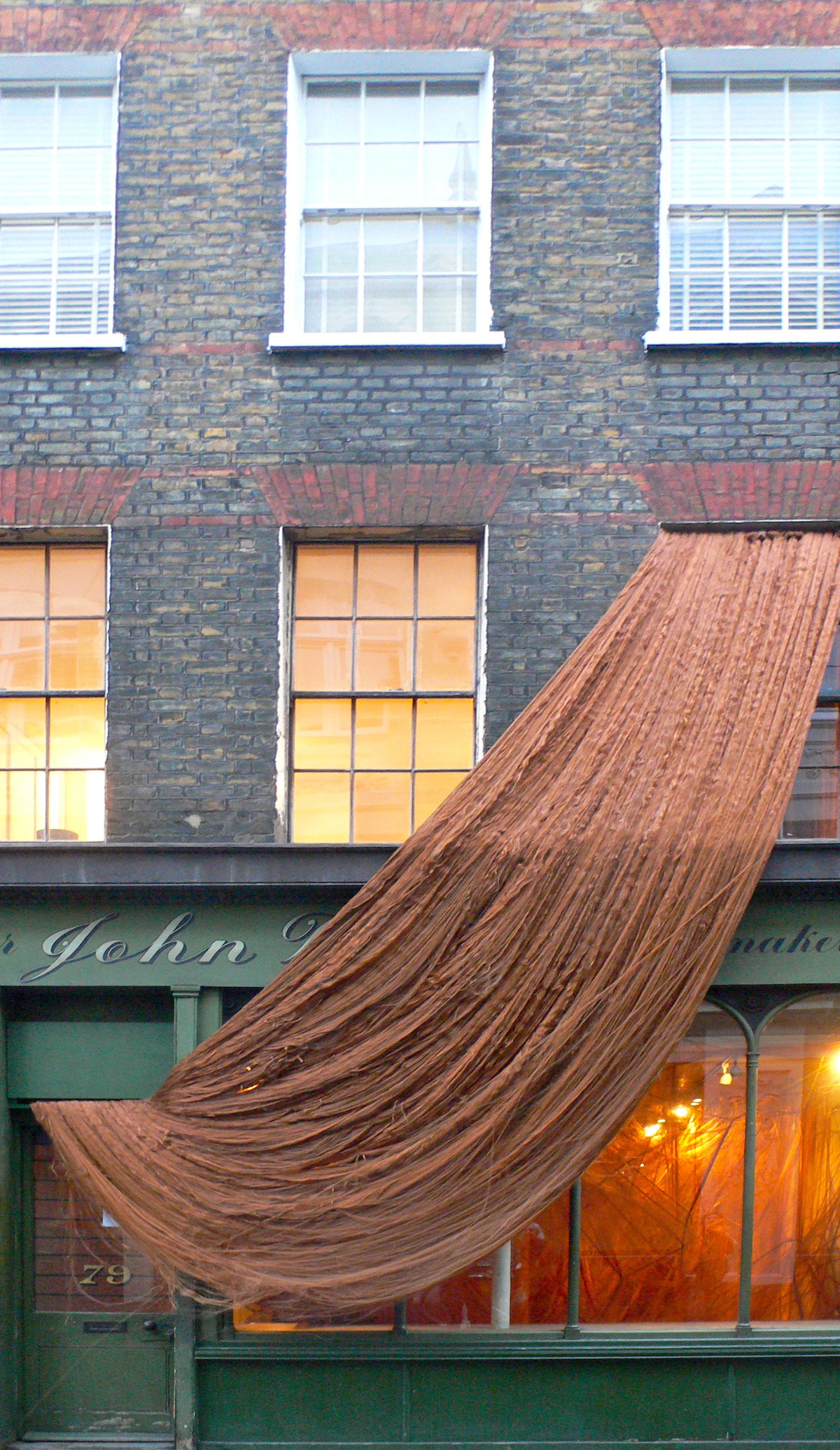
Galleries don’t usually have fringes. It’s not a hard and fast rule, of course, but in practice they seldom have much hair at all and if they do it’s usually just on the inside. During Alice Anderson’s exhibition Time Reversal in 2010, Riflemaker in Soho (the London one, that h isn’t lowercase by accident) was something of an exception in that respect. But then exception seems to be what Riflemaker does best (if only because the building is distinctly more rickety than the average West End gallery space).

The centrepiece of Anderson’s exhibition was an installation made from hair – okay, doll’s hair; real hair really doesn’t grow quite this long – that one saw first from the street when approaching the gallery. The hair seemed to go on forever. It hangs down from an upstairs window, forming a fringe that partially covers the door; looping back up it nips back in to the gallery above the door. And that’s just what could be seen from outside…

Continue reading

Dust to dust

Takahiro Iwasaki, Out of Disorder, 2011; Cornerhouse Manchester (image: WeAreTape)

Takahiro Iwasaki, Out of Disorder (hair), 2011

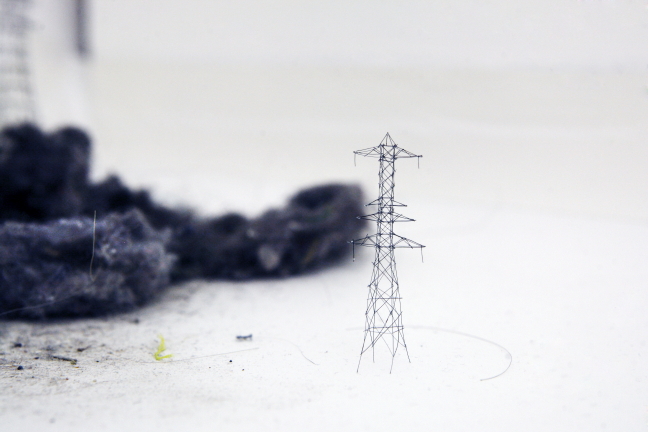
It was a random conversation about the Cornerhouse in Manchester that reminded me about Takahiro Iwasaki’s work, which I saw there last year in the exhibition Constellations, and as some of it involves the use of hair this seems like as good a time to write about it as any what with hair being my preoccupation of the week. It was noticing that Constellations included the work of Katie Paterson and Felix Gonzalez-Torres that put it firmly on my list of things I needed to see during a very brief trip to Manchester last summer and though they didn’t disappoint, it was Iwasaki’s work that charmed me the most when I got there. Out of Disorder is a tiny, fragile world of constructions made of and emerging from the stuff of our daily lives. In some cases the stuff in question is dust and hair found in the space which become mountains and pylons.

Continue reading

Hairy tales

Kiki Smith, Untitled (Hair), 1990

Though the degree to which hair can disgust is undoubtedly lessened by being mediated through photography or print, it nonetheless has a certain hold for me at least. I think it’s the connection with fairy tales and a sense that it’s in some way magical. I know nothing of spells at all apart from the opening lines of Macbeth but there’s hair right there, as far as I recall, so my mind makes that connection whether or not it would be borne out by, you know, actually looking stuff up. And of course, hair can stand in for the body. And in this lithograph by Kiki Smith, I think I’d argue that it stands in for both the artist and the process of recording in that the hair becomes a kind of drawing. Indeed, in this image the hair is Smith’s; the print is one of a folio of work in which Smith used imprints and photocopies of parts of her hair, face and neck as the basis for making prints.

Continue reading

Delicacy and disgust

Mona Hatoum, Hair Necklace, 1995

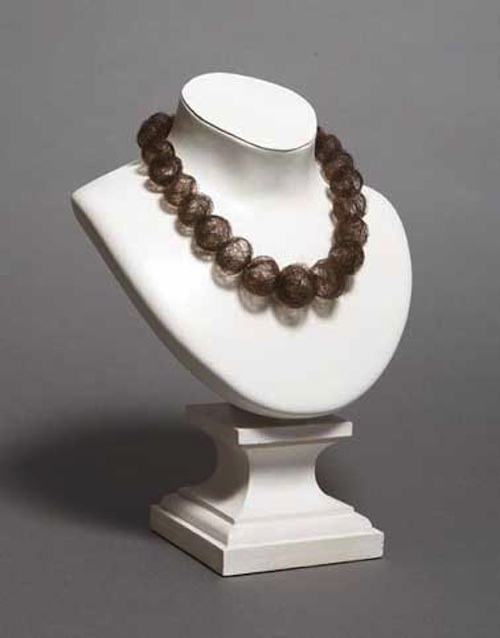
At first glance, especially through the window of an expensive jewellery shop*, Mona Hatoum’s Hair Necklace might appear to be delicate beads made of spun metal thread. A closer look – or knowing the name of the piece – would immediately give the game away though and this delicately beautiful necklace would immediately become somewhat less appealing. A single string of beads as a necklace isn’t exactly unusual. And the idea of carrying a lock of a loved one’s hair in a necklace, specifically a locket, is hardly new. Combine the two ideas though and you get something rather less commonplace and much more interesting. Hatoum’s hairball beads are undeniably beautiful. There is an extraordinary filigree delicacy to them. Nonetheless, those odd stray ends disturb. And the realisation that this is hair – real hair – inevitably offsets the aesthetic appeal.

Continue reading

Drawing with light

Wolfgang Tillmans, Freischwimmer 26, 2003

The relationship between painting and photography is has also been explored by Wolfgang Tillmans in work made over the last decade or so. For Tillmans the work starts and ends with photographic process, but in making the images the fundamental notion of photography as drawing with light is used to make images that feel much closer to painting than photography. These are large-scale, painterly abstract pictures are made without a camera; the photographic paper simply records the light Tillmans directs at it.

Continue reading

Ironing out the details

Gerhard Richter, Detail (Red-blue), 1970

The relationship between painting and photography lies at the heart of Gerhard Richter’s practice, from paintings made from found photographs to photographs of paintings made from, yes, photographs, this is territory Richter has explored more thoroughly and from more directions than perhaps any other artist. The Detail paintings, started in 1970, explore the nature of painting and the way in which we so often experience the complexity of the painted surface rendered smooth as a photographic surface. In these paintings, Richter has taken small details from paintings made with a heavy impasto and reproduced these, massively enlarged, as smooth painted surfaces. In Detail (Red-blue) a small area of heavily textured paint is represented as a three metre wide painting.

Continue reading