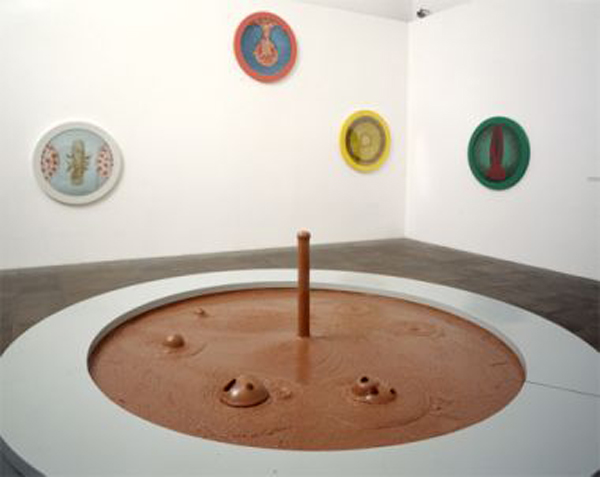
I guess I’m still thinking about chocolate – it is still Easter after all – but yesterday’s post also left the desire/disgust dichotomy firmly in my mind too so today’s post being about Helen Chadwich’s work might easily have been predicted. And where better to start than with Cacao, Chadwick’s 1994 chocolate fountain. At first sight the work looks like a mud bath of some sort and the spluttering as air bubbles through certainly sounds a lot like the bubbling mud of a hot spring. But things aren’t quite that simple. Firstly there’s the central column to consider: it’s hardly reminiscent of a decorative fountain with water falling prettily, indeed it appears deliberately and somewhat comically phallic. But it’s not really the way the work looks and sounds that I remember most vividly – though both are clear in my mind – it’s the heady smell of chocolate that fills the space. So much chocolate and none of it for eating! Ultimately then, this is a work that looks and sounds slightly unpleasant and has a smell that quickly becomes cloying, and yet I’ve always wanted to stay with it longer than is strictly necessary.
Monthly Archives: April 2012
Artful eating
What better time than Easter Sunday to be thinking about chocolate. Lots of chocolate. And having posted about artists working with their own body the last couple of days, today I’m all about an artist who uses her body not as the source of the image but as the tool to make the work. In Gnaw, Janine Antoni gnawed away at a 600lb block of chocolate and another of lard, using the blocks as two parts of a three part installation. The work is a strange one. On the one hand chocolate is delicious, but lard?! Okay, so I’m a vegetarian, a block of lard is never going to be something I enjoy being faced with in a gallery or anywhere else, but I think disgust is a pretty universal response.
Body parts
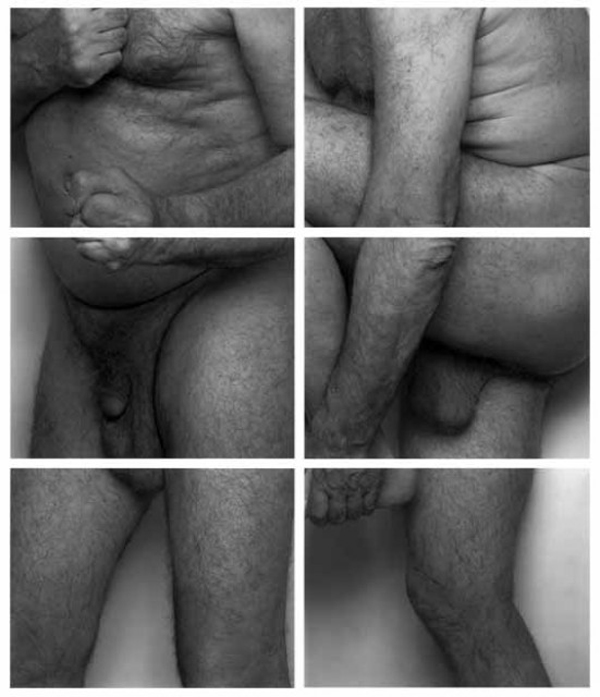
John Coplans, Frieze, No.8, 2002
Thinking about the fragmented body in Gary Hill‘s Inasmuch As It Is Always Already Taking Place made me think about the self portraiture of John Coplans who repeatedly photographed his own – aging – body for (almost) the last two decades of his life. Several things interest me about Coplans’s work. Firstly, there’s the way they don’t conform to expectations of the nude in art. As the Guerrilla Girls have established, the nude is generally female and in an increasingly youth-centred culture the ageing body isn’t often the subject of attention. Here the focus is on the ordinary.
Stripped bare
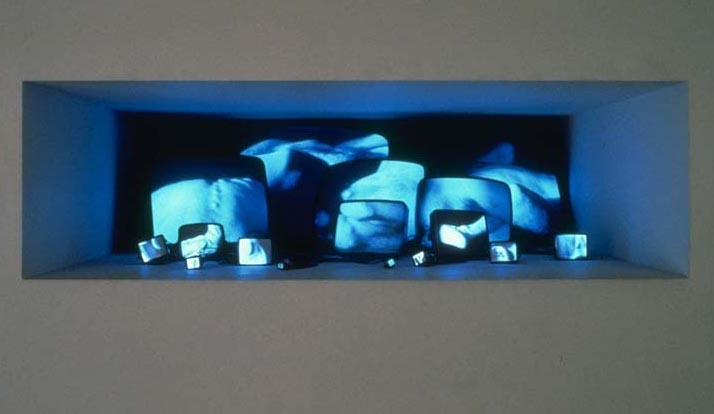
Gary Hill, Inasmuch As It Is Always Already Taking Place, 1990
Like Nam June Paik, Gary Hill often uses the physicality of the television as part of the work but for Hill the box is something to shed leaving the screen and the tube behind it to occupy the space. Multi-screen video works become installations in which the means of display takes on its own significance. Inasmuch As It Is Always Already Taking Place is, in a way, a self portrait, albeit a fragmented one and one which tells us little about Hill.
Boxes of tricks
Nam June Paik, TV is Kitsch, 1996
As we lose the analogue television signal, the impetus to get rid of old analogue televisions is even stronger. The cathode ray tube makes them bulky and heavy next to the sleek lines of plasma and LCD televisions and the need to have an external box to pick up a signal adds to the feeling that the time has come. But that same bulk that seems so annoying in the average living room is key to quite a lot of art from the last few decades. The box is part of what can blur the boundaries between moving image and sculpture. In the case if Nam June Paik’s TV is Kitsch it is the physical presence of the television casings that gives the work its form.
Art, subversion and soap opera
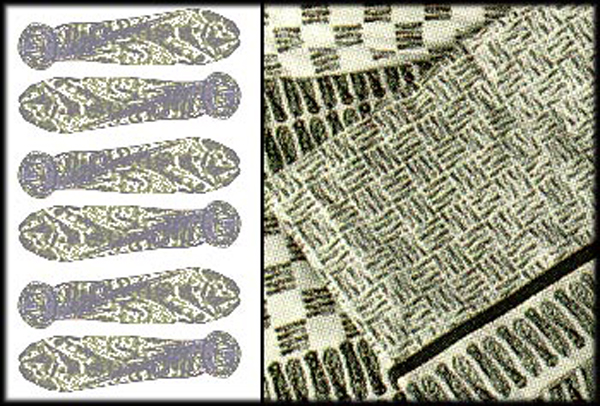
GALA Committee, Safety Sheets, 1996
The television interventions of the likes of Hall, Arnatt and Burden are things I always tend to think wouldn’t happen now, or at least not on mainstream television. But there’s this nagging doubt that say, but if those things aren’t possible, how did art – and pretty subversive art at that – sneak its way into Melrose Place (yes, Melrose Place, an Aaron Spelling production) as recently as the mid to late 1990s? It doesn’t sound likely. And yet, it happened.
The art of advertising / the advertising of art
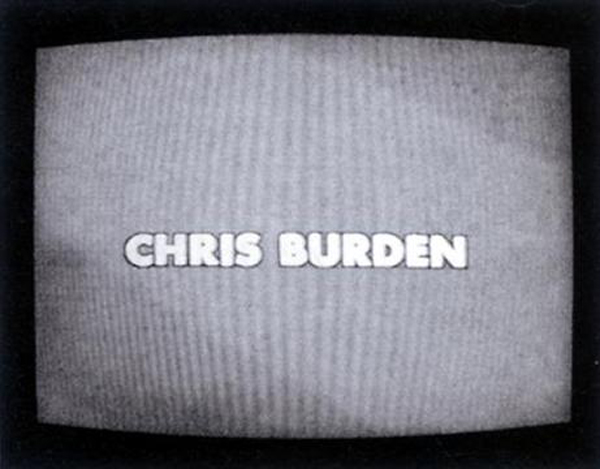
For Chris Burden, best known at the time for difficult and dangerous performances such as Shoot (1971), television offered an appealing platform. His initial proposals for performance works having been turned down, his first television appearance was a 1972 interview that he – literally – hijacked to pursue his own agenda, turning the interview into a performance called TV Hijack. It’s not this that I want to write about though, mostly because I find the idea quite hard to contemplate but also because I find his subsequent strategy of buying advertising time rather more interesting.
Art isn’t usually advertised on television – the Damien Hirst retrospective at Tate Modern notwithstanding – and the idea of an artist working with the format of a 10 second advert is an intriguing one.
We interrupt this broadcast…
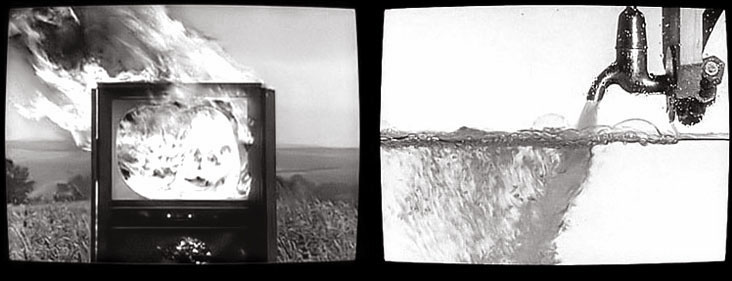
David Hall, Interruption piece and Tap piece from TV Interruptions (7 TV pieces), 1971
Art and television don’t have much of a relationship. There are programmes about art, of course, but even though video art is pretty common in galleries, there’s not much actual art on TV. To an extent, it was ever thus. But there are some interesting examples, and as the analogue switch-off approaches here in London, it seems like a good time to think about them, especially as the occasion is being marked at Ambika P3 with a timely exhibition of David Hall’s work.
Trained as a sculptor, David Hall turned his attention to experimental film at the start of the 1970s, ultimately becoming a pioneer artists’ film and video in Britain, and coining the phrase time-based media. In 1971, Hall was commissioned to make a series of works to be broadcast on Scottish television. This series of TV interruptions were broadcast unannounced and uncredited to what must have been a somewhat baffled audience.