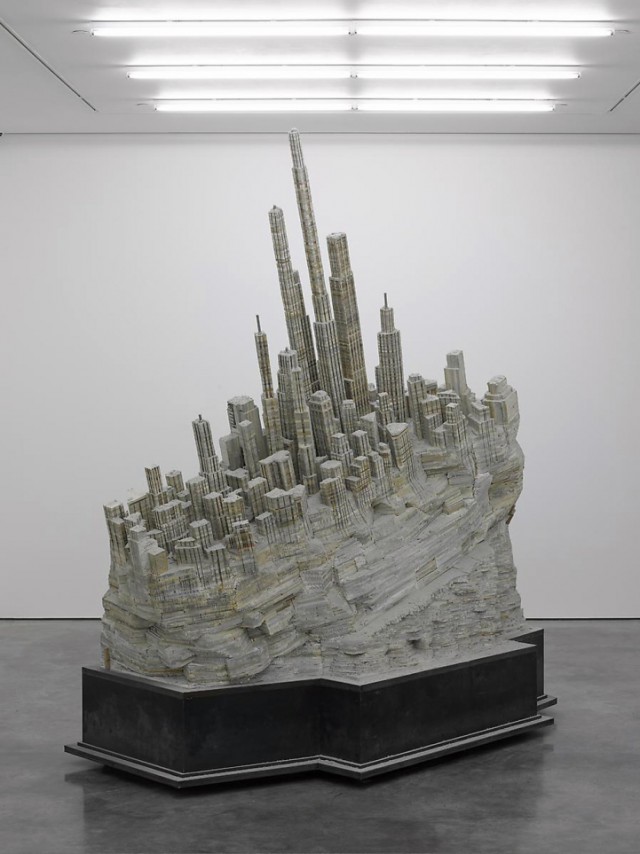
The idea of books as art is hardly new. The concept of the artist’s book is a familiar one; indeed, there are artists’ book fairs all over the place. It’s just that when books become art is usually in the form of a book work: a book by an artist that functions as a work in its own right rather than as documentation. In Liu Wei’s exhibition at White Cube, Bermondsey at the moment, books have become sculpture and taken on the form of a city seemingly teetering on a rock with skyscrapers leaning at alarming angles.
Tag Archives: sculpture
Deformities and pregnant pauses
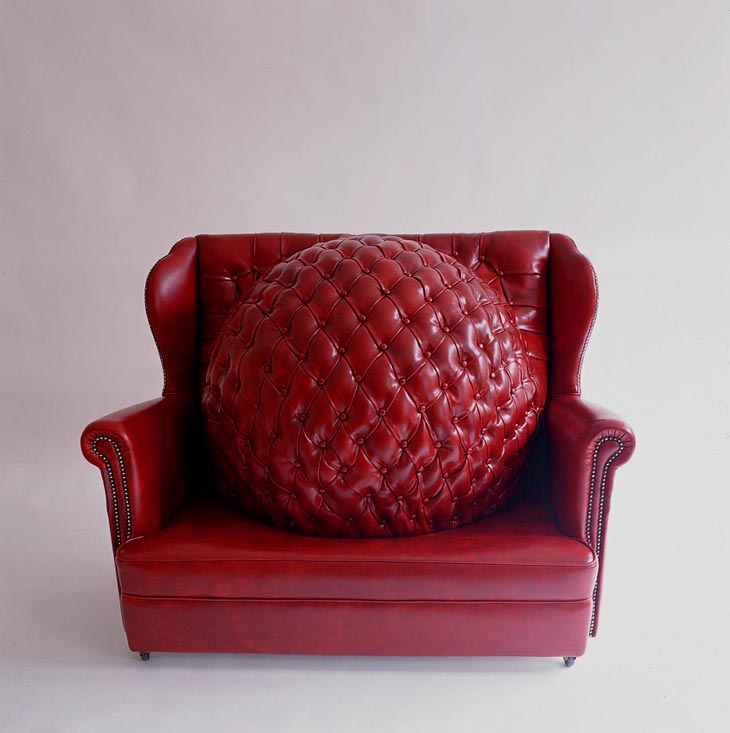
Nina Saunders, The Age of Reason, 1995
If rice can be art – and clearly it can be, and good art at that – then so can all sorts of everyday objects and materials. Like chairs. Admittedly chairs might more usually be expected to count as, say, furniture design, but attempts to categorise things can so easily go wrong and sometimes a chair just isn’t a chair. Such as when it’s afflicted by a large spherical tumour. Or when it starts to collapse in on itself. Or, well, any number of things really…
The stuff of art (and life)
Vong Phaophanit, Neon Rice Field, 1993
Rice is a staple. It’s a foodstuff a large portion of the world’s population depends on. For those of us with the luxury of choice whose diet has become mixed as a result of the movement of people, goods and traditions, it has less cultural significance but is nonetheless something we take for granted, while knowing we could survive without it. For us it could perhaps be argued that art is something akin to a staple. We could perhaps find a substitute if push came to shove but in its own way it nourishes us. Mix the two and you have Vong Phaophanit’s Neon Rice Field an extraordinary installation for which Phaophanit was nominated for the Turner Prize in 1994.
Fragments and feathers
Alan Rath, Yes, Yes, Yes!, 2012
Spending a week in New York is a great way to see a lot of art. There’s all the stuff you expect to see of course – great exhibitions at MoMA, the Met, the Guggenheim etc – and there are the big name commercial galleries that are always worth a visit and then there are the galleries you just wander into because something catches your eye. By the end of this visit, I felt – as usual, I suppose – that there was so much I’d wanted to see but hadn’t managed to get to. I could happily spend a week wandering round Chelsea and probably the same again elsewhere.
Aware of how little I’d seen I snuck a last quick visit to Chelsea into my final morning, in the main wandeing at random, and just as I really needed to start thinking about getting back to the hostel – oh, this glamorous life! – I spotted Alan Rath’s work in Bryce Wolkowitz and had to take a look.
Like a sex machine
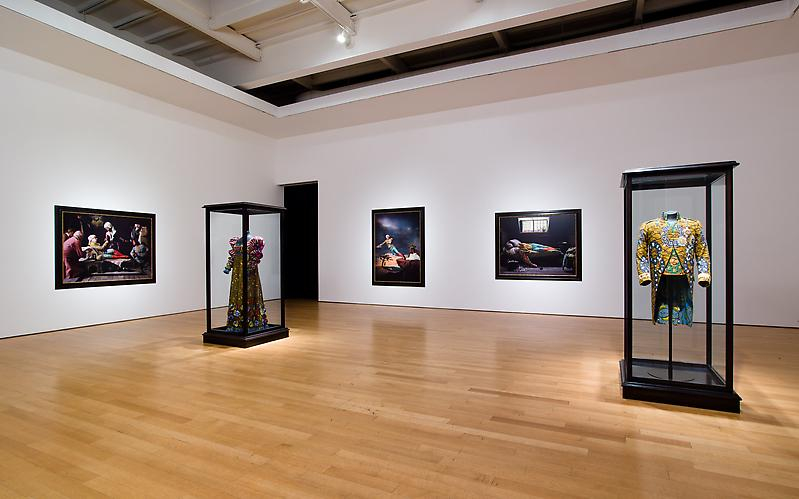
Yinka Shonibare MBE, Addio del Passato at James Cohan Gallery
The key characteristic of Yinka Shonibare’s work is his use of Dutch wax fabric. Based on Indonesian batik fabrics but manufactured in Europe by the Dutch, who then exported it to West Africa when it failed to catch on in the Netherlands, and bought by Shonibare from Brixton market in London, the fabric has connotations of colonialism, post-colonialism and the movement of cultures thereby engendered and of the multi-culturalism of contemporary London. Thus it neatly connects the different aspects Shonibare’s own background as a British-born, Nigerian-raised Londoner and has allowed him to build a practice that is simultaneously coherent and diverse and both serious and playful. These complexities and contradictions are reinforced by Shonibare’s adoption of the letters MBE after his name when he was given the honour in 2005: an artist whose work could be seen as commenting on empire accepted and uses an honour that makes him a Member of the Most Excellent Order of the British Empire.
It’s not surprising then the work in Shonibare’s exhibition Addio del Passato at James Cohan Gallery is by turns beautiful and fascinating and very, very funny. Equally unsurprising perhaps is that the work I especially want to write about is all of these things. And also really rather rude…
Scrapyard sculpture
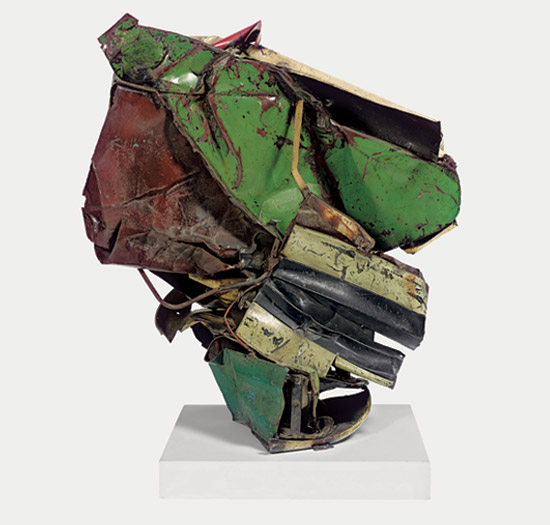
John Chamberlain, Hatband, 1960
The automobile has a very particular place in American culture. It’s central to countless films and novels, helping to drive (sorry) the narrative. Though cars do appear in art – in photography, painting and sculpture – they are less prevalent here though from the minimalist sculpture of the mid-twentieth century onwards there was certainly a clear interest in using industrial processes and making work that defied expectations about the nature of sculpture in particular. Expectations about painting had already been shattered by minimalism and abstract expressionism.
A horse, of course
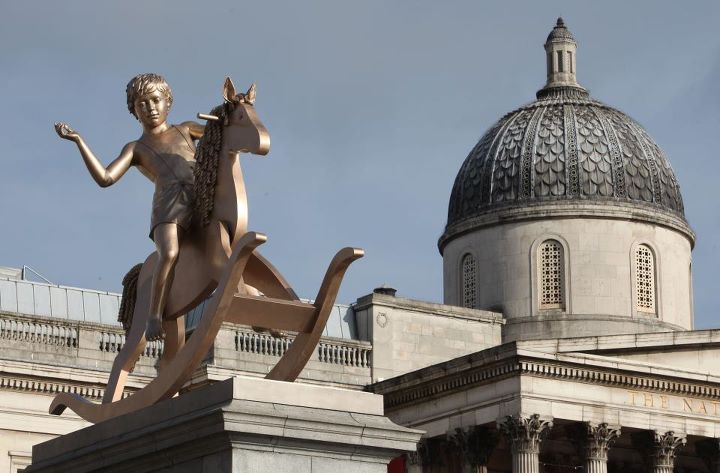
Elmgreen and Dragset, Powerless Structures Fig. 101, 2012
If, in a public square in a capital city, you have an empty plinth intended for a statue of a figure on a horse then what better to put on it than a statue of a figure on a horse? After testing a lot of alternatives on the fourth plinth in Trafalgar Square, the plinth that never quite got its statue, it should come as no surprise that the powers that be have yielded to the inevitable and installed the statue that was always meant to be there. Sort of.
Solid water
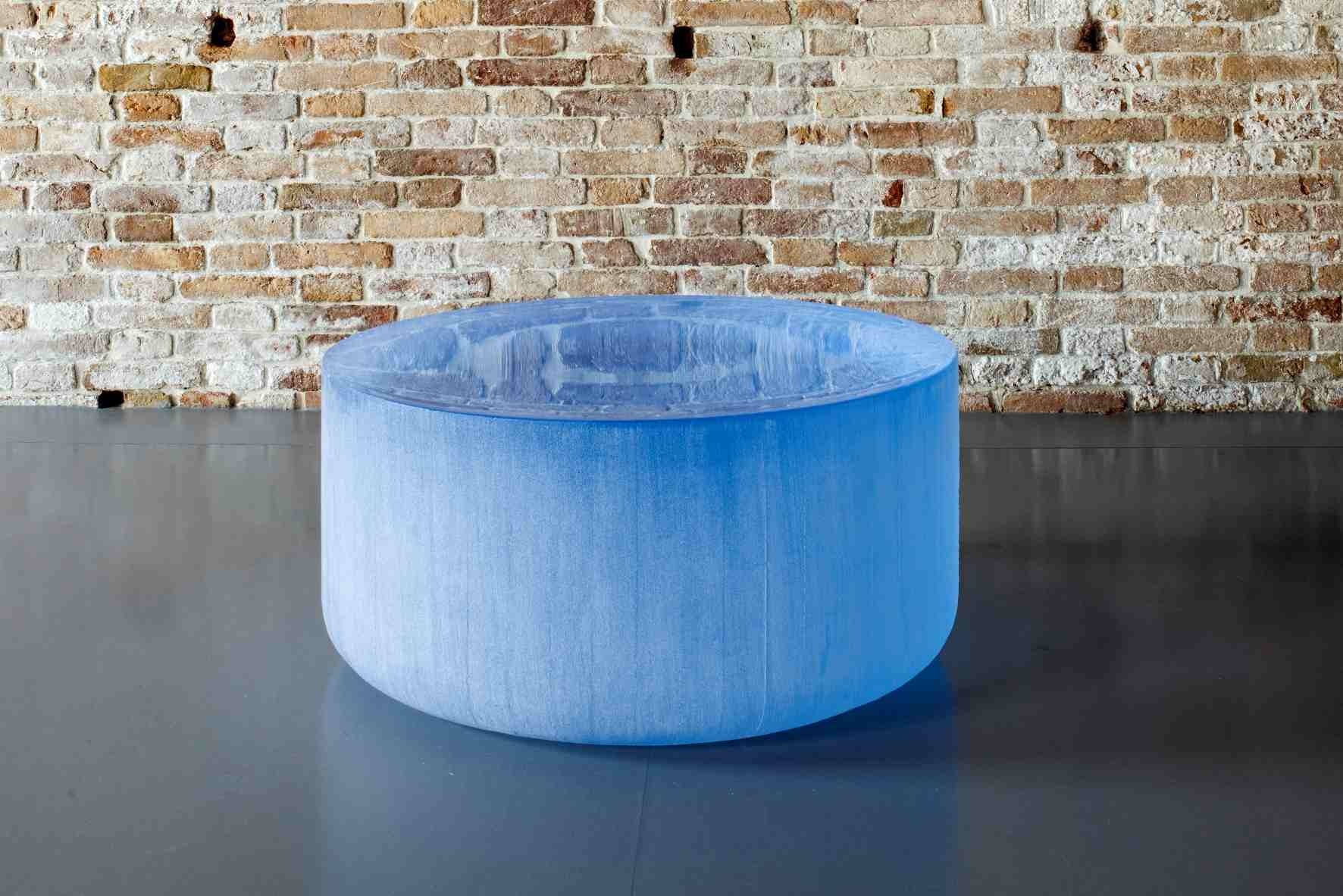
Roni Horn, Well and Truly, 2009-10
The is a something visually confusing about Roni Horn’s Well and Truly, on show at the moment in at Punta della Dogana as part if the exhibition In Praise of Doubt. The work consists of a number of similar cast glass sculptures each of which looks like water, solidified – but somehow, inexplicably, as solid water, rather than ice – in the form of a low straight-sided dish (that is, as a short column with a slight rounding where the sides meet the base). The sides look sanded (though this is from contact with the mold during casting) but the tops, which dip slightly, are clear and reflect their surroundings.
On seeing the wood and the trees
Giuseppe Penone, Tree of 12 Metres, 1980-82
Perhaps it’s down to my preoccupation with forests this week, but I decided it was time to revisit Giuseppe Penone’s Tree of 12 Metres at Tate Modern. The starting point of this sculpture – an industrially sawn timber beam – remains visible at the base of the pieces but Penone has carved it back meticulously and – by following the clues given by the knots in the wood – revealed the wood’s past as a tree.
Shadows in the forest
Loris Gréaud, Gunpowder Forest Bubble, 2008
There is something enchanted about Loris Gréaud’s Gunpowder Forest Bubble (currently installed in Palazzo Grassi as part of the exhibition The World Belongs to You). By the light the moon, which hangs low in the shadowy forest, I can see that I am alone. The trees are bare and dark; they loom above me. There is a sense of theatre about the installation, albeit without a predetermined narrative. This is the forest as a fairytale space where anything is possible, and anything – perhaps especially – danger might be revealed. And there is danger here, notionally at least, for the stark carbonised trees are coated in gunpowder. Rationally I might know that the risk is minimal to non-existent, but still: gunpowder! That hardly seems safe.