Skin deep

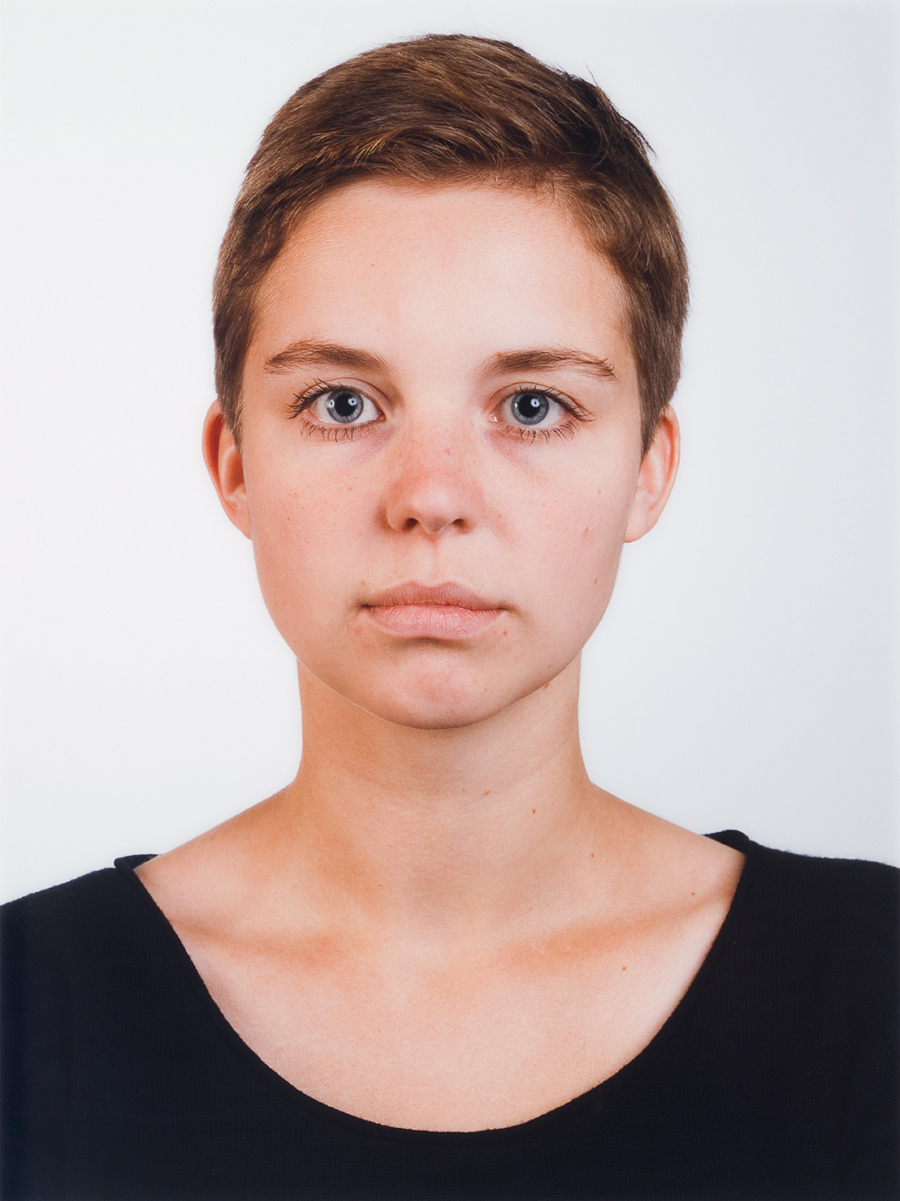
Thomas Ruff, Portrait (I. Graw), 1988

Having taken the slow route from the Bechers to portraiture it seems like a good time to ponder the more obvious forward jump, so today I’ve found myself thinking about Thomas Ruff’s Portraits, a body of work he started while still a student of Bernd Becher at the Kunstakademie Düsseldorf and has continued – in parallel with other work – ever since. Initially working in black and white, Ruff quickly moved to colour and made the series using a large format camera so that the faces are recorded in unrelenting detail. At their most simple, these are like passport photographs but for the eessential detail of scale: Ruff’s prints are around two metres tall.

Continue reading

Taking an average

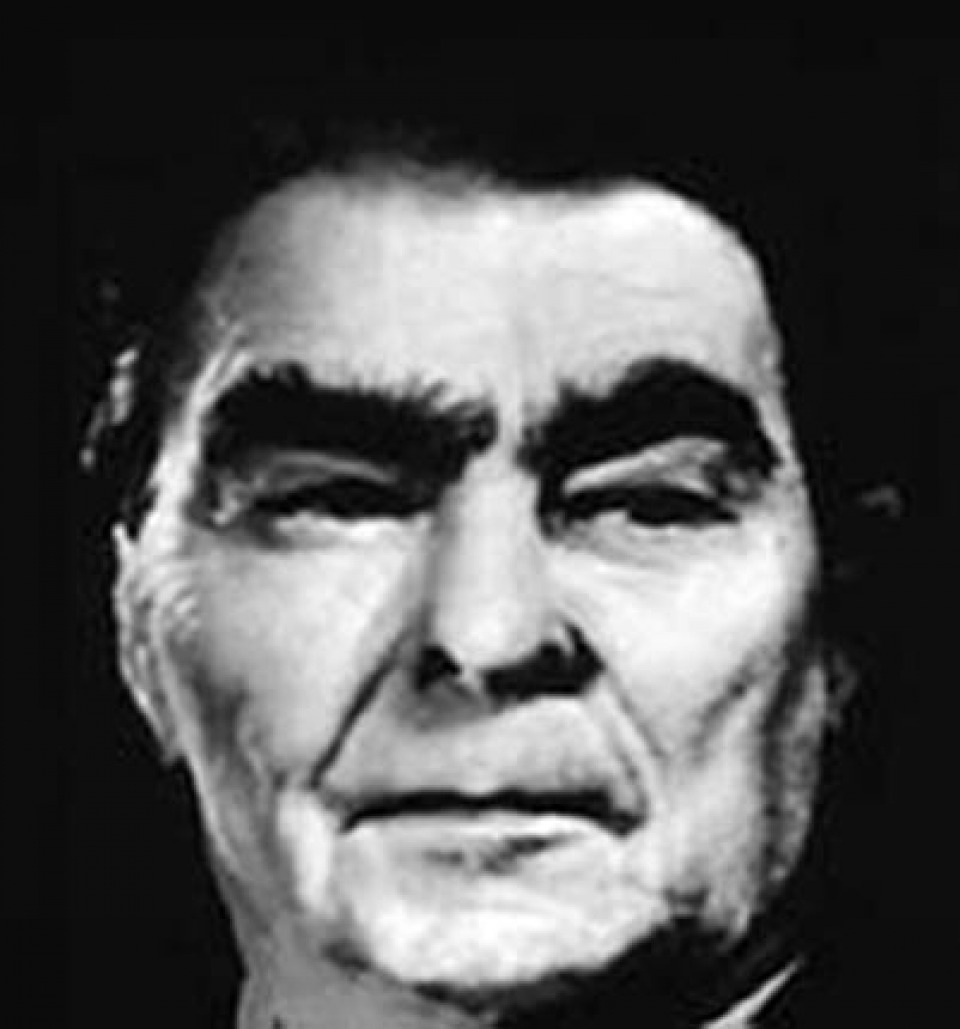
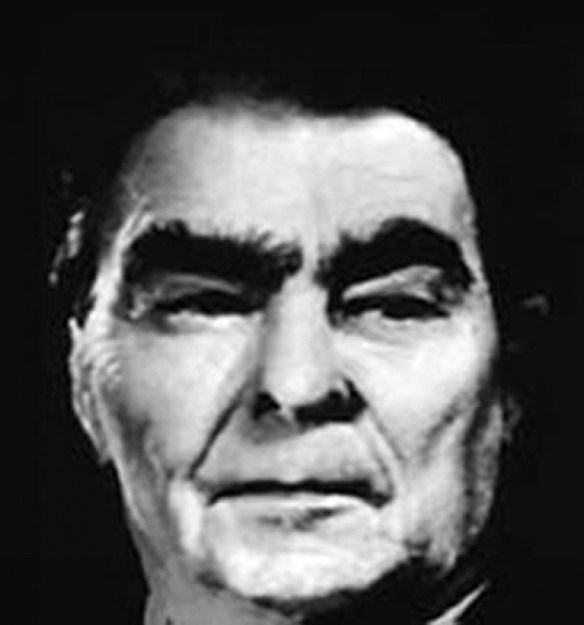
Nancy Burson, Warhead I (55% Reagan, 45% Brezhnev, less than 1% each of Thatcher, Mitterand, and Deng), 1982

The idea of the digital composite that Idris Khan uses to such great effect isn’t a new one by any means. Possibly somewhat surprisingly it goes back several decades, with Nancy Burson – who had been involved with Experiments in Art and Technology (EAT) since leaving college in the late 1960s – making composite portraits digitally in the early 1980s. Composite photographic portraits of course have a much longer history – Francis Galton’s composites of criminal types were made in the late nineteenth century for instance – but the use of digital is something Burson pioneered.

It’s not all about the technology though. Indeed, it’s as art that Burson’s work interests me more. In building her composites, Burson is effectively making layered photomontages and accordingly her work can be seen as the combining of two (or more) elements to reveal a third meaning. In Warhead I, Burson has combined the imagges of world leaders accoring to the percentage of the world’s nuclear arsenal they had at their disposal. This being 1982 that effectively mean merging the faces of Leeonid Brezhnev and Ronald Reagan. Though in a way this makes me think about the significance of nuclear weapons during the Cold War it’s also interesting that it seems to come from a simpler time. How many faces would be in the mix now? And would anyone be able to accurately pinpoint the percentages?

Continue reading

A sense of completeness

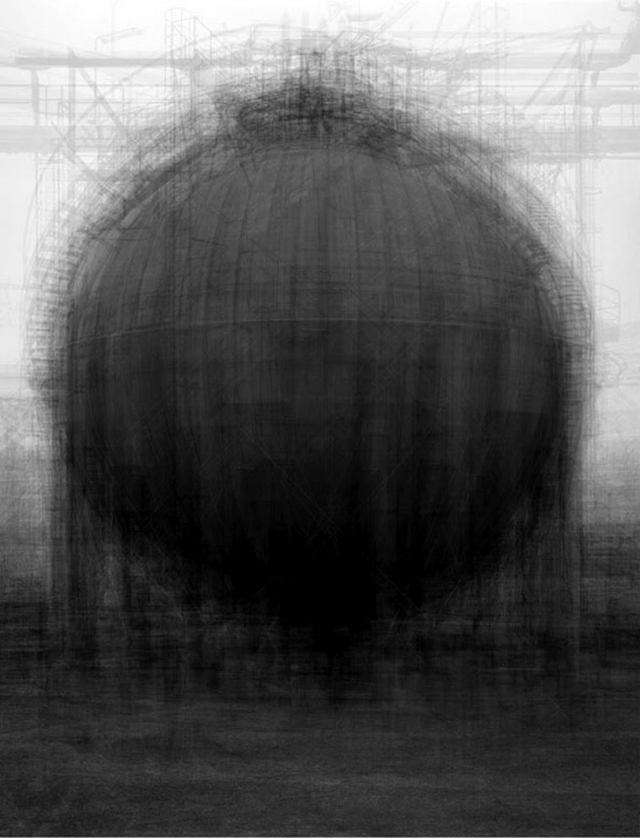
Idris Khan, every… Bernd and Hilla Becher Spherical Type Gasholders, 2004

The objectivity that characterises Bernd and Hilla Becher’s recording of industrial architecture resulted in pictures that allow examination of the structures in almost forensic detail and their typological approach to display allows comparisons between buildings of the same type. The precision that comes from using a large format camera and the neutral lighting of an overcast sky makes for an extraordinary level of detail. There is a sense of completeness that comes from seeing multiple structures of each type.

Idris Khan has taken the Bechers’ work as a starting point for a different examination of the same territory. Rather than building up a picture of the whole from the precise detail of each individual image, Khan has taken an average. By overlaying all the Bechers’ images of a particular type of structure – for instance spherical type gasholders – Khan has produced sketchy pictures that seem to suggest an approximate version of how each type of building might be expected to look.

Continue reading

The art of looking at art

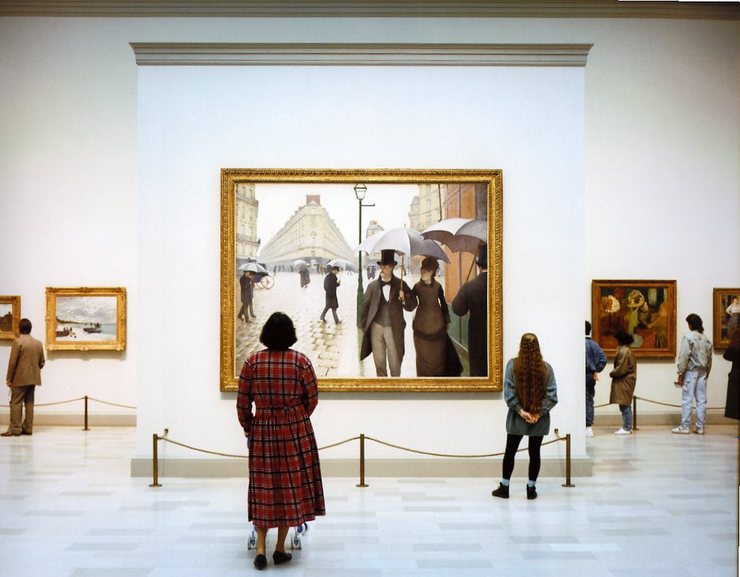
Thomas Struth, Art Institute of Chicago II, 1990

Given that this blog is essentially about looking at art, it seems like a good idea to think about how that happens. Thomas Struth’s museum photographs provide a fascinating insight into the way visitors behave in art museums. In most of the pictures, viewers are looking at historical paintings, or sometimes sculpture, and we are looking at them. Struth typically adopts a broadly objective viewpoint, for instance in Art Institute of Chicago II we are looking straight at Gustav Caillebotte’s Paris Street; Rainy Day (1877) and at the backs of those looking at it. The painting’s audience is two individual women, each seemingly lost in their own thoughts about the work in front of them.

Continue reading

Chance encounter

Christian Boltanski, Chance, 2011

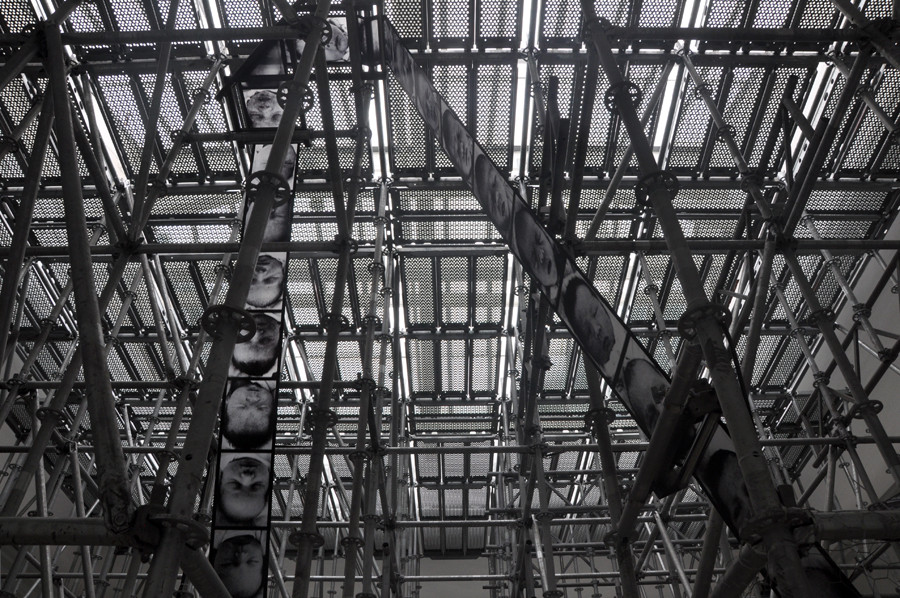
Since I seem to be stuck in mazes and cages this week, it’s perhaps no surprise that Christian Boltanski’s installation for the French pavilion at the 54th Venice Biennale last year has worked its way back to the front of my mind. For me, this was one of the highlights of the Biennale though admittedly I think I’ve yet to see a work by Boltanski that I haven’t liked. This work does feel quite different to most of Boltanski’s installations though, not least because it’s playful – literally, in that it includes a game – and open to a hopeful reading, though more sombre interpretations are also possible.

Continue reading

In a state of change

Sam Taylor Wood, Still Life, 2001

Looking at Jeanne Dunning’s mouldy still lives yesterday made me think about Sam Taylor Wood’s Still Life, a time-lapse video work in which a basket of fruit reminiscent of countless still life paintings gradually decays and is taken over by rather beautiful white mold. At first sight, shown on a plasma screen, the work mimics a painting and it takes time to realise that the fruit is gradually changing as it starts to rot. This is beautiful decay but it’s still hard not to feel a little repulsed by the outcome.

Continue reading

The familiar made strange

Jeanne Dunning, Hand Hole, 1994

Jeanne Dunning has always been good at making the familiar look strange. It was pictures of hairstyles that first drew me to her work but it was body and food pictures that I first saw in a gallery. In real life the prints were seductive and the images intriguingly strange. In part the defamiliarisation of the body in Hand Hole is down to the way the picture is composed, but it’s also about the scale of the image. Though Dunning’s prints are often modest in size, in images like Hand Hole there is still a shift from the human scale. Add to this the ambiguity of the image when seen along side similarly strange pictures of food.

Continue reading

Sensory overload

Helen Chadwick, Cacao, 1994

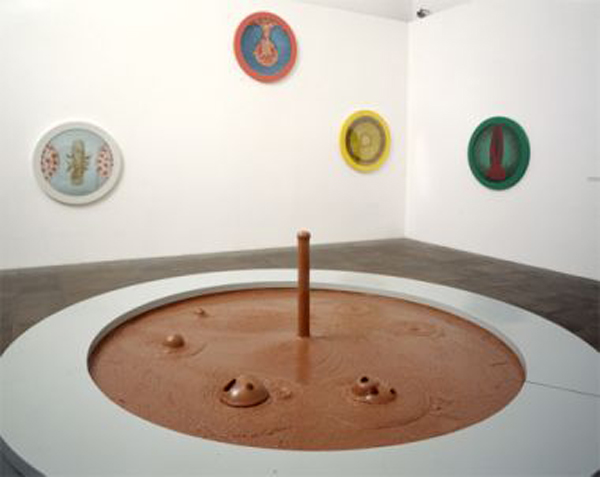
I guess I’m still thinking about chocolate – it is still Easter after all – but yesterday’s post also left the desire/disgust dichotomy firmly in my mind too so today’s post being about Helen Chadwich’s work might easily have been predicted. And where better to start than with Cacao, Chadwick’s 1994 chocolate fountain. At first sight the work looks like a mud bath of some sort and the spluttering as air bubbles through certainly sounds a lot like the bubbling mud of a hot spring. But things aren’t quite that simple. Firstly there’s the central column to consider: it’s hardly reminiscent of a decorative fountain with water falling prettily, indeed it appears deliberately and somewhat comically phallic. But it’s not really the way the work looks and sounds that I remember most vividly – though both are clear in my mind – it’s the heady smell of chocolate that fills the space. So much chocolate and none of it for eating! Ultimately then, this is a work that looks and sounds slightly unpleasant and has a smell that quickly becomes cloying, and yet I’ve always wanted to stay with it longer than is strictly necessary.

Continue reading

Body parts

John Coplans, Frieze, No.8, 2002

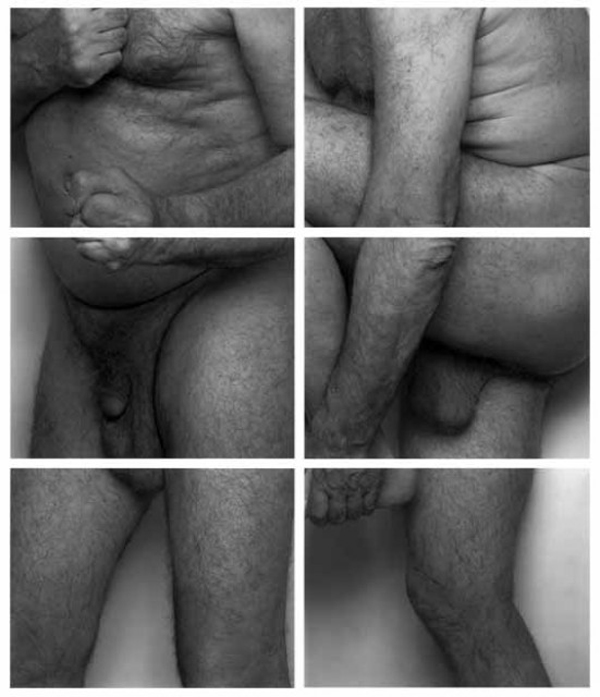
Thinking about the fragmented body in Gary Hill‘s Inasmuch As It Is Always Already Taking Place made me think about the self portraiture of John Coplans who repeatedly photographed his own – aging – body for (almost) the last two decades of his life. Several things interest me about Coplans’s work. Firstly, there’s the way they don’t conform to expectations of the nude in art. As the Guerrilla Girls have established, the nude is generally female and in an increasingly youth-centred culture the ageing body isn’t often the subject of attention. Here the focus is on the ordinary.

Continue reading

Make do and mend

Zoe Leonard, Strange Fruit (for David) (detail), 1992-97

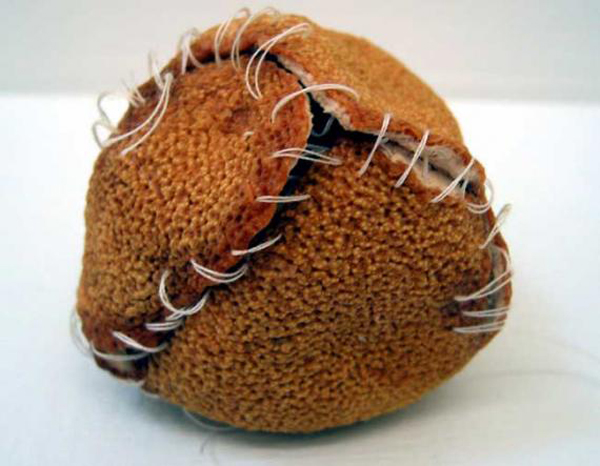
There is something sad and touching about emptied out fruit stitched back up in a futile attempt at mending. But there’s also something about it that amuses me in a way. I think in Zoe Leonard’s installation Strange Fruit (for David) the thing that both moves me and makes me smile is the scale of the thing. It feels like a point that could have been made with a few pieces has taken control and not let Leonard stop; the empty fruit are scattered liberally across the floor, filling the space. In total roughly three hundred pieces of fruit have had their peel or skin dried out and put back together with stitching or other forms of fixing or adornment.

Continue reading