Airy stories

Martin Creed, Work No. 200 Half the air in any given space, 1998

While I’m thinking about spaces of confusion and installations that can disorientate the viewer it seems like aa good opportunity to have think about Martin Creed’s Work No. 200 and Work No. 247 both also titled Half the air in any given space. In these works, half the air in the space is separated from the rest by being contained within balloons. This is another work I’ve somehow managed to miss and it’s right there on my list of things I really want to see.
Continue reading

Lost in the fog

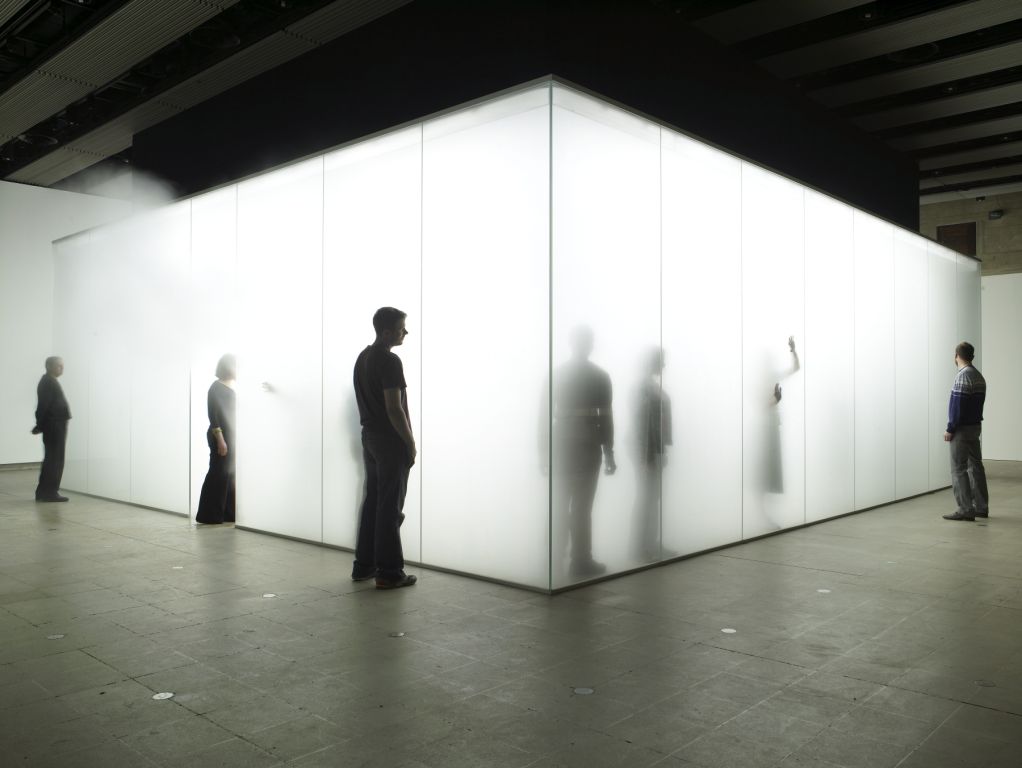
Antony Gormley, Blind Light, 2007

Disorientation and an assault on the senses isn’t something I normally associate with Antony Gormley. Figurative sculptures, yes; glass boxes full of fog and confusion, no. Them’s the rules. But rules are made to be broken, I suppose, and the unexpected from an artist you thought you’d got the measure of is no bad thing.

Blind Light is a brightly lit, glass walled room filled with mist. As people enter the space they quickly disappear from view. From the outside occasionally shadowy figures can be seen as they get close to the walls, hands becoming suddenly clear as they touch the wall.

Continue reading

The weight of darkness

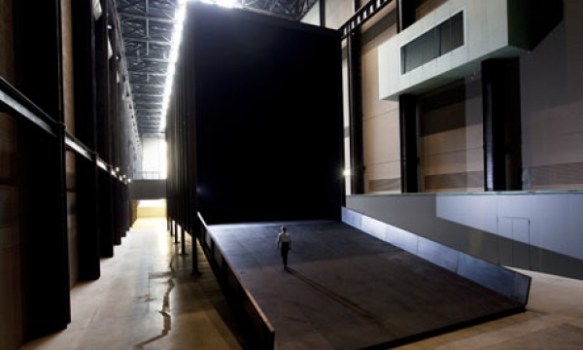
Miroslaw Balka, How It Is, 2009

Disorientation is a powerful force. Whereas Klein’s white void might have amounted to nothingness as art, Miroslaw Balka’s How It Is, the 2009 Unilever Commission for the Turbine Hall of Tate Modern, couldn’t be seen as nothingness in quite the same way. This was an altogether heavier void and, for me, its weight was a significant part of its power.

Continue reading

A blank canvas

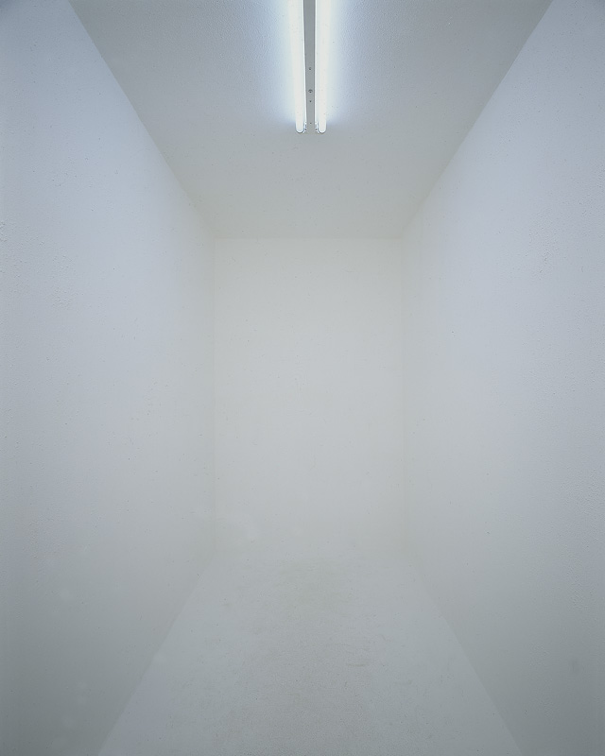
Yves Klein, Immaterieller Raum (Immaterial Space), Museum Haus Lange, Krefeld, 1961 (restored 2009)

Over the last few posts I realise I have been dealing with increasingly immaterial art. Though the work is visible it’s ultimately mostly made of nothingness. So, with Invisible soon to open at the Hayward Gallery, now seems like as good a time as any to think about work that really is made of nothing. The void as art. Well we’ve been here before in a way with Yves Klein’s Leap into the Void, but that was an actual photograph and art can get much more insubstantial than that…

Continue reading

Mirror, mirror

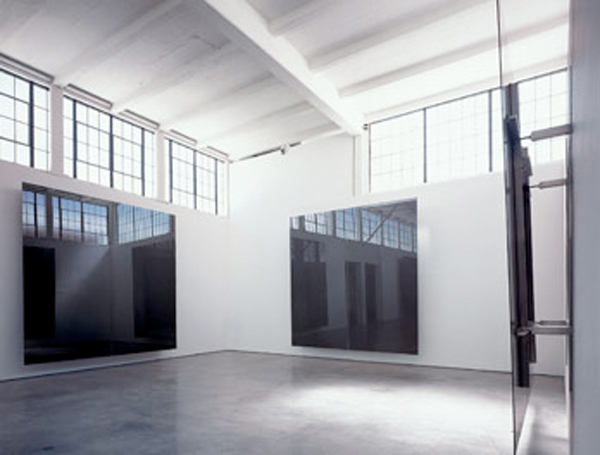
Gerhard Richter, Six Grey Mirrors, 2003

Of all Gerhard Richter’s work – and his practice is unusually varied – it’s probably his exploration of the relationship between painting and photography that interests me most. But I’d struggle to come up with a body of work by Richter that I don’t like, though I guess the 1980s’ squeegee paintings would probably be on the list if I tried – the colours just don’t work for me – though I love the later squeegee paintings. I’m often unsure quite where I stand when it comes to Richter’s work with mirrors and glass. I like the work, but the paintings are so amazing that the other works can seem irrelevant by comparison. But, like most art, it depends on the context.

Dia:Beacon is an extraordinary place. A former factory converted to display the Dia Art Foundation‘s collection of works from the last half century or so in appropriate surroundings, the industrial architecture is put to good use to provide some unusual and unusually large spaces to show the work. Many of the works housed here can’t easily be accommodated elsewhere. The collection – much of which was acquired in the 1970s and ’80s – contains work by many key late twentieth century artists – primarily but not exclusively American – with industrial scale sculpture particularly well represented; since the 1990s works by other artists of broadly the same generation have been added to the collection including Gerhard Richter’s Six Grey Mirrors.

Continue reading

Weights and measures

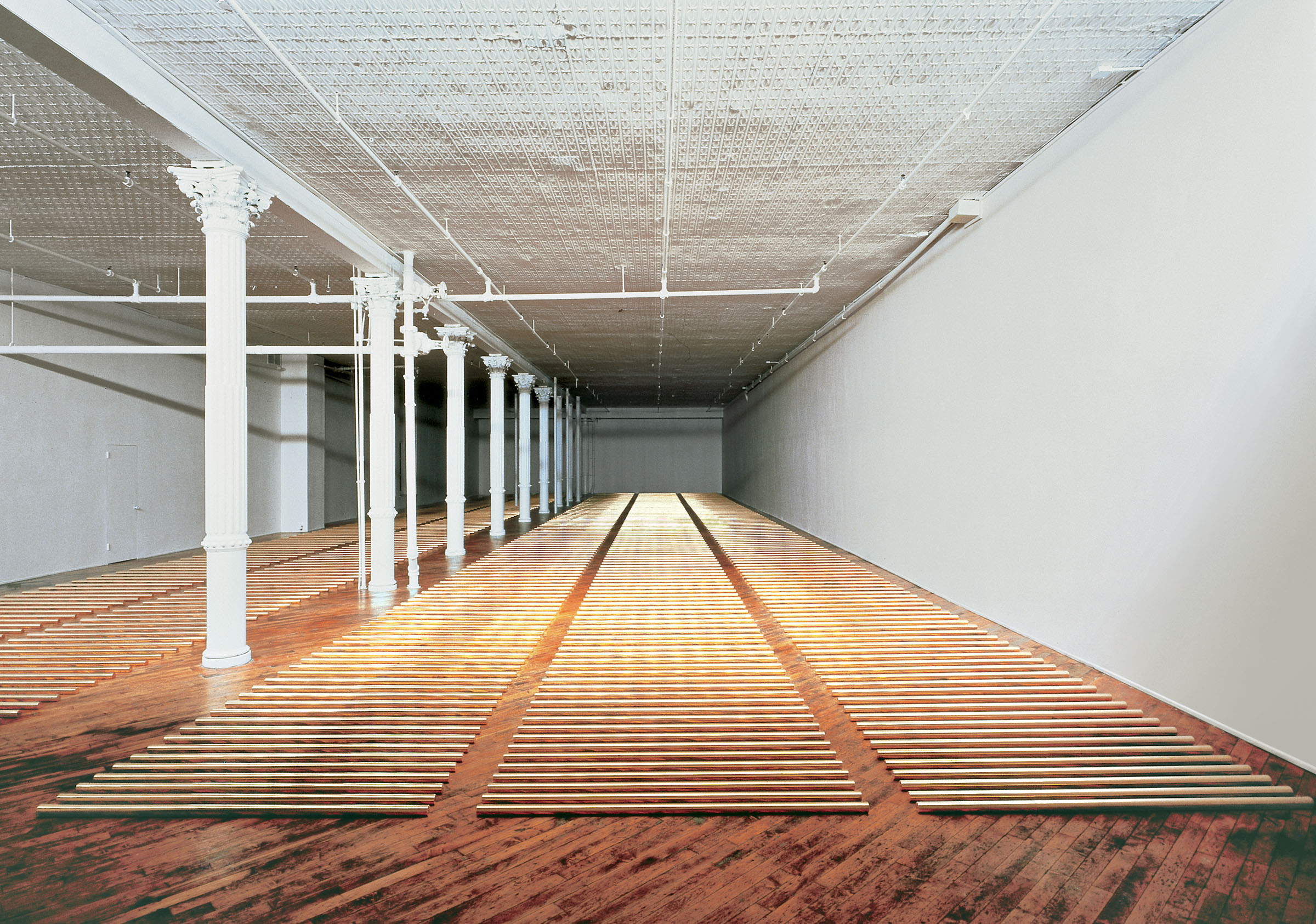
Walter De Maria, The Broken Kilometer, 1979

There was a time when SoHo in New York City was full of artists. Space was cheap and artists like Donald Judd bought whole buildings to live and work in; the area was full of studios and galleries. Gradually both have dispersed. The galleries have moved north to Chelsea and to find artists’ studios in any real density it’s probably necessary to head to Williamsburgh in Brooklyn. If you look closely, there are still traces of the old SoHo among the designer stores, hotels, bars and restaurants though. Judd’s home and studio is still there at 101 Spring Street, now owned by the Judd Foundation, and will be open to the public once the building restoration is complete. Artists Space has moved several times in its forty year history but remains in SoHo, on Greene Street.

Also tucked away in SoHo are two long-term installations made by Walter De Maria in the 1970s, maintained by the Dia Foundation and still housed in their original locations. Both define the spaces they’re housed in, both fit with some of the themes of American sculpture of the late mid-twentieth century such as the use of non-traditional materials and processes and a minimal approach that is rooted in geometries and measurement.

Continue reading

Same difference

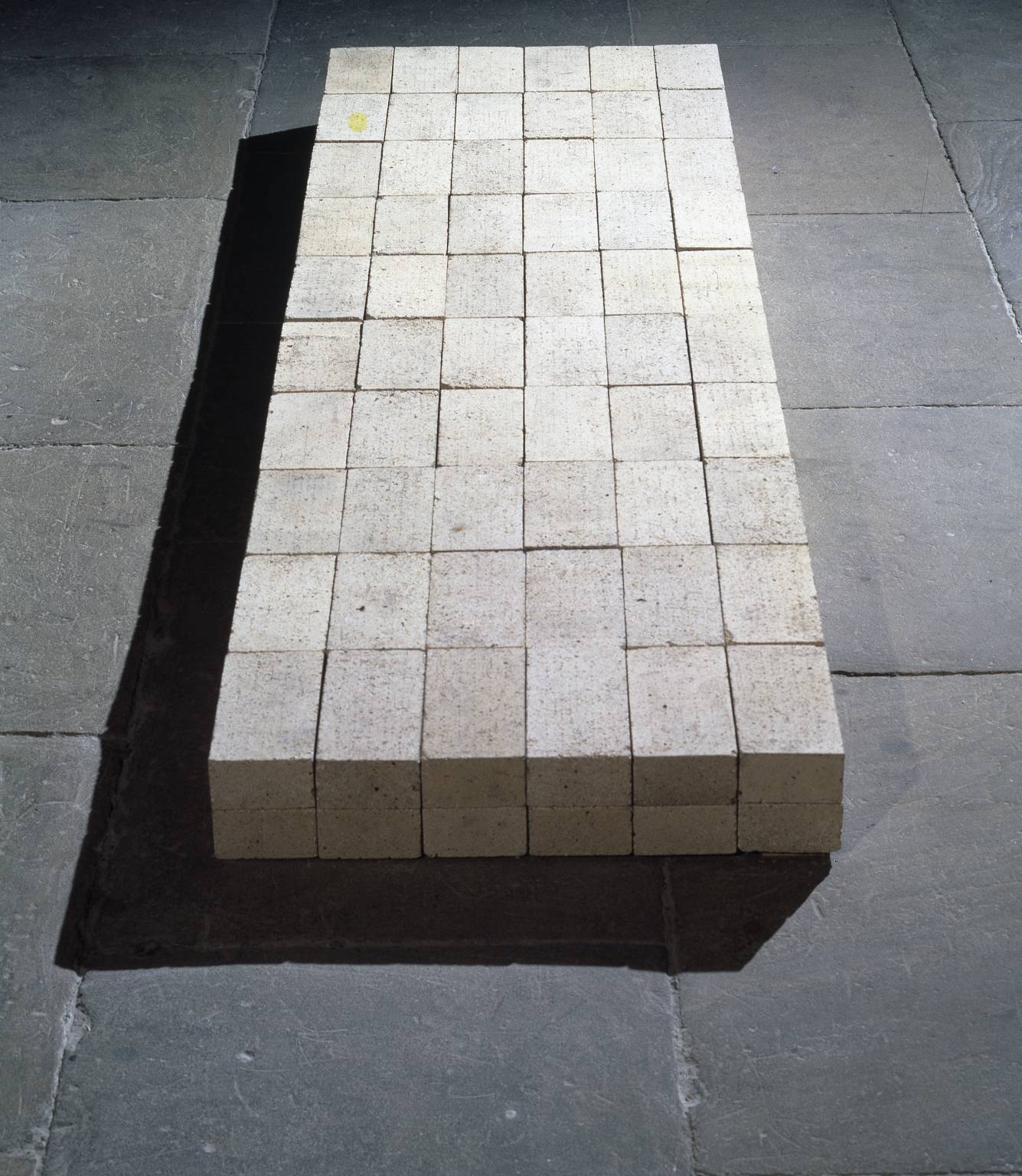
Carl Andre, Equivalent VIII, 1966-69

When it comes down to it, one pile of bricks is pretty much like another. At least, that’s the way things work in Carl Andre’s Equivalent series. Each of the eight sculptures in the series consists of 120 bricks laid out on the floor two layers deep. Though each is laid out in a different arrangement, as each contains the same number of the same type of bricks, each occupies the same volume of space and can therefore be seen as equivalent.

Equivalent VIII, bought by the Tate in 1972, is described as 2 high x 6 header x 10 stretcher; in other words the bricks are in two layers each six bricks wide by ten bricks long. The work is probably more commonly known as the bricks, or perhaps the pile of bricks, and has long been one of the most controversial artworks held by a British art museum.

Continue reading

Infinity curves

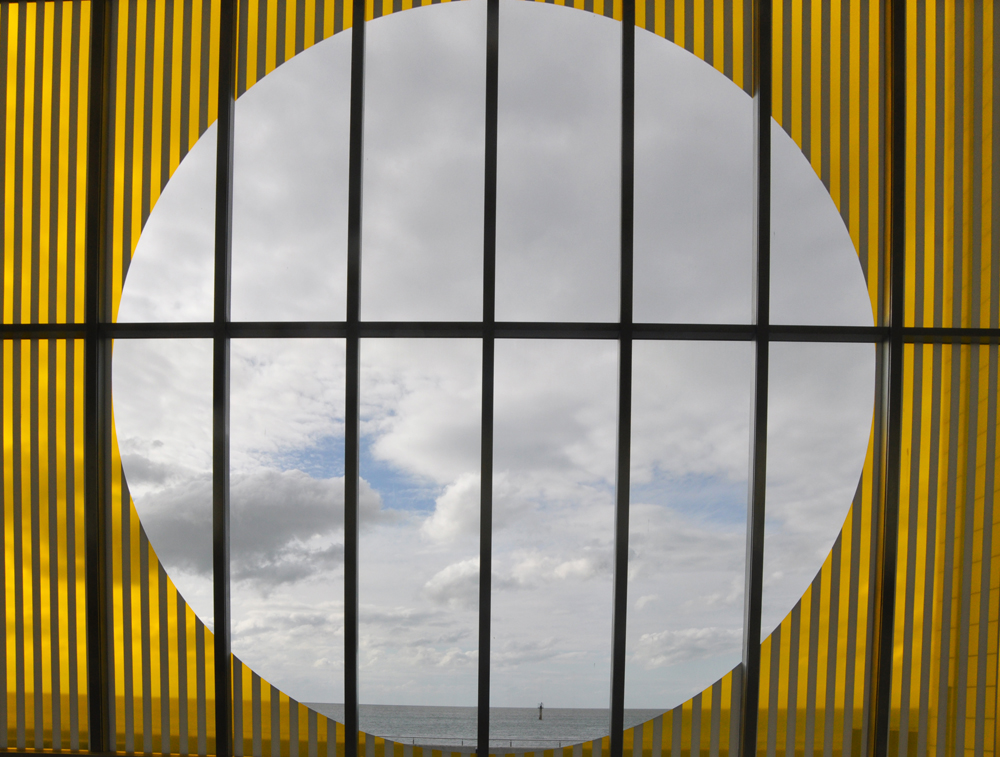
Daniel Buren, Borrowing and Multiplying the Landscape, 2011

Art is a window on the world. Well, in the case of Daniel Buren’s Borrowing and Multiplying the Landscape, installed for the opening of Turner Contemporary in Margate last year, it is. Buren’s installation modifies the view of the sea beyond the windows of the gallery foyer by covering much of the glass with coloured tape so that the sea is seen through a circular window cut into the yellow stripes. In a sense the work forms an inverse sun framing, on my visit at least, the greyness of and English summer afternoon. Ah well.

Continue reading

Smoke and mirrors

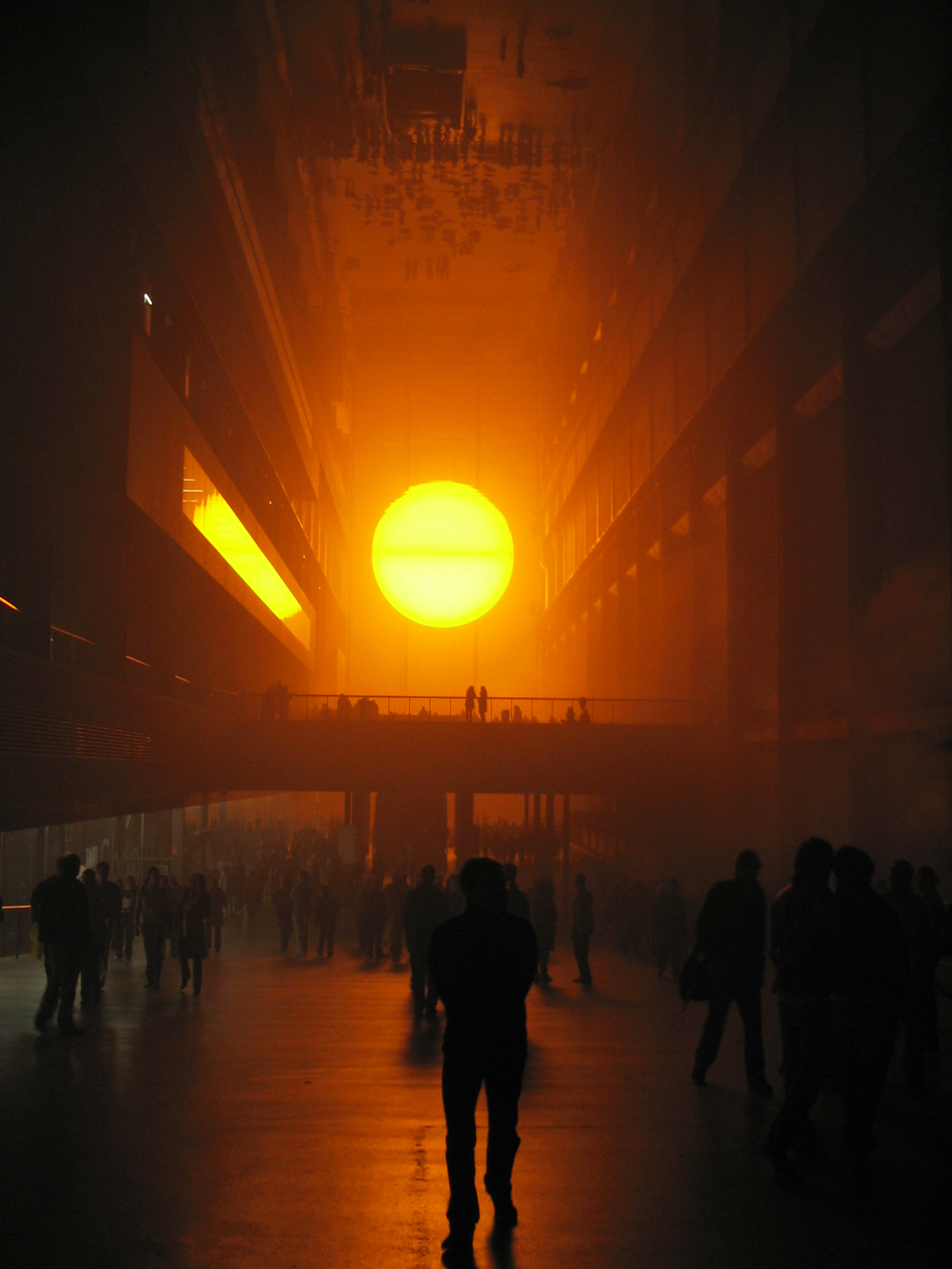
Olafur Eliasson, The Weather Project, 2003Olafur Eliasson, The Weather Project, 2003 (Turbine Hall, Tate Modern)

Mirrors can make a room look bigger. We all know that. They can also make a space confusing. We all know that too. At some stage, most of us have probably been in a public place with a mirrored wall and though the room extended further than it actually did. We may even have walked into the mirror by accident. These things happen.

The idea of a mirrored ceiling is a strange one. On the one, hand it’s an idea with somewhat seedy connotations. On the other hand, it can double the height of a room; okay, so it can only seem to do that, but you know what I mean. It’s this, somewhat disorientating, effect that Olafur Eliasson was going for when he installed a false ceiling in the Turbine Hall of Tate Modern as part of his 2003 installation The Weather Project. In the event, it both messed with our perception of the height of the space and made people behave in a way that they usually don’t in an art museum.

Continue reading

Upside down

Richard Wilson, 20:50, 1987 (Matt’s Gallery, Martello Street, London)

Art can make us see the world differently. Certainly the way both Gordon Matta-Clark and Richard Wilson have cut away sections of buildings challenges our perception of architecture making us see city spaces differenttly in a literal but nonethheless interesting way.

Wilson’s iinstallation 20:50, a room with a seemingly mirrored surface at roughly waist height, offers a strangely new understanding of the space it’s installed in. For the unsuspecting visitor, the first clue about the nature of the surface is the smell, approaching the room one is greeted with a powerful aroma of oil. Suddenly the  title – 20:50 – makes sense: the room is flooded with used engine oil. A walkway leads out into the middle of the space, from which you get to see the features of the room reflected all around you.

Continue reading