A sense of completeness

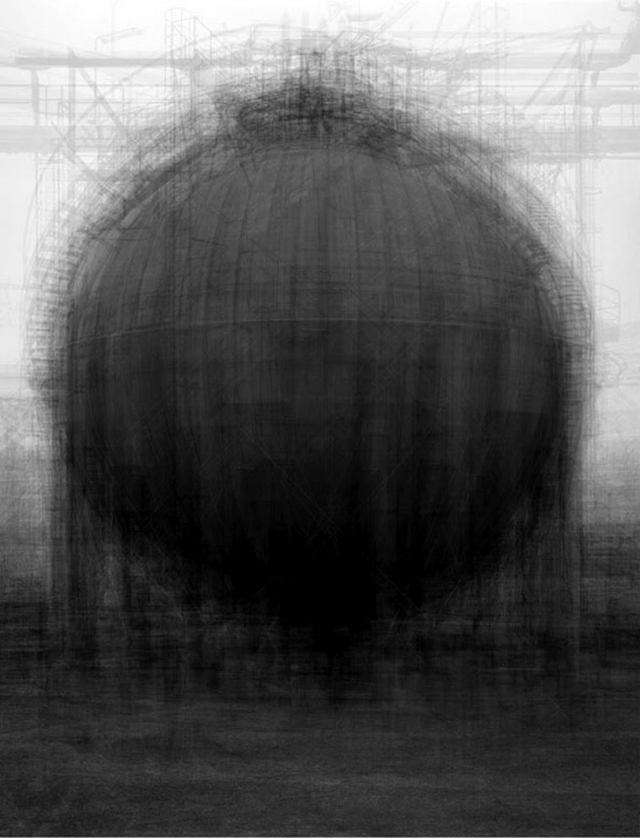
Idris Khan, every… Bernd and Hilla Becher Spherical Type Gasholders, 2004

The objectivity that characterises Bernd and Hilla Becher’s recording of industrial architecture resulted in pictures that allow examination of the structures in almost forensic detail and their typological approach to display allows comparisons between buildings of the same type. The precision that comes from using a large format camera and the neutral lighting of an overcast sky makes for an extraordinary level of detail. There is a sense of completeness that comes from seeing multiple structures of each type.

Idris Khan has taken the Bechers’ work as a starting point for a different examination of the same territory. Rather than building up a picture of the whole from the precise detail of each individual image, Khan has taken an average. By overlaying all the Bechers’ images of a particular type of structure – for instance spherical type gasholders – Khan has produced sketchy pictures that seem to suggest an approximate version of how each type of building might be expected to look.

Continue reading

Art on acid

Painting with hydrochloric acid on nylon, 1961

There are lots of ways to paint, as a quick wander through any major art museum will amply demonstrate. But there are those who change out understanding of art through their work, and Gustav Metzger is one such. Metzger’s notion of auto-destructive art, which he initially defined in 1959, was an interesting and highly-influential on which was rooted in the belief that Western society was failing (Metzger has been a Marxist all his adult life). The idea is that the work has the capacity to destroy itself or that it is destroyed by the actions of its creator.

Gustav Metzger: Auto-Destructive Art (1959)
Auto-destructive art is primarily a form of public art for industrial societies.
Self-destructive painting, sculpture and construction is a total unity of idea, site, form, colour, method, and timing of the disintegrative process.
Auto-destructive art can be created with natural forces, traditional art techniques and technological techniques.
The amplified sound of the auto-destructive process can be an element of the total conception.
The artist may collaborate with scientists, engineers.
Self-destructive art can be machine produced and factory assembled.
Auto-destructive paintings, sculptures and constructions have a life time varying from a few moments to twenty years. When the disintegrative process is complete the work is to be removed from the site and scrapped.

Continue reading

Sign systems

Bob and Roberta Smith, Make Art Not War, 1997

There is of course a very long tradition of text painting. It’s just that it’s not an art tradition but a commercial one: signwriting. Though shop signs are seldom painted now it’s still a form we recognise. This is an approach to painting that is about immediate communication of a message. And it’s an approach Bob and Roberta Smith uses very effectively as art.

Continue reading

Hiding in plain sight

Sean Landers, Navel Gaze, 1995

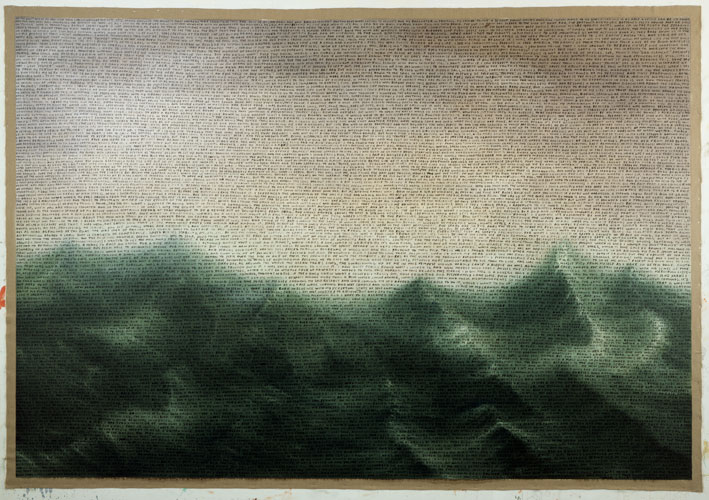
If a picture paints a thousand words then what happens when the picture is words? Sean Landers uses painting as a way to tell stories but it’s not the picture part of the equation – when there is one, and more often than not there isn’t – that does the talking. It’s all those words.

I saw Landers’s work first in Young Americans at the Saatchi Gallery in, I think*, 1996. I remember being mesmerised by it. I made a very good attempt at reading the paintings but I think I failed. By the time you’re about three or four lines in it’s hard to get from the end of one line to the start of the next without skipping or re-reading so hoolding on to the thread of the narrative becomes troublesome.

Continue reading

It’s only words

John Baldessari, Everything is Purged from this Painting, 1968

Thinking about books becoming art yesterday made me ponder the use of text – one of the raw materials of books – as art. Language is key to the conceptual art of the 1960s, with the idea taking precedence over aesthetics. Inevitably the resulting work could be rather dry and hard to engage with, but this is far from universally true. John Baldessari’s text paintings work on several levels for me. Firstly, Baldessari confuses matters by rendering his text in paint on canvas. Secondly, the text is often funny, especially in the context of painting.

Continue reading

Through the trees

Peter Doig, Concrete Cabin, 1994Peter Doig, Concrete Cabin, 1994

Thinking about houses in the middle of nowhere for the previous post started me thinking about a couple of Peter Doig paintings and in particular what gives them a very different feeling to Michael Raedecker’s landscapes. The most obvious difference is in the time of day depicted; these are daytime scenes which makes for a very different feel. And they’re straightforward paintings, whereas part of the strangeness in Raedecker’s scenes comes from  the use of stitch in the paintings. But, of course, it’s more than that.

Continue reading

After dark

Michael Raedecker, Ins and Outs, 2000

There’s something about houses in the middle of nowhere. In some respects I can see the attraction of living in a modernist box surrounded by trees, although clearly in practice I’d miss the tube and being able to get to galleries and theatres and the cinema and decent shops and, oh, the list goes on but it gets too boring to type. In the end though, surprisingly, it’s not fear of not being in London that’s the biggest factor, it’s the fear of just not knowing what’s out there. Okay, so being in a hermetically sealed glass box might be warm and safe but if you can’t see what’s outside, well, it could be anything.

Continue reading

Animal stories

Paula Rego, Pregnant Rabbit Telling Her Parents, 1982

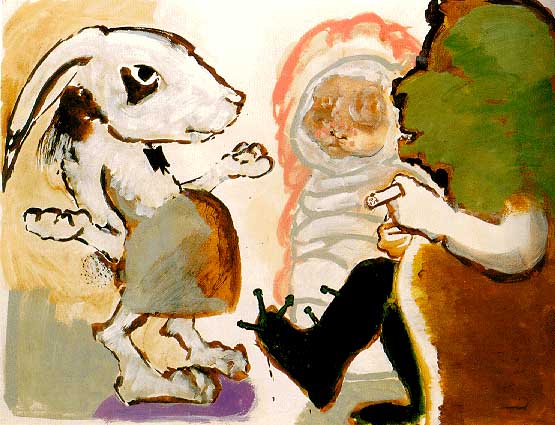
As the cliché has it, a picture paints a thousand words. I’m not sure how often that’s actually true – if ever – but Paula Rego certainly gives it a good go. There is frequently a personal element to the stories she tells though for me the pleasure more often comes from setting the background aside and letting the image do the talking. Casting animals in the roles of her protagonists mean that Rego’s stories often make me smile. In this respect a particular favourite is Pregnant Rabbit Telling Her Parents. Actual rabbits of course must spend a good deal of time pregnant, so their parents would be unsurprised by the news the painting’s title character is breaking – indeed Rabbit has a somewhat brazen, what of it look about her – but actual rabbits would also have rabbits as parents. In the world of Paula Rego that would be far too easy.

Continue reading

Glossy indifference

Gary Hume, Bad Tooth, 2011

Gary Hume’s exhibition The Indifferent Owl is as slick and polished as one might expect from an artist who paints with gloss paint and exhibits at White Cube, but for me, though I generally like Hume’s work a lot, there is something missing. Quite what that something is I don’t know but maybe it’s the indifference in the exhibition’s title seeping out and affecting the way I see the work.

Continue reading

Size isn’t everything

Anselm Kiefer, Dat rosa miel apibus, 2010-11

There is something extraordinary about Anselm Kiefer’s paintings. The surfaces aren’t quite like anyone else’s and the scale of the work means that standing before one I always feel part of the picture space. The paintings in Kiefer’s exhibition Il Mistero delle Cattedrali at White Cube Bermondsey are less heavily textured than some of his work but the surfaces are still rough and often salty.

Continue reading