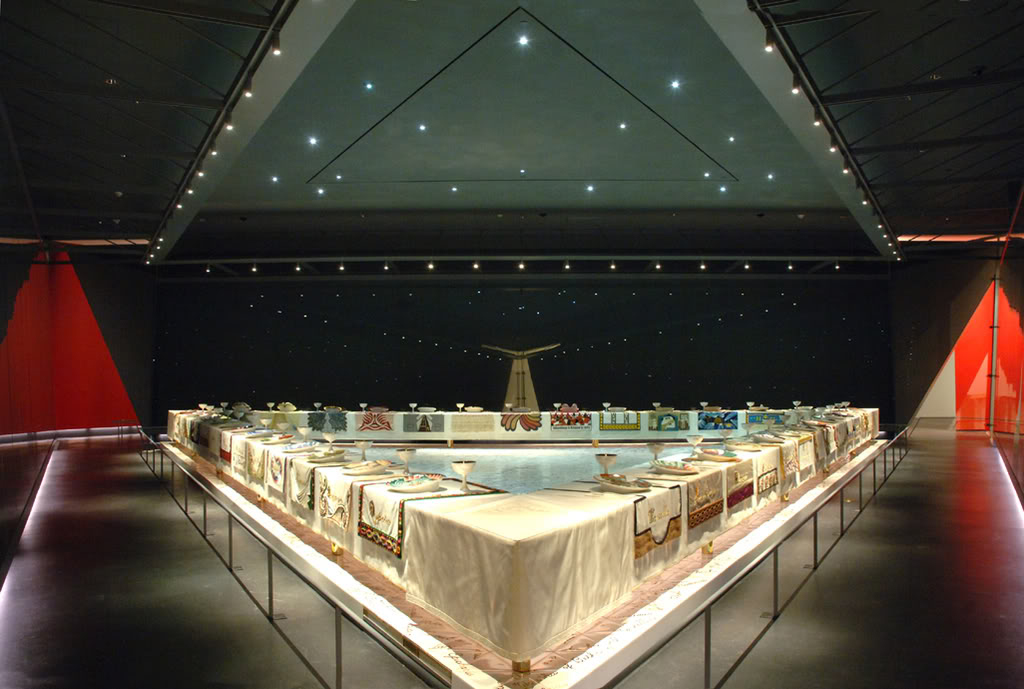
 Judy Chicago, The Dinner Party, 1974-79
Bodily functions
Reply
Judy Chicago, The Dinner Party, 1974-79
 Ron Mueck, Drift, 2009
Ron Mueck, who started his working life making models for children’s television before turning his attention and transferring his skills to art, makes the world look strange and often grotesque. His hyper-real figures vary dramatically in scale, from vastly larger than life to positively diminutive; the one thing they never are is life-size. His exhibition at Hauser and Wirth – Mueck’s first solo show in London in over a decade according to the press release – contains just four works but managed to give me quite a lot to think about nonetheless.
Drift occupies on wall of an otherwise empty gallery. A man floats on a lilo on a sea of turquoise. Well, I say he floats. It’s hard to see it any other way but the sea of turquoise is the wall so the floating is imagined given that the man and his lilo are vertical. He seems bathed in sunlight; his hands hang over the sides of the airbed, as though trailing water. He looks relaxed though his eyes are invisible behind his sun glasses and his face is slightly stern.
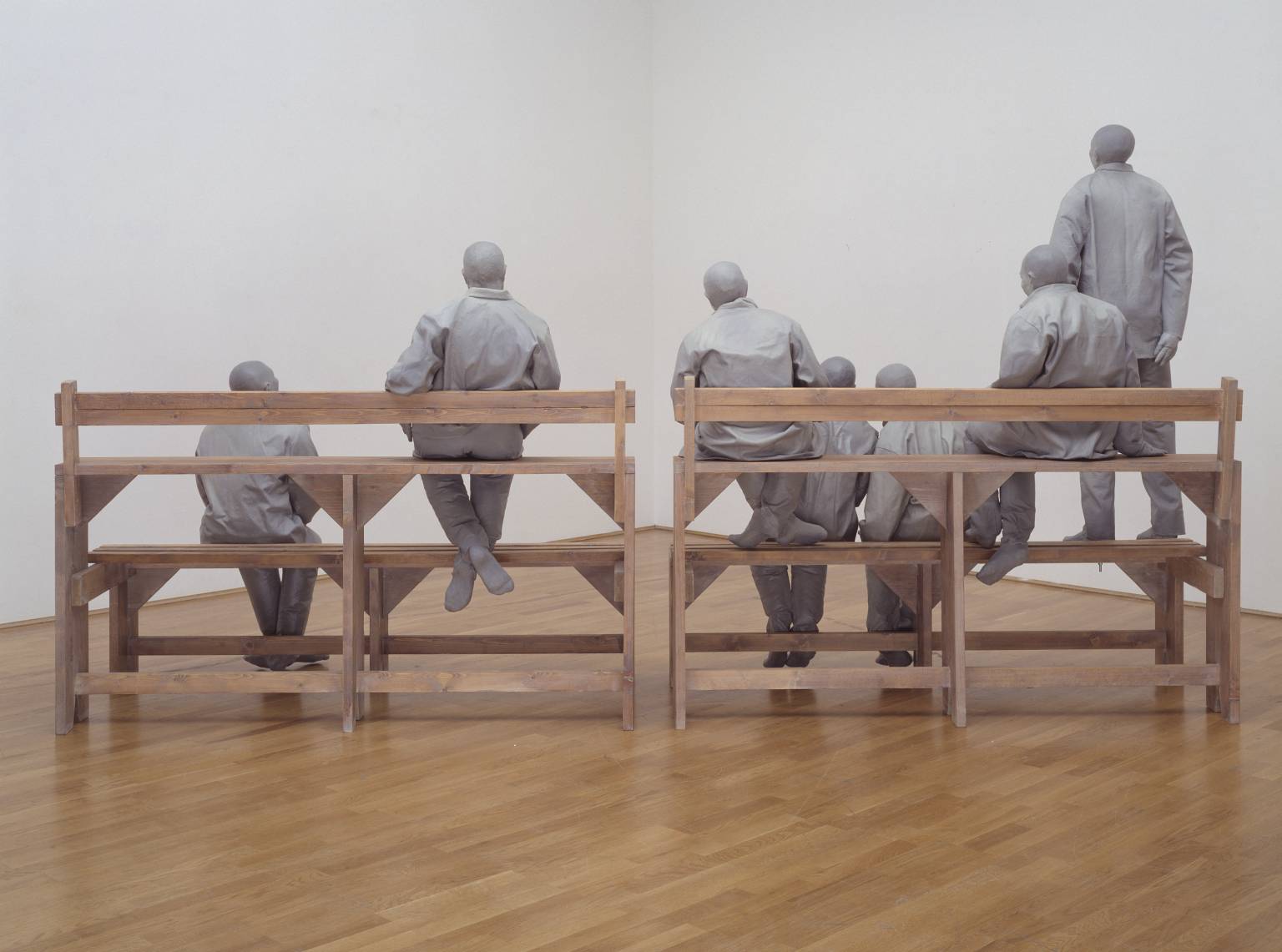 Juan Muñoz, Towards the Corner, 1998
From behind it’s the grey uniformity of the figures that’s striking. They look relaxed and comfortable on the wooden terraced seating. One or two lean in towards one another conspiratorially, but in the main though they are sharing the experience, they seem lost in their own enjoyment of whatever it is they’re watching. Working one’s way round the edge of the piece to see the the work from what we assume to be the front is a very different experience. No longer one of the crowd of watchers – and by now trapped in the corner of the room by the work – one immediately becomes not merely the watched but the laughed at. Regular readers will probably have realised by now that I like art that makes me laugh; disconcertingly, in Juan Muñoz’s Towards the Corner it is the art that is doing the laughing. And it’s laughing at me.

Duane Hanson, Tourists II, 1988
Models of people made in the name of art are hardly a new concept but nonetheless there’s something unexpected about figurative sculpture that needs a second glance – at least – to reveal itself as object rather than person. Duane Hanson’s figures look very real – indeed his working process included casting from live models – and often very out of place in contemporary gallery spaces. It’s the incongruousness of the figures in the context that makes me most enjoy the ones who look like they just might be real until one gets close enough to spot the pretence. Seen in a London gallery, Hanson’s Tourists look like they might be American tourists who have wandered into a contemporary art space by mistake. Hanson is dealing in stereotypes, but in doing so, he is asking us to question our own preconceptions.
 Kerry Stewart, This Girl Bends, 1996
Kerry Stewart’s children are older – in the main, we’re back to the adolescents of Rineke Dijkstra’s Beach Portraits – and less strange than the young kids Loretta Lux and Nicky Hoberman represent, but that doesn’t mean that all’s right with their world. Stewart works with sculpture and installation to create works that can in a way be seen as portraits. They involve people after all. In Stewart’s case the people are made from, variously, plaster or fibreglass and paint. There is a level of realism but also a strangeness that once again seems best explained in terms of the uncanny.
This Girl Bends presents us with a girl in a gravity-defying pose. Her eyes are open but staring, her clothes are ambiguous in their plainness: the collar suggests day wear but her trance-like state says sleepwalker more than it says concentration to me. I confess though that I’m not sure whether I’ve seen this work in real life and it wasn’t one of the works that brought Stewart to mind today; nonetheless, I really like the oddness of it and would like to come across it in a gallery.
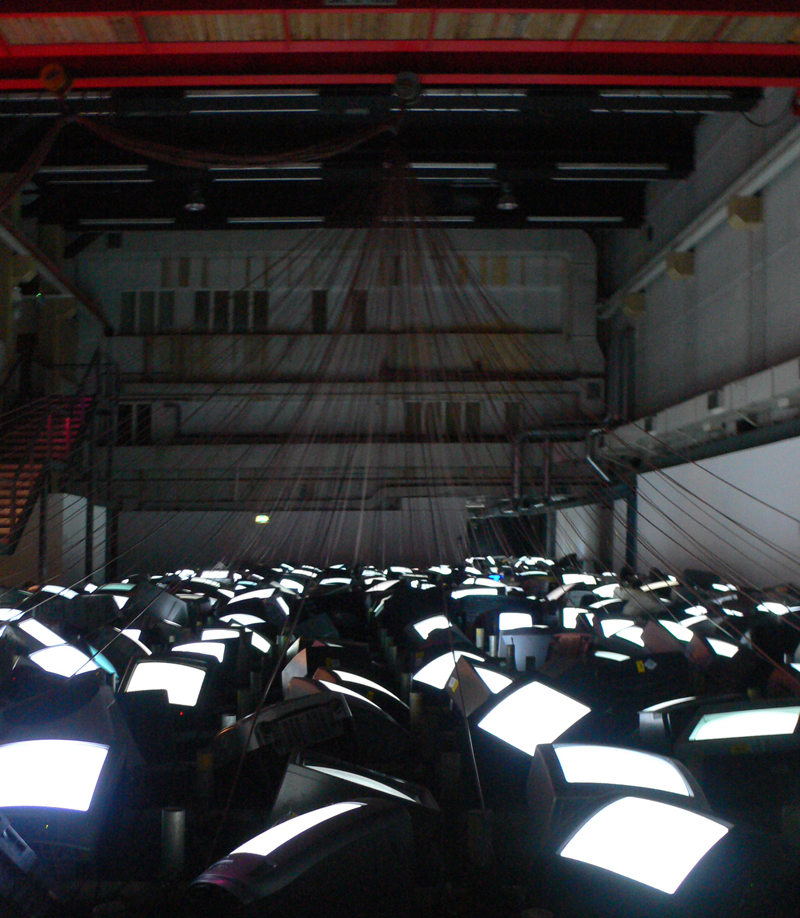 David Hall, 1001 TV Sets (End Piece), 2012
As of Wednesday, analogue telly is a thing of the past. Well okay, it’s clinging on for a few more months in a couple of parts of the country, but for most of us in the UK old tellies either need to be attached to a digibox or it’s all over. At Ambika P3, David Hall’s End Piece … exhibition (part of which I wrote about here a week or two ago) is a fitting way to mark its passing. The centrepiece of the exhibition is the extraordinary, descriptively titled installation 1001 TV Sets (End Piece). With the analogue switchoff on Wednesday the work went from being a bewildering jumble of images with a cacophonous soundtrack to 1001 different types of snow. The sound is still loud but it’s a constant static now rather than the chaos of five competing television channels.
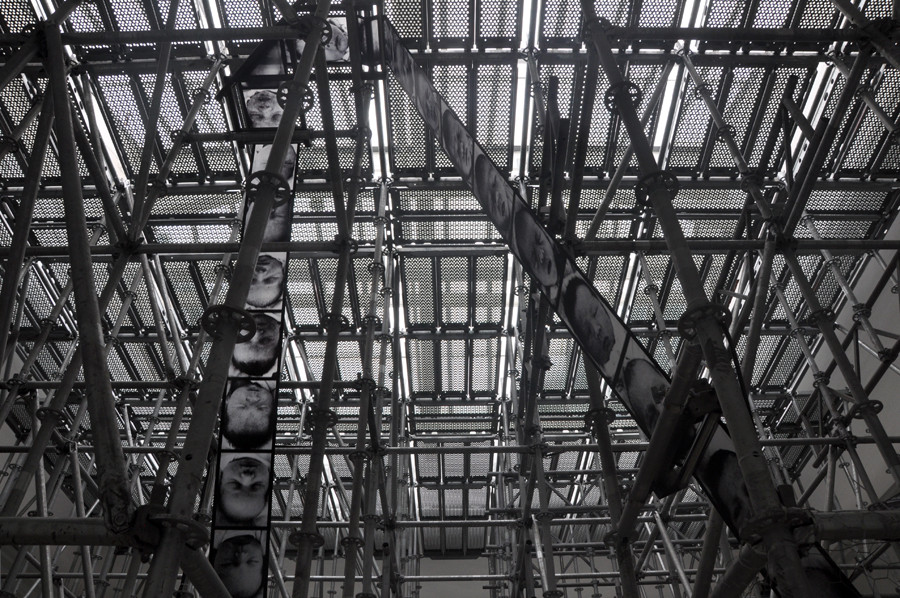 Christian Boltanski, Chance, 2011
Since I seem to be stuck in mazes and cages this week, it’s perhaps no surprise that Christian Boltanski’s installation for the French pavilion at the 54th Venice Biennale last year has worked its way back to the front of my mind. For me, this was one of the highlights of the Biennale though admittedly I think I’ve yet to see a work by Boltanski that I haven’t liked. This work does feel quite different to most of Boltanski’s installations though, not least because it’s playful – literally, in that it includes a game – and open to a hopeful reading, though more sombre interpretations are also possible.
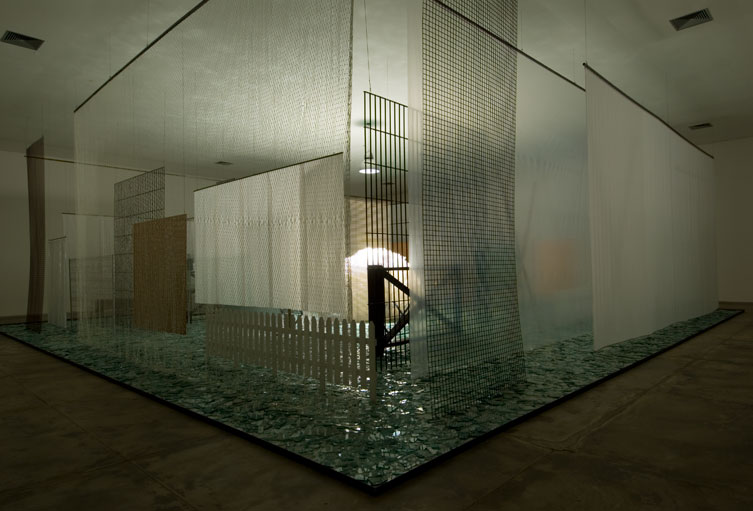 Cildo Meireles, Through, 1983-89/2008
Installation art can be risky. It’s just that usually the risks are more about whether the pieece will work and whether viewers will respond as one hopes rather than whether they’ll stumble on a floor of broken glass. But having risked his own freedom by making overtly political work while living in a military dictatorship, Cildo Meireles was never likely to be put off by something like a slight – and largely theoretical – risk of an audience member sustaining a minor injury. Unlike the harmless threat of the long shadows and caged-in feeling of being in a Mona Hatoum installation, Meireles’s Through does involve a level danger, albeit a low one.
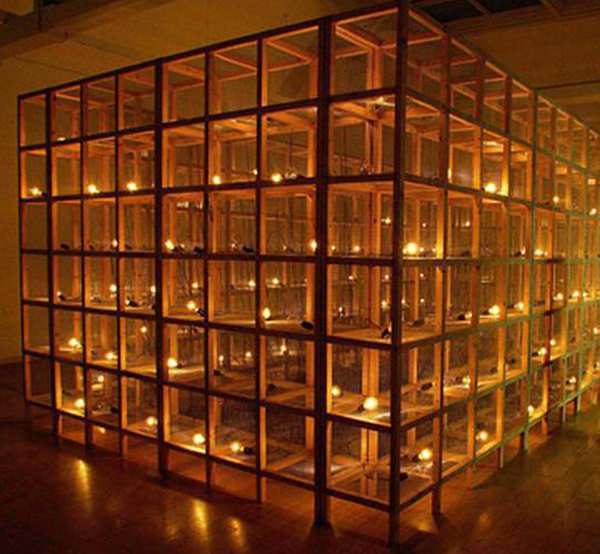 Mona Hatoum, Current Disturbance, 1996
The whimsy of Noble and Webster’s use of shadows is witty enough but ultimately – for me at least – the work is unsatisfyingly slight. I enjoy it well enough at the time but the work never really gets under my skin. But shadow is a powerful force and it’s one that Mona Hatoum uses to really good effect.
In installations like Current Disturbance – which I saw at the Whitchapel Gallery in 2010 – Hatoum uses shadow as a meaning force. The bare lightbulbs fade in and out and the crackle of an electric current gives a sinister edge to the changing light levels. The gridded structure – reminiscent of the cages occupied by battery hens perhaps – feels prison-like. The installation has an architectural feel, but if this is a city space it is a densely-populated and uncomfortable one.
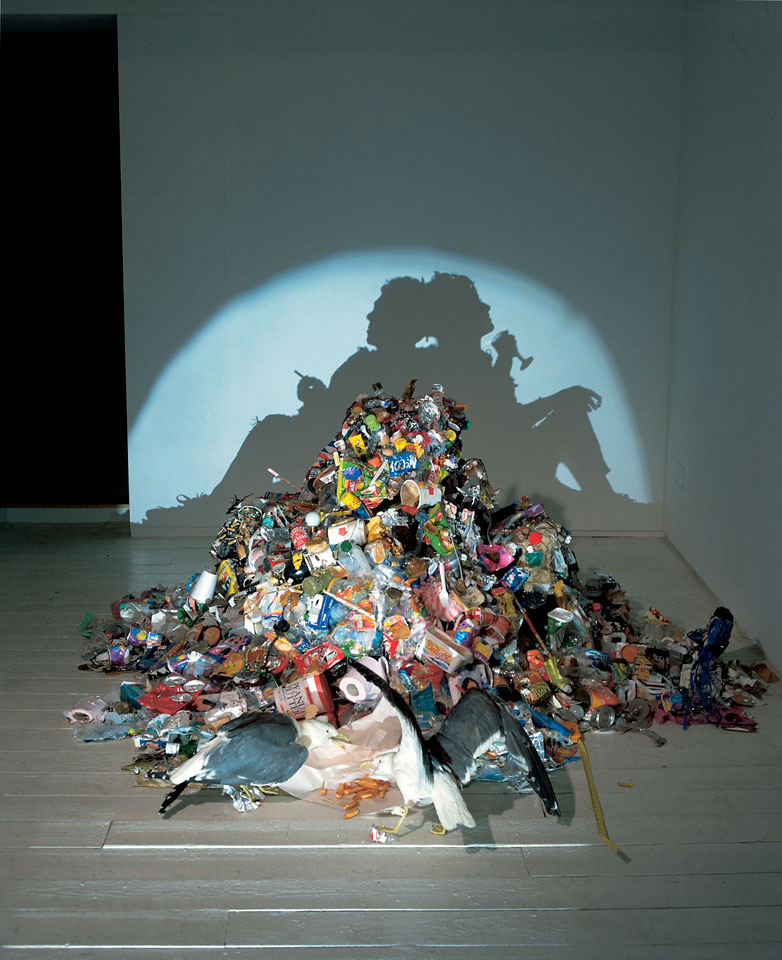 Tim Noble and Sue Webster, Dirty White Trash (With Gulls), 1998 ( months’ worth of artists’ trash, 2 taxidermy seagulls, light projector)
Tim Noble and Sue Webster make rubbish self-portraits. That’s not to say they made self-portraits that are rubbish (though of course that’s a matter of opinion). No. It’s that they make self-portraits from rubbish. If we are what we eat – as the old cliché susggests – then surely we’re also defined in some way what we throw away.
The materials for Dirty White Trash (With Gulls) six months’ worth of artists’ trash. Noble and Webster have assembled the trash into a pile that casts a shadow of the couple sitting back to back, smoking and drinking as seagulls seem to pick at the pile of rubbish that forms the image.
 IMAGE OBJECT TEXT