The sound of melting ice

Katie Paterson, Vatnajökull, 2007

Vatnajökull in Iceland is the largest glacier in Europe. But it’s melting into a lagoon, thanks, one assumes, to climate change. For a week in June 2007, artist Katie Paterson submerged a microphone, attached to a mobile phone, into the freezing waters of the ever expanding Jökulsárlón lagoon making it possible to listen to the sound of the ice melting.

For the work Vatnajökull (the sound of), Paterson displayed the phone number – in the form of a neon sign – at the Slade School of Fine Art in London as part of her MFA degree show.

Continue reading

The stuff of art (and life)

Vong Phaophanit Neon Rice Field 1993

Vong Phaophanit, Neon Rice Field, 1993

Rice is a staple. It’s a foodstuff a large portion of the world’s population depends on. For those of us with the luxury of choice whose diet has become mixed as a result of the movement of people, goods and traditions, it has less cultural significance but is nonetheless something we take for granted, while knowing we could survive without it. For us it could perhaps be argued that art is something akin to a staple. We could perhaps find a substitute if push came to shove but in its own way it nourishes us. Mix the two and you have Vong Phaophanit’s Neon Rice Field an extraordinary installation for which Phaophanit was nominated for the Turner Prize in 1994.

Continue reading

Everything and nothing at all

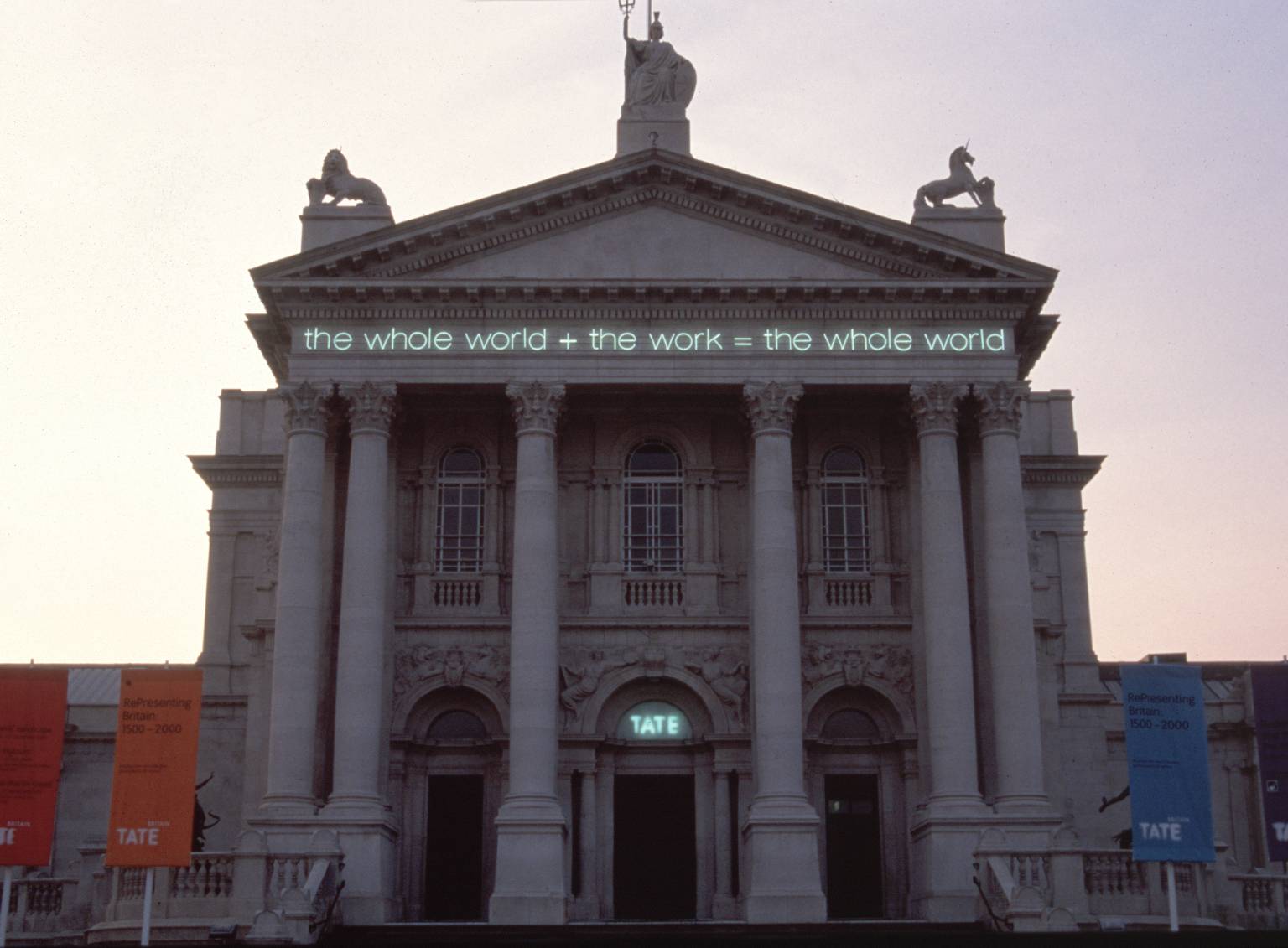
the whole world + the work = the whole worldMartin Creed, Work No. 232: the whole world + the work = the whole world, 2000

There are two ways to see this. Clearly if A + B = A then B = 0, so in Martin Creed’s equation the work can definitely be read as nothing at all. But is art really a big fat zero? And if it is, is the outside of a major art museum the place to say it? Well, let’s try again…

Continue reading

Time and tide

Low Tide Wanderings installationThomas Schütte, Low Tide Wanderings, 2001 (installed in Print/Out at MoMA, 2011)

In 2001, with digital practices becoming increasingly widespread in the visual arts, Thomas Schütte decided to use very traditional, analogue image-making as a way of keeping a visual diary. Rather than drawing in sketchbooks, as he usually would, Schütte adopted the more labour-intensive approach of etching. He subsequently produced an edition of 139 prints, one of which is included in the Print/Off at MoMA.

Reading someone else’s diary, a decade after the event, isn’t necessarily that interesting and in part the fascination of this work lies in the installation rather than the images. The prints are suspended on lines criss-crossed through the gallery just above head height (if, like me, you’re quite short).

Continue reading

Forty parts of perfect

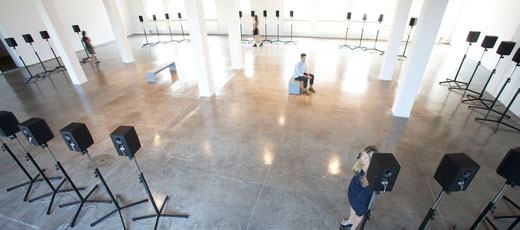
Janet Cardiff, The Forty Part Motet, 2001

It starts with a bit of whispering and low-level chatter from around the room but gradually the singing starts, quietly at first but quickly getting louder as different voices join in. Before I know it, the room is full of sound. Whether seated in the centre of the oval of speakers – one for each of the forty voices of the Salisbury Cathedral Choir singing Thomas Tallis’s Spem in alium – or wandering among the speakers picking up individual voices, this is not a soundscape it’s possible to experience in the concert hall.

Continue reading

A horse, of course

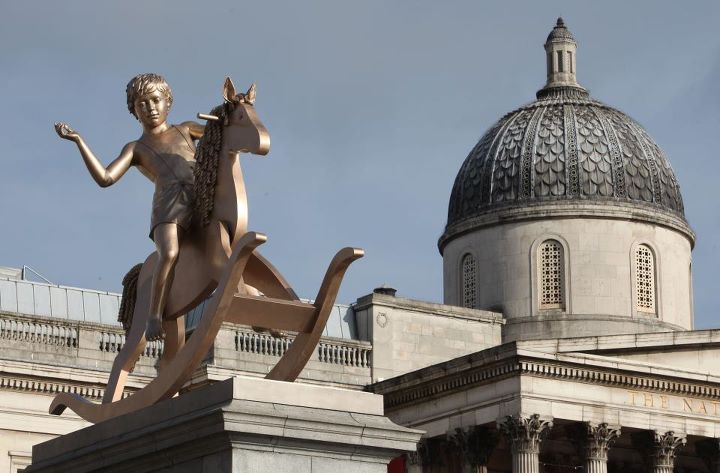
Elmgreen and Dragset, Powerless Structures Fig. 101, 2012

If, in a public square in a capital city, you have an empty plinth intended for a statue of a figure on a horse then what better to put on it than a statue of a figure on a horse? After testing a lot of alternatives on the fourth plinth in Trafalgar Square, the plinth that never quite got its statue, it should come as no surprise that the powers that be have yielded to the inevitable and installed the statue that was always meant to be there. Sort of.

Continue reading

A web of enchantment

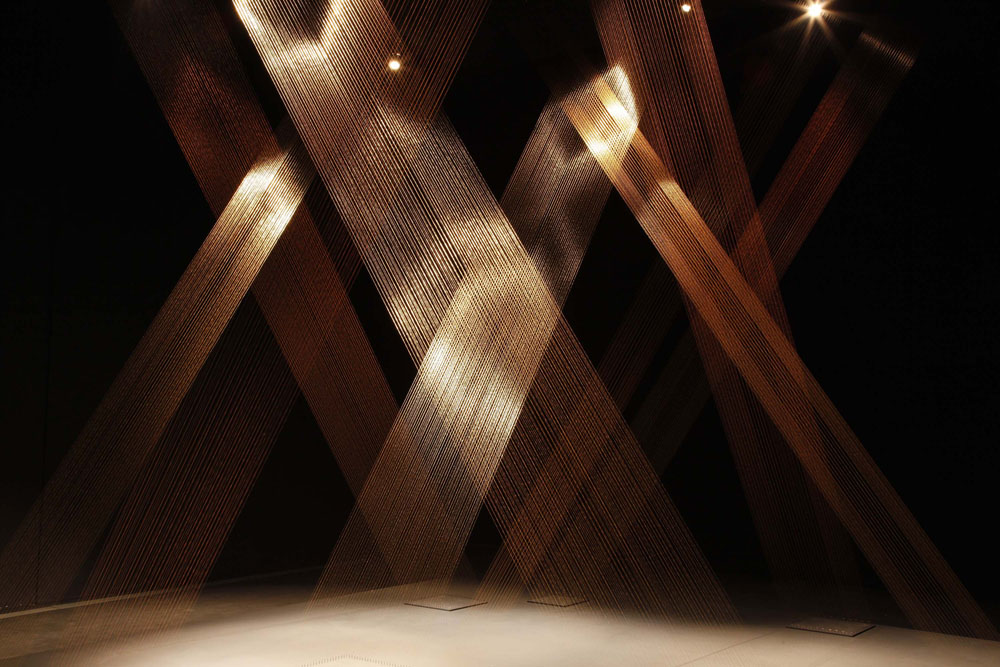
Lygia Pape, Ttéia 1, C (Web), 2011 (Installation view, Serpentine Gallery)

Perhaps it’s just my preoccupation of the week (or perhaps I’m desperate to make links here, no matter how tenuous), but seeing Lygia Pape’s beautiful installation of gold thread at the Serpentine Gallery put me in mind of a forest. The space is disrupted by thread that sparkles in the space rendering it unnavigable. The thread seems to form beams of light through the darkness, like sunlight penetrating a forest. Though the whole of Magnetized Space, Lygia Pape’s installation at the Serpentine Gallery, is fascinating and though this may be the only work I’ve seen in real life before, Ttéia 1, C is definitely the highlight for me.

Continue reading

Shadows in the forest

Loris Gréaud, Gunpowder Forest Bubble, 2008

There is something enchanted about Loris Gréaud’s Gunpowder Forest Bubble (currently installed in Palazzo Grassi as part of the exhibition The World Belongs to You). By the light the moon, which hangs low in the shadowy forest, I can see that I am alone. The trees are bare and dark; they loom above me. There is a sense of theatre about the installation, albeit without a predetermined narrative. This is the forest as a fairytale space where anything is possible, and anything – perhaps especially – danger might be revealed. And there is danger here, notionally at least, for the stark carbonised trees are coated in gunpowder. Rationally I might know that the risk is minimal to non-existent, but still: gunpowder! That hardly seems safe.

Continue reading

Beautiful decay

Anya Gallaccio, Beauty, 1991-2003

Flowers have a long history in art, not least in the history of pretty but clichéd painting. The flowers in Anya Gallaccio’s work aren’t painted though, nor sculpted. They are real, presented in panels and not altered – or, crucially, preserved – in any way.

Continue reading

Looking efficiency in the eye

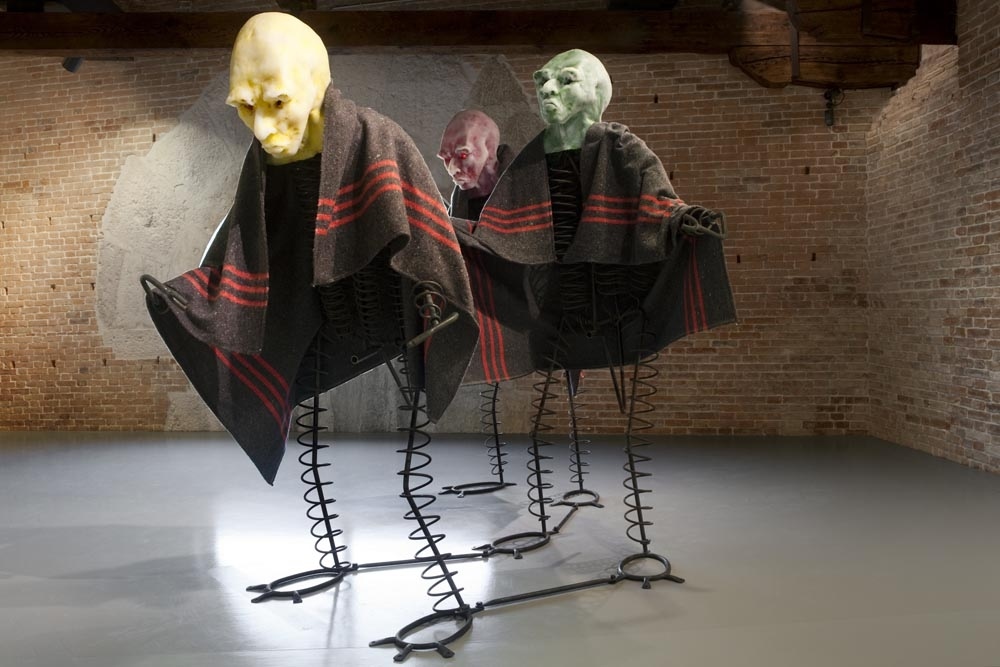
Thomas Schütte, The Efficiency Men, 2005

There is something slightly terrifying about Thomas Schütte’s The Efficency Men. The metal frame bodies are strange and the blankets round their shoulders give an air of pathos but ultimately it’s the eyes in their oversize heads that get me. Staring into the eyes of one of the figures isn’t at all comfortable.

Continue reading