Long hot summers

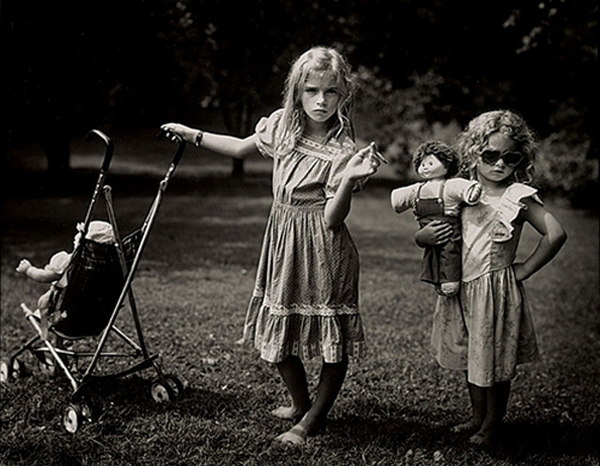
Sally Mann, The New Mothers, 1989

Sally Mann’s series of photographs of her children Emmett, Jessie and Virginia, made over a seven year period and both exhibited and published as Immediate Family, tells of the freedom of long hot summers spent in the countryside around the family’s home in Lexington, Virginia. Mann photographed the children only in the summer when they were out of school and free to play. Made with a large format camera, the pictures are very far removed from the informal snapshots we generally take to document family life. These pictures – whether they look it or not – are deliberately posed and carefully made. The children are playing but their play is for the camera.

Given the heat of the Virginia summer, it’s perhaps unsurprising that the children are often naked and it’s this that has caused the greatest controversy. Given the hysteria that now surrounds images of children it’s hard to see Immediate Family without factoring in the issues that now surround the representation of children.
Continue reading

Motherhood as art

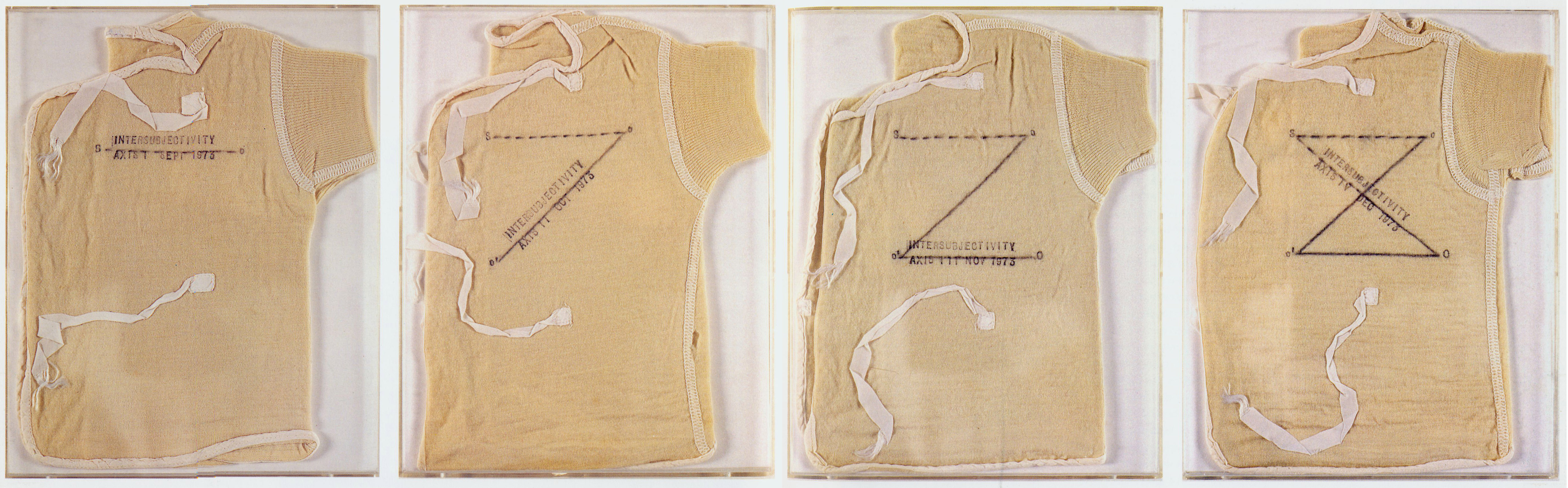
Mary Kelly, Post-Partum Document (detail: vests, from Introduction), 1973-79

Like Susan Hiller, Mary Kelly documented her pregnant belly as art but it is the work she made after the birth of her childfor which she is better known. Post-Partum Document made between 1973 and ’79, the first years of her son’s life, is an extensive document of the mother and child relationship and of the nature of motherhood. The work is in six sections and contains over a hundred items of documentation from the vests shown above to diary notes, graphs and other data and artefacts such as stained nappy liners. The work is driven by the process of making it and clearly parts of that process aren’t pleasant.

Continue reading

Counting the days

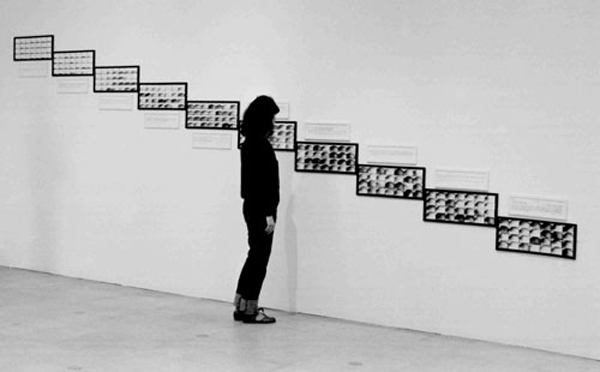
Susan Hiller, Ten Months, 1977-79

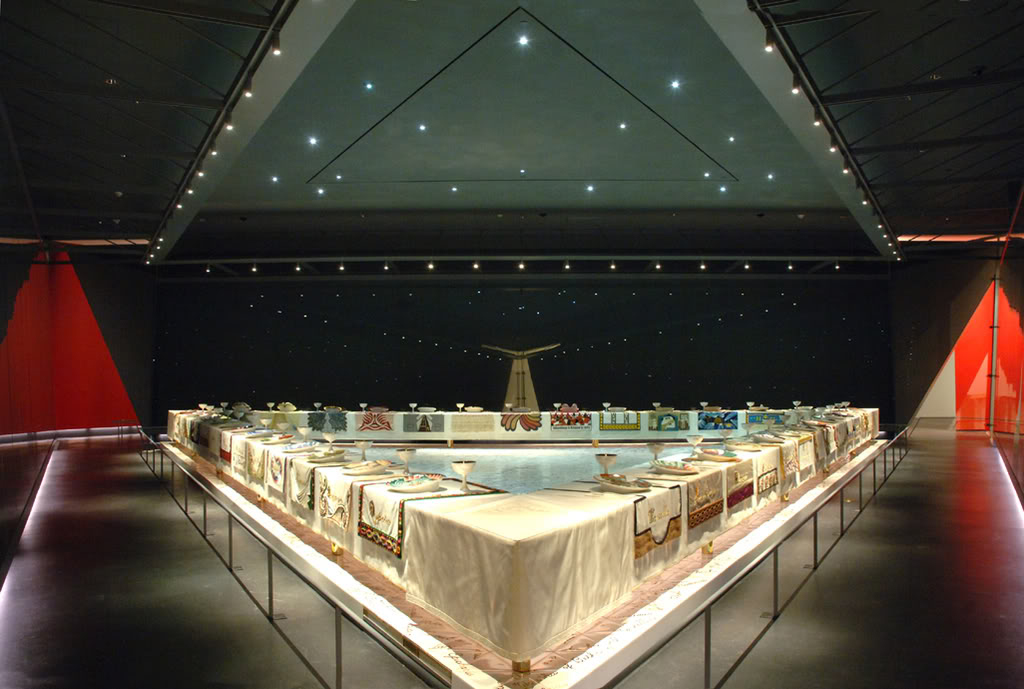
To an extent the work of both Jenny Saville and Judy Chicago is seen as feminist in part because it reclaims the female nude for women artists. So far so good, but why then do I take issue with Chicago’s approach – or at any rate to The Dinner Party – while finding Saville’s work challenging and relevant? In part of course it’s to do with the earnest nature, and perhaps hippy thinking, of 1970s feminism. So do I have the same response to other work from that era? Well, yes and no.

Susan Hiller’s Ten Months takes the artist’s pregnancy as it’s subject matter. Hiller photographed her growing belly throughout and arranged the photographs in 10 grids, read from left to right and stepping down the wall, each one corresponding to a lunar month. So far, so hippy. Along with the images, each grid has a text taken from Hiller’s journal. The text for each month is brief and the editing process brings the work back on track for me.

Continue reading

Bodily functions

Judy Chicago, The Dinner Party, 1974-79

The reputation of the 1970s isn’t great. If you type ‘1970s the decade’ into its search box, Google helpfully suggests the additions ‘that taste forgot’ and ‘style forgot’. Thanks for that. In fairness, in all sorts of ways it was a pretty rubbish decade. But it was also a decade in which some pretty great art was made and one in which women used art as a political weapon as never before. Probably. I’m sure there are plenty of earlier examples, but there was a pretty significant connection between female artists and the emerging women’s movement. Feminist artists like Mary Kelly, Martha Rosler, Judy Chicago and others made work that challenged previous modes of representation and sought to celebrate women and the female body on their own terms. Inevitably, the results weren’t always pretty.
Continue reading

This solid flesh

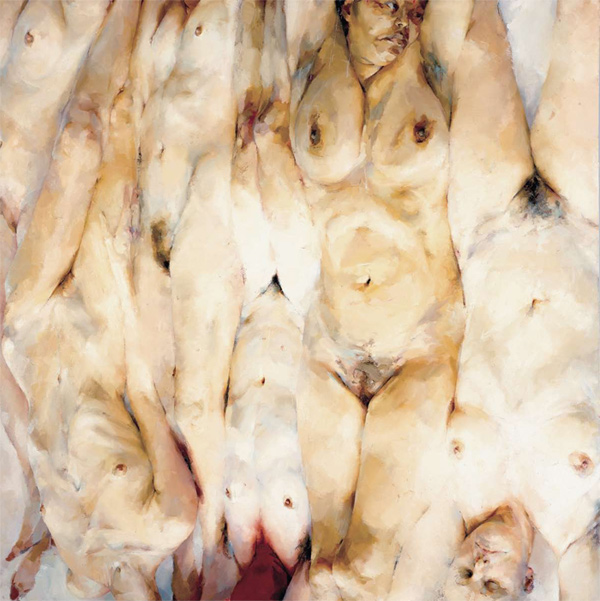
Jenny Saville, Shift, 1996-97

It was the chicken in Ron Mueck’s show at Hauser and Wirth that made me think of Jenny Saville. I realise that probably sounds crazy but the chicken skin put me in mind of Saville’s Shift, a vast painting (something like 3.3m x 3.3m, so able to dominate the space even in a sizeable gallery) showing a row of women squashed up against each other. It’s a painting I haven’t seen in many years but of all Saville’s work – and she’s a painter I like a lot – it’s the piece that’s always had the strongest hold over me. It’s partly that Jenny Saville paints flesh really well and partly that I like the way she makes me think about body image and the way we’re conditioned to see ourselves. These aren’t the idealised figures of art history or women’s magazines; they are women as women are. It turns out that painting the female nude and feminism aren’t mutually exclusive – however much a trip to almost any major art museum might make it seem that way – which is good to know.

Continue reading

Laughter, pain and shadow

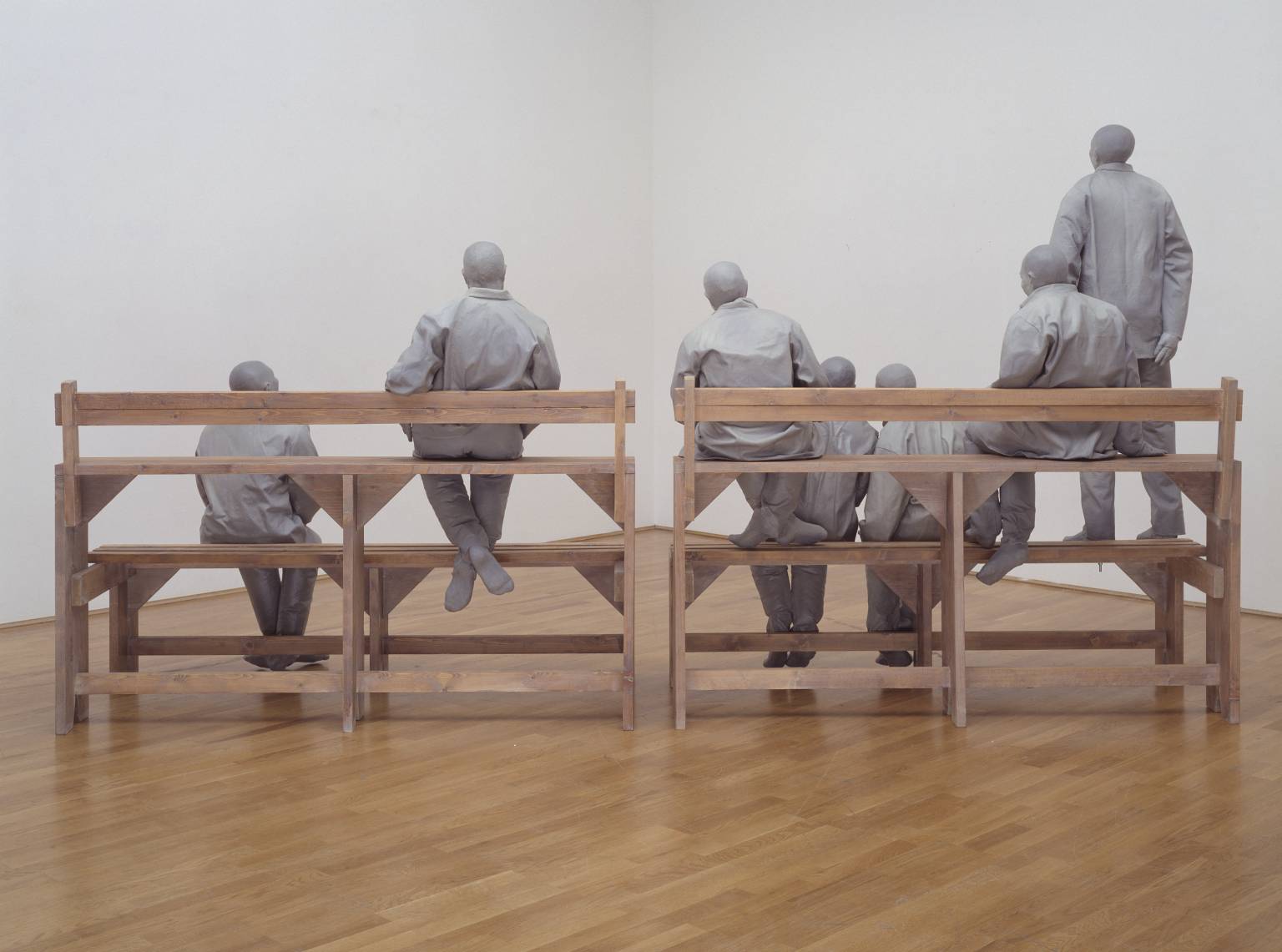
Juan Muñoz, Towards the Corner, 1998

From behind it’s the grey uniformity of the figures that’s striking. They look relaxed and comfortable on the wooden terraced seating. One or two lean in towards one another conspiratorially, but in the main though they are sharing the experience, they seem lost in their own enjoyment of whatever it is they’re watching. Working one’s way round the edge of the piece to see the the work from what we assume to be the front is a very different experience. No longer one of the crowd of watchers – and by now trapped in the corner of the room by the work – one immediately becomes not merely the watched but the laughed at. Regular readers will probably have realised by now that I like art that makes me laugh; disconcertingly, in Juan Muñoz’s Towards the Corner it is the art that is doing the laughing. And it’s laughing at me.

Continue reading

In the crowd

Duane Hanson, Tourists II, 1988

Models of people made in the name of art are hardly a new concept but nonetheless there’s something unexpected about figurative sculpture that needs a second glance – at least – to reveal itself as object rather than person. Duane Hanson’s figures look very real – indeed his working process included casting from live models – and often very out of place in contemporary gallery spaces. It’s the incongruousness of the figures in the context that makes me most enjoy the ones who look like they just might be real until one gets close enough to spot the pretence. Seen in a London gallery, Hanson’s Tourists look like they might be American tourists who have wandered into a contemporary art space by mistake. Hanson is dealing in stereotypes, but in doing so, he is asking us to question our own preconceptions.

Continue reading

Model behaviour

Kerry Stewart, This Girl Bends, 1996Kerry Stewart, This Girl Bends, 1996

Kerry Stewart’s children are older – in the main, we’re back to the adolescents of Rineke Dijkstra’s Beach Portraits – and less strange than the young kids Loretta Lux and Nicky Hoberman represent, but that doesn’t mean that all’s right with their world. Stewart works with sculpture and installation to create works that can in a way be seen as portraits. They involve people after all. In Stewart’s case the people are made from, variously, plaster or fibreglass and paint. There is a level of realism but also a strangeness that once again seems best explained in terms of the uncanny.

This Girl Bends presents us with a girl in a gravity-defying pose. Her eyes are open but staring, her clothes are ambiguous in their plainness: the collar suggests day wear but her trance-like state says sleepwalker more than it says concentration to me. I confess though that I’m not sure whether I’ve seen this work in real life and it wasn’t one of the works that brought Stewart to mind today; nonetheless, I really like the oddness of it  and would like to come across it in a gallery.

Continue reading

Curious children

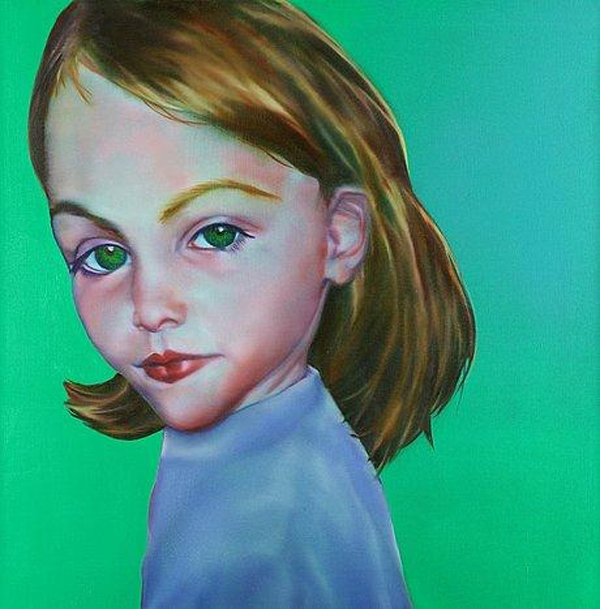
Nicky Hoberman, Spectre, 1998

The strange world of childhood is central to Nicky Hoberman’s painting. Like those in Loretta Lux’s photographs, there is something not quite right about these children and the space they inhabit. Here though the children are isolated completely from the context of the world outside and shown against plain coloured backgrounds that offer no clue as to their situation. Though the facial features in Spectre are only slightly out of proportion – there is something especially disturbing about the eye that should be furthest from us being larger than the one we’re closer to – it’s the relationship of the girl’s head to her body that confuses me more. The body – smaller than it should be – lacks detail to the extent that I can’t quite decide whether her head’s even facing the right way.

Continue reading

Tales of the uncanny

Loretta Lux, Dorothea, 2001

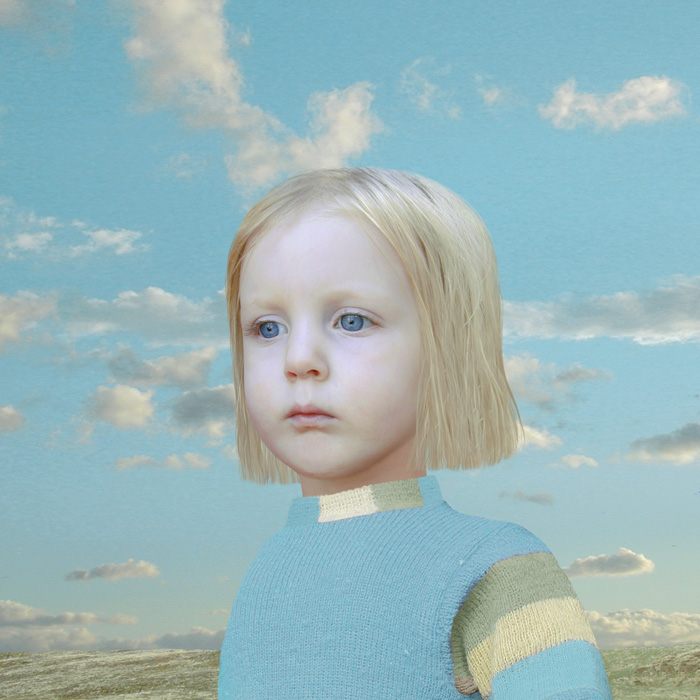
Children are weird. Well, in the world of Loretta Lux they are anyway. It’s hard to work out exactly what’s wrong, but clearly something’s up. It’s partly the washed out colours but there’s definitely more. These children don’t seem entirely real. They have a doll-like quality and though they lack the telltale golden eyes, there is perhaps something of the Midwitch Cuckoos about them. At very least, they seem to be in a trance of some sort.

Continue reading