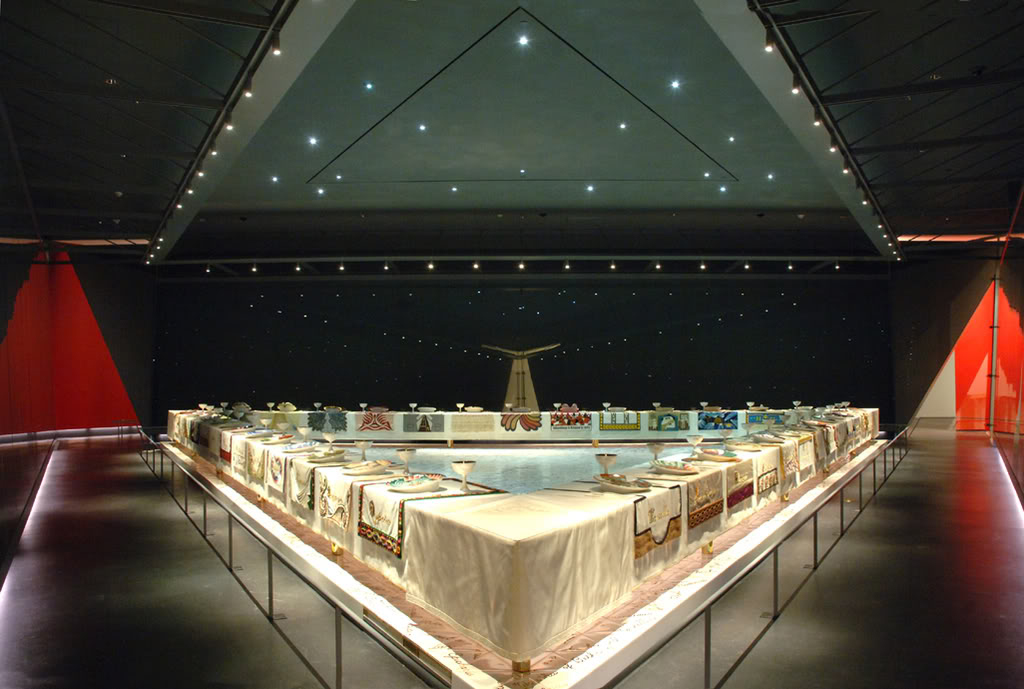
 Judy Chicago, The Dinner Party, 1974-79
Bodily functions
Reply
Judy Chicago, The Dinner Party, 1974-79

Fiona Banner, Apocalypse Now, 1997
Stories can be told in many different ways, words on the page and images on a cinema screen being two of the most common. It’s when the means of story-telling becomes words on a cinema screen that things start to get confusing. I’m not sure how easy it’d be to try to follow the story of Apocalypse Now from Banner’s piece of the same name, but the narrative is all there. It’s just that it’s there as a hand-written text on a page the size and shape of a cinema screen. And only yesterday there I was claiming Sean Landers choice of line length seemed excessive!
 Thomas Schütte, Low Tide Wanderings, 2001 (installed in Print/Out at MoMA, 2011)
In 2001, with digital practices becoming increasingly widespread in the visual arts, Thomas Schütte decided to use very traditional, analogue image-making as a way of keeping a visual diary. Rather than drawing in sketchbooks, as he usually would, Schütte adopted the more labour-intensive approach of etching. He subsequently produced an edition of 139 prints, one of which is included in the Print/Off at MoMA.
Reading someone else’s diary, a decade after the event, isn’t necessarily that interesting and in part the fascination of this work lies in the installation rather than the images. The prints are suspended on lines criss-crossed through the gallery just above head height (if, like me, you’re quite short).
 Ellen Gallagher, DeLuxe, 2004-5
Significant highlights of my visit to MoMA were the connected exhibitions Print/Out and Printin’ that look at the way print is used in contemporary art. The latter, organised by artist Ellen Gallagher and Sarah Suzuki, Associate Curator in MoMa’s Department of Prints and Illustrated Books, is centred around Gallagher’s DeLuxe a grid of 60 frames each containing a collaged print based on adverts found in mid-twentieth century black lifestyle magazines and newspaper articles. DeLuxe is an extraordinary, fascinating work that demands, and rewards, close scrutiny. I am fascinated both by the adverts Gallgher has found and by her use materials – particularly plasticine – in the collages.
 IMAGE OBJECT TEXT