In the stacks

Marcos Saboya and Gualter Pupo, aMAZEme, installation in Royal Festival Hall, 2012

If someone had asked me to imagine what 250,000 books looked like, I’m not sure I’d have had a clue. A quarter of a million anything is a lot, that much I do know. But I was always rubbish at guessing the number of smarties in the jar at fêtes, and those numbers were always in the hundreds which is much more manageable somehow. Anyway, in case you happen to be wondering what 250,000 books looks like, there they are, made into a maze resembling the fingerprint of writer and educator Jorge Luis Borges by Brazilian artists Marcos Saboya and Gualter Pupo in the Clore Ballroom at the Royal Festival Hall. As with almost everything else in London this summer, it’s part of the London 2012 Festival, the culmination of the Cultural Olympiad.

Continue reading

Building in hope

Yael Bartana, Summer Camp, 2007 (still)

Yael Bartana, Summer Camp (still), 2007

There are many ways of making political art. For some the point needs to be made in an explicit way while others are happier to leave things open to interpretation. Though Summer Camp is much easier to make sense of than And Europe Will Be Stunned, which I wrote about here recently, Yael Bartana is clearly towards the open to interpretation end of the scale. In Summer Camp, Bartana records the rebuilding of the house of a Palestinian family in the village of Anata (east of Jerusalem) by volunteers organised by the Isreali Committee Against House Demolitions (ICAHD), a non-violent direct action group both protests about house demolitions and seeks to rebuild demolished houses. The team of volunteers filmed by Bartana included both Palestinians and Isrealis as well as people from other countries. In a sense then, Summer Camp is effectively a documentary, but as with the films that form And Europe Will Be Stunned there’s more to it than that. 

Continue reading

Coded messages

Cerith Wyn Evans, Astrophotography…The Traditional Measure of Photographic Speed in Astronomy…’ by Siegfried Marx (1987), 2006

Thinking about Kris Martin’s Mandi iii and its futile attempts to communicate information reminds me about Cerith Wyn Evans’s chandeliers, one of which – the snappily titled Astrophotography…The Traditional Measure of Photographic Speed in Astronomy…’ by Siegfried Marx (1987) – was in the Fade In/Fade Out exhibition at Bloomberg SPACE. Unlike Martin’s piece though, Wyn Evans’s did communicate its message, alebit in a way few could read without assistance. Astrophotography…The Traditional Measure of Photographic Speed in Astronomy…’ by Siegfried Marx (1987) is not just the title of the work but also of the text it is painstakingly spelling out in morse code.

Continue reading

Simple confusion

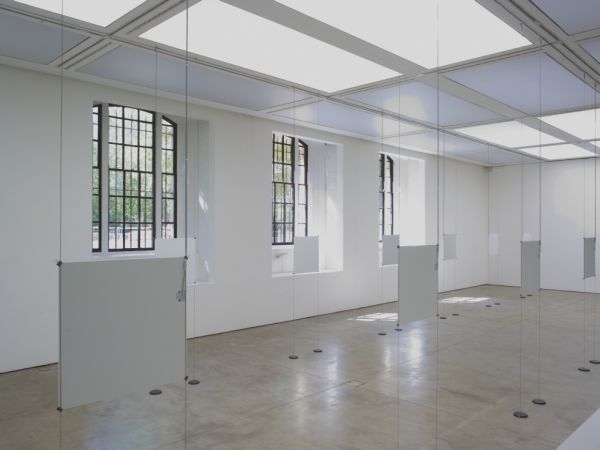
Bruce Nauman, Days, 2009

There is a beautiful simplicity to Bruce Nauman’s Days at the ICA. The space is empty but for two rows of plain white squares suspended at roughly head height. Walking between the white panels – seven in in each row – it’s clear that they’re loudspeakers and that from each a voice can be heard speaking the days of the week. So far, so simple. The space is almost empty and what’s in there is simplicity itself – my liking for art that’s minimal and preferably white can be no secret to anyone who’s been reading this on even a semi-regular basis – so predictably enough I’m in favour of  Days from the start.

Continue reading

Today, tomorrow and yesterday

The unmediated sea at Margate.

There’s something compelling about the sea. It looks so flat and innocent but it demands our respect and we know how violent it can be. But even on the dullest, stillest day, I think I could stare out to sea for quite a long time without getting bored. Standing outside Turner Contemporary at Margate, Mark Wallinger’s Sinema Amnesia is watching the sea this summer and showing it back to us in the form of The Waste Land. The installation takes the form of a shipping container supported by scaffolding and not trying to pretend otherwise. There are references to cinema not just in the title but also the signage but otherwise it’s essentially just a black box in a car park in a run-down seaside town, albeit a car park outside a contemporary art gallery.

Mark Wallinger, Sinema Amnesia installed in Margate, 2012

Continue reading

A simple state of change

Hans Haacke, Wide White Flow, 1967

Looking at Hans Haache’s Floating Sphere yesterday made me think about another work of Haacke’s that surprised me when I came across it at Paula Cooper Gallery in New York a few years ago (February 2008, fact fans). I’d gone to the show because I was in New York with students and at least one Chelsea gallery day is kind of compulsory and because I really like Hans Haacke’s work but haven’t seen nearly as much of it as I’d like in real life; as on any visit to New York, there wasn’t time to see everything I wanted to, but this was always going to be high enough on my list to make the cut. My previous knowledge of Haacke’s work was in the main of more politically driven works and of a drier, more conceptual approach.

I fully expected to be interested and absorbed. Being bowled over by the beauty of the work came as a complete surprise.

Continue reading

Memory and pain

Doris Salcedo, A Flor de Piel, 2011-12

Probably best known in London for Shibboleth – the crack in the floor of the Turbine Hall at Tate Modern – Doris Salcedo is an artist with an extraordinary ability to take the most ordinary objects and materials and turn them into moving and often highly political works. Her current exhibition at White Cube, Mason’s yard contains just two works. Nonetheless it gave me a lot to think about and, time permitting, I’d like to go back.

In the upstairs space, A Flor de Piel looks more like flayed skin than rose petals. The piece is a large-scale blanket of what must amount to many, many thousands of petals and stitches which the press release describes – much better than I can – as ‘a shroud composed of sutured rose petals’. That word sutured seems apt. There is a sense of the bodily in its skin-like appearance and also a feeling of a surgical mending rather than a more domestic sewing together (though of course the two essentially amount to the same act).

Continue reading

Burning light

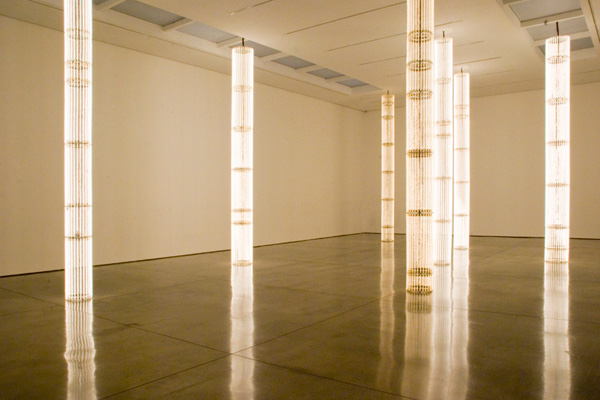
Cerith Wyn Evans, S=U=P=E=R=S=T=R=U=C=T=U=R=E (‘Trace me back to some loud, shallow, chill, underlying motives overspill’), 2010

Going back to work that transforms the space in an unexpected way, thinking about Martin Creed’s Work No. 227: The lights going on and off made me think about Cerith Wyn Evans’s S=U=P=E=R=S=T=R=U=C=T=U=R=E (‘Trace me back to some loud, shallow, chill, underlying motives overspill’) which I first saw at White Cube Mason’s Yard a couple of year ago and again recently in a somewhat pared down form at the extraordinary De La Warr Pavilion in Bexhill in Sea.

The installation is a series of columns made of lighting filaments running though glass tube. The columns both form obstructions in the room and alter the light levels within it. More interestingly though they generate a huge amount of heat. And, as you may have guessed given the mention of Creed’s installation, they go on and off.

Continue reading

Dirty work

Mark Dion, Tate Thames Dig, 1999

In 1999 the process of transforming what had once been Bankside Powerstation into Tate Modern was well underway. Tate had long since needed more space in which to show its two collections – the national collections of British Art and of Modern Art (here considered to be post-1900) – and the new space was eagerly anticipated. The collections would at last get their own spaces, each museum facing the Thames one from Millbank on the northern bank, the other from Bankside, further east and on the southern bank of the river.

In anticipation of the new space, Mark Dion adopted the role of archaeologist to create the installation Tate Thames Dig, initially shown in the Art Now room at what was then known as the Tate Gallery (now Tate Britain).

Continue reading

True blue

Roger Hiorns, Seizure (detail: crystals on wall), 2008

Although I knew the basis of the work – a flat full of copper sulphate crystals – nothing could quite have prepared me for Roger Hiorns’s 2008 installation Seizure. Unlike the installations I’ve written about in the last few posts, this wasn’t remotely disorientating – that wasn’t the idea at all – rather, it was the astonishingly beautiful result of a process that was both hugely ambitious and possibly a little bit crazy.

With the support of Artangel – who make it possible for artists to realise unusually difficult projects such as this one, or Michael Landy’s Breakdown – Hiorns sealed one of the flats before introducing copper sulphate solution which was then left to crystallise. The result was a blue wonderland in a run-down low-rise block in inner London.

Continue reading