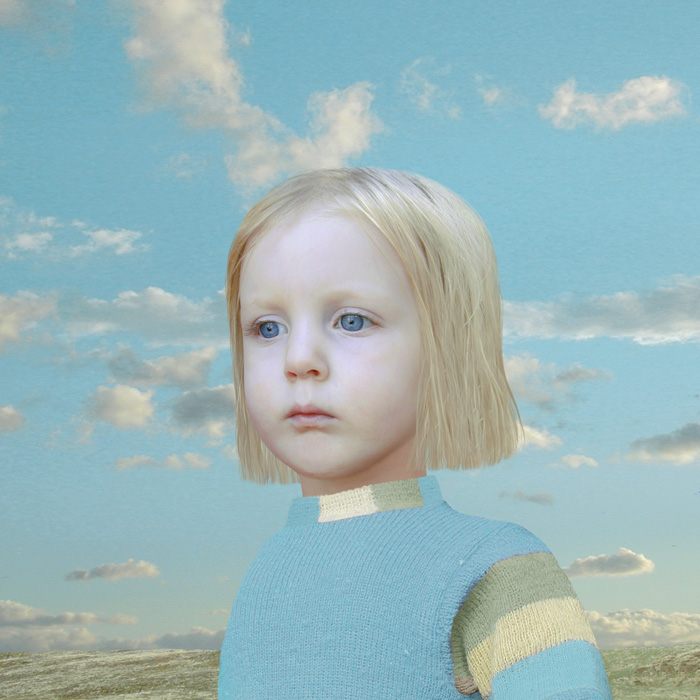
Children are weird. Well, in the world of Loretta Lux they are anyway. It’s hard to work out exactly what’s wrong, but clearly something’s up. It’s partly the washed out colours but there’s definitely more. These children don’t seem entirely real. They have a doll-like quality and though they lack the telltale golden eyes, there is perhaps something of the Midwitch Cuckoos about them. At very least, they seem to be in a trance of some sort.
Category Archives: Photography
On the edge
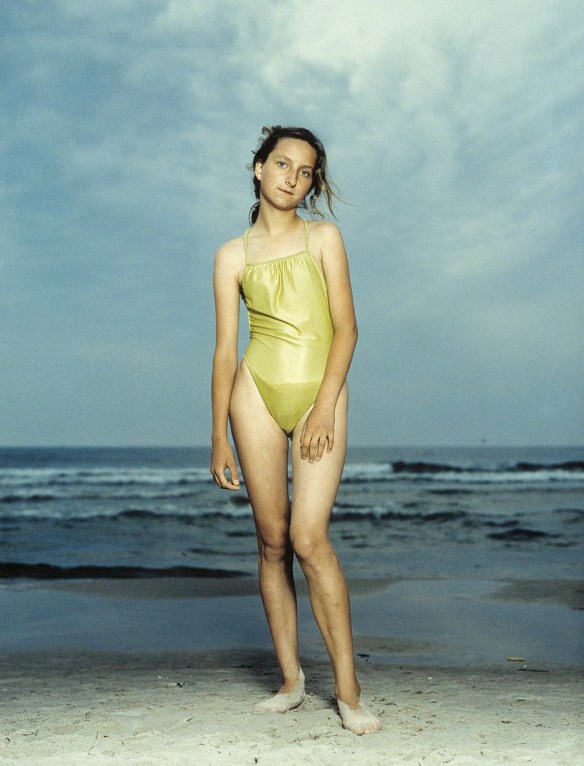
Rineke Dijkstra, Kolobrzeg, Poland, July 26 1992, 1992
Staying with portraiture but today with a little more information that simply what the subject looks like, Rineke Dijksta’s Beach Portraits take a typological approach that suggests she shares some influences with Thomas Ruff. Despite a consistency of approach, Dijkstra doesn’t seek to achieve the same level of neutrality at Thomas Ruff does with the Posrtraits series. Apart from the images I’m concentrating on here, the series includes pictures of boys and of groups of adolescents but in the interests of not ramblong on too much I’m limiting myself to looking at three of the pictures of girls.
Dijkstra’s Beach Portraits series is of adolescents standing facing the camera with the sea behind them. Despite the simplicity of this approach, each has a slightly different stance which suggests very different levels of confidence. The girl photographed in Kolobrzeg, Poland, July 26 1992 has a relaxed stance and her gaze seems to connect with the viewer. What I find most touching about this picture is the slightly ill-fitting swimsuit which looks as though it may be cut for a slightly more developed figure, damp at the bottom suggesting she’s just come out of the sea but hasn’t been swimming.
Skin deep
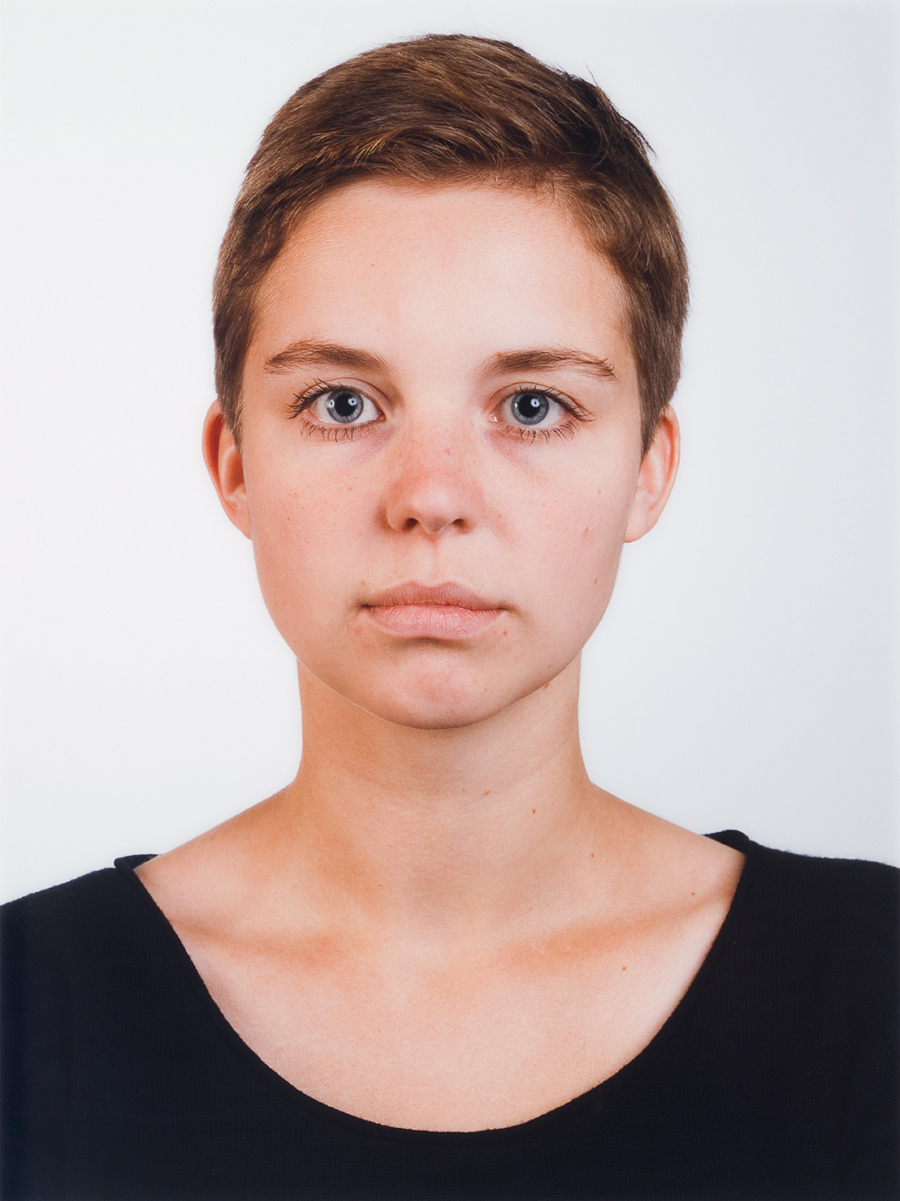
Thomas Ruff, Portrait (I. Graw), 1988
Having taken the slow route from the Bechers to portraiture it seems like a good time to ponder the more obvious forward jump, so today I’ve found myself thinking about Thomas Ruff’s Portraits, a body of work he started while still a student of Bernd Becher at the Kunstakademie Düsseldorf and has continued – in parallel with other work – ever since. Initially working in black and white, Ruff quickly moved to colour and made the series using a large format camera so that the faces are recorded in unrelenting detail. At their most simple, these are like passport photographs but for the eessential detail of scale: Ruff’s prints are around two metres tall.
Taking an average
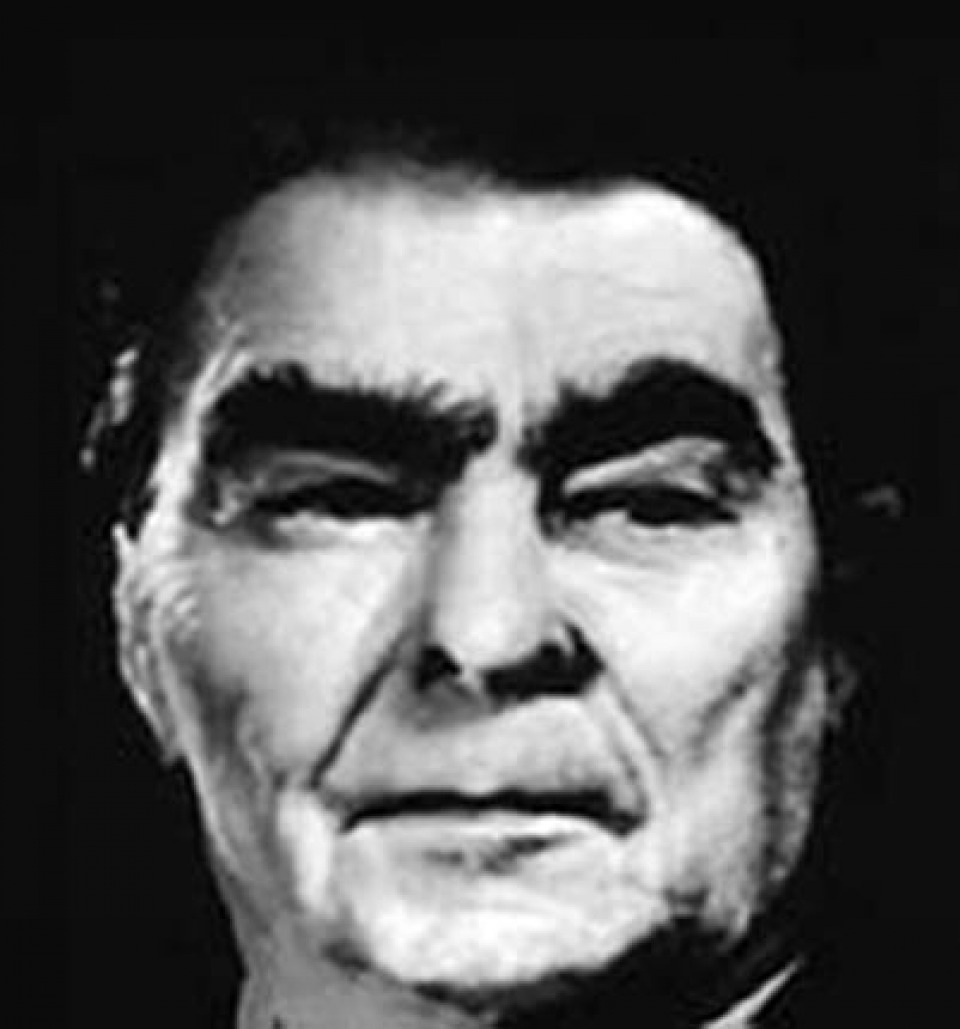
Nancy Burson, Warhead I (55% Reagan, 45% Brezhnev, less than 1% each of Thatcher, Mitterand, and Deng), 1982
The idea of the digital composite that Idris Khan uses to such great effect isn’t a new one by any means. Possibly somewhat surprisingly it goes back several decades, with Nancy Burson – who had been involved with Experiments in Art and Technology (EAT) since leaving college in the late 1960s – making composite portraits digitally in the early 1980s. Composite photographic portraits of course have a much longer history – Francis Galton’s composites of criminal types were made in the late nineteenth century for instance – but the use of digital is something Burson pioneered.
It’s not all about the technology though. Indeed, it’s as art that Burson’s work interests me more. In building her composites, Burson is effectively making layered photomontages and accordingly her work can be seen as the combining of two (or more) elements to reveal a third meaning. In Warhead I, Burson has combined the imagges of world leaders accoring to the percentage of the world’s nuclear arsenal they had at their disposal. This being 1982 that effectively mean merging the faces of Leeonid Brezhnev and Ronald Reagan. Though in a way this makes me think about the significance of nuclear weapons during the Cold War it’s also interesting that it seems to come from a simpler time. How many faces would be in the mix now? And would anyone be able to accurately pinpoint the percentages?
A sense of completeness
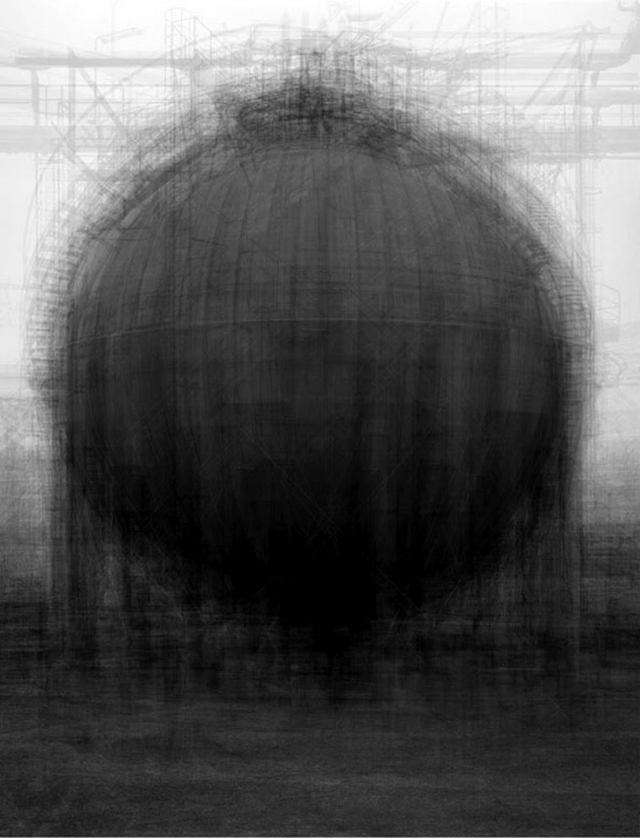
Idris Khan, every… Bernd and Hilla Becher Spherical Type Gasholders, 2004
The objectivity that characterises Bernd and Hilla Becher’s recording of industrial architecture resulted in pictures that allow examination of the structures in almost forensic detail and their typological approach to display allows comparisons between buildings of the same type. The precision that comes from using a large format camera and the neutral lighting of an overcast sky makes for an extraordinary level of detail. There is a sense of completeness that comes from seeing multiple structures of each type.
Idris Khan has taken the Bechers’ work as a starting point for a different examination of the same territory. Rather than building up a picture of the whole from the precise detail of each individual image, Khan has taken an average. By overlaying all the Bechers’ images of a particular type of structure – for instance spherical type gasholders – Khan has produced sketchy pictures that seem to suggest an approximate version of how each type of building might be expected to look.
Collecting the set
Bernd and Hilla Becher, Cooling Towers Wood-Steel, 1959-77
It would, I suppose, be possible to see Bernd and Hilla Becher’s pictures of industrial structures as boring, particularly if one were to restrict one’s attention to one or two pictures, though for me I think fascination with the detail always wins out. These are perfect pictures. They record the appearance of industrial structures – water towers, gas holders, mine heads etc – with complete objectivity and in forensic detail. The pictures were made over a period nearly five decades – they started collaborating in 1959 and continued until Bernd Becher’s death in 2007 – using a large format camera in the neutral lighting of overcast weather. The structures are viewed straight on, so that verticals remain vertical; the large format camera helps here but the Bechers also worked from raised viewpoints so that we are looking at the structures as directly as possible.
The art of looking at art
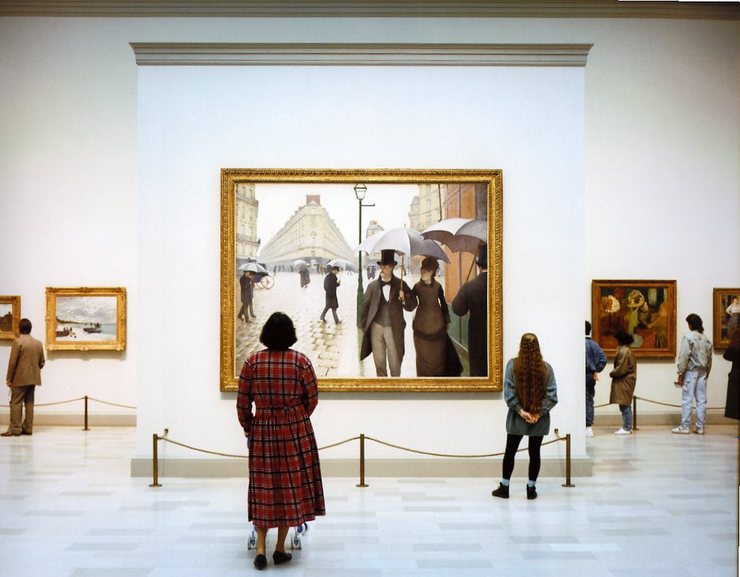
Thomas Struth, Art Institute of Chicago II, 1990
Given that this blog is essentially about looking at art, it seems like a good idea to think about how that happens. Thomas Struth’s museum photographs provide a fascinating insight into the way visitors behave in art museums. In most of the pictures, viewers are looking at historical paintings, or sometimes sculpture, and we are looking at them. Struth typically adopts a broadly objective viewpoint, for instance in Art Institute of Chicago II we are looking straight at Gustav Caillebotte’s Paris Street; Rainy Day (1877) and at the backs of those looking at it. The painting’s audience is two individual women, each seemingly lost in their own thoughts about the work in front of them.
Chance encounter
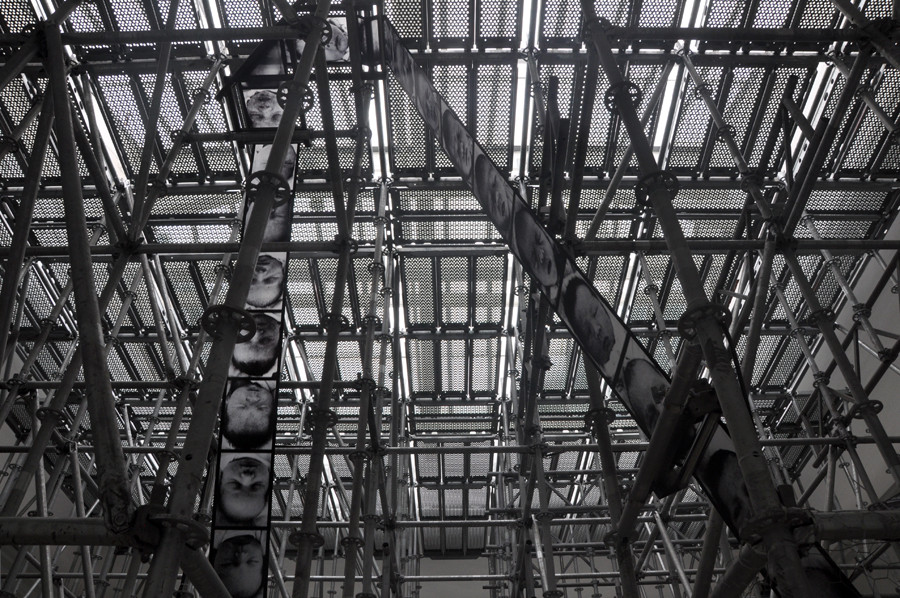
Christian Boltanski, Chance, 2011
Since I seem to be stuck in mazes and cages this week, it’s perhaps no surprise that Christian Boltanski’s installation for the French pavilion at the 54th Venice Biennale last year has worked its way back to the front of my mind. For me, this was one of the highlights of the Biennale though admittedly I think I’ve yet to see a work by Boltanski that I haven’t liked. This work does feel quite different to most of Boltanski’s installations though, not least because it’s playful – literally, in that it includes a game – and open to a hopeful reading, though more sombre interpretations are also possible.
In a state of change
Sam Taylor Wood, Still Life, 2001
Looking at Jeanne Dunning’s mouldy still lives yesterday made me think about Sam Taylor Wood’s Still Life, a time-lapse video work in which a basket of fruit reminiscent of countless still life paintings gradually decays and is taken over by rather beautiful white mold. At first sight, shown on a plasma screen, the work mimics a painting and it takes time to realise that the fruit is gradually changing as it starts to rot. This is beautiful decay but it’s still hard not to feel a little repulsed by the outcome.
The familiar made strange
Jeanne Dunning, Hand Hole, 1994
Jeanne Dunning has always been good at making the familiar look strange. It was pictures of hairstyles that first drew me to her work but it was body and food pictures that I first saw in a gallery. In real life the prints were seductive and the images intriguingly strange. In part the defamiliarisation of the body in Hand Hole is down to the way the picture is composed, but it’s also about the scale of the image. Though Dunning’s prints are often modest in size, in images like Hand Hole there is still a shift from the human scale. Add to this the ambiguity of the image when seen along side similarly strange pictures of food.