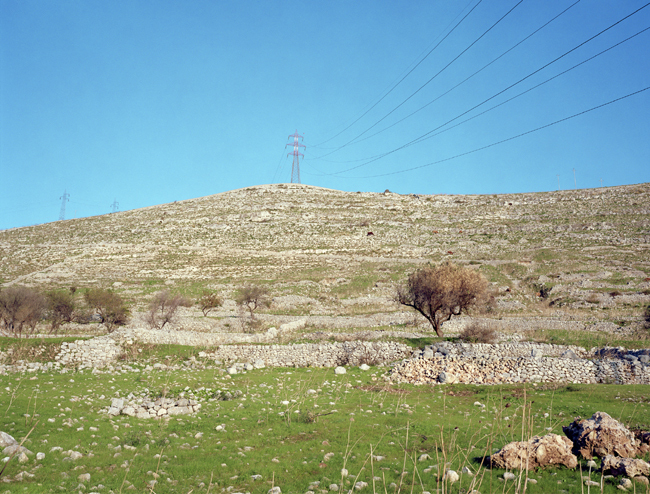
 Jeff Wall, Hillside near Ragusa, 2007
I went to Jeff Wall’s show at White Cube unsure quite what to expect. At some point when I wasn’t paying attention, Wall left behind the elaborate tableaux and sometimes less than obvious references to the history of painting and started to tell different stories – somehow simultaneously simpler and more complex – through his photographs. The work here is from two separate bodies of work that feel in some ways as though they could have been made by two different people.
In the ground floor space there are three photographs of the Sicilian landscape. Described as ‘documentary pictures’ in the press release, these tell of a landscape fundamentally unchanged over time but one in which the modern world is nonetheless constant visual presence. The drystone walls in Hillside near Ragusa might have been there for centuries staying low to blend into their surroundings; man is not a recent incomer to this place. By contrast, the electricity pylons stride across the hillside with a confidence that its natural inhabitants – the short, windswept trees growing on the low ground – don’t seem to share.

 IMAGE OBJECT TEXT