Through the looking glass

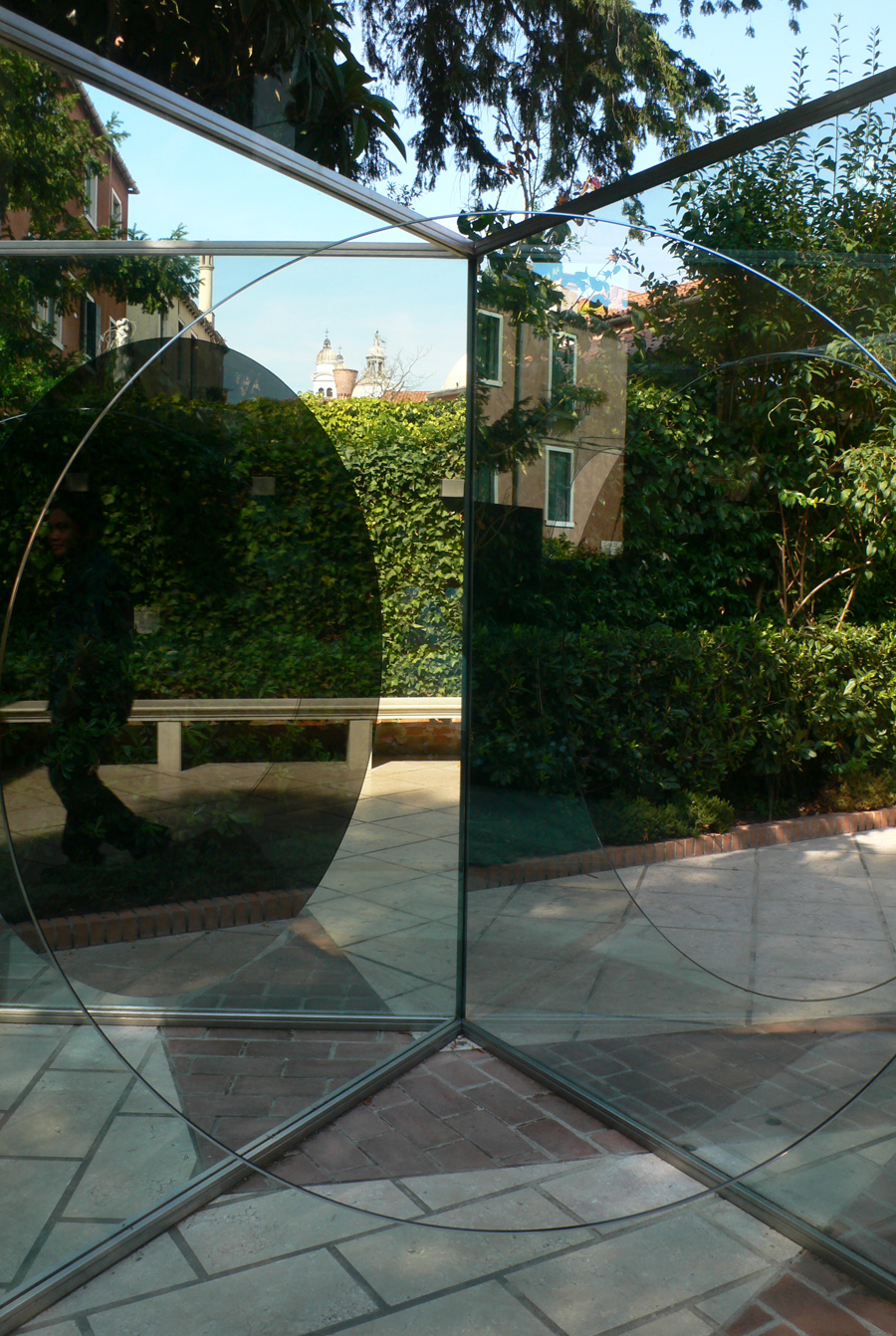
Dan Graham, Triangular Solid with Circular Inserts, 1989
(installed at Peggy Guggenheim, Venice)

Over the last couple of posts we’ve kind of established that reflections can be confusing and can change the way we experience space. But regular readers must know by now that once I’ve caught hold of a thread I’ll pull at it just that bit longer than is reasonable so today is, um, well, more of the same really. Sorry about that.

Much of Dan Graham’s work, in particular his two-way mirror pavilions – could be seen as architecture as well as art. The pavilions are small glass structures which are usually partly made of mirrored glass which confuses the way the structure reflects the environment it sits in. The effect of this is that people are prone to wandering in and out of view unexpectedly and the space seems to change as one walks round or through the structure.

Continue reading

Down to earth

Anish Kapoor, Vertigo and Non-Object (Pole), both 2008

On one level, this is probably the most inappropriately titled post I’ve written. Anish Kapoor’s work is, in my view at least, usually very far from down to earth. At its best, Kapoor’s work is extraordinary; it can redefine the space it occupies and disorientate, baffle and sometimes entertain its viewers. But – with the notable exception of the quietly beautiful, and easily overlooked, pregnant wall pieces – subtle it ain’t. Pompous, yes. Excessive, certainly. Subtle, not so much.

To start with the entertaining, by bringing strangely distorting mirrored surfaces into the gallery space, Kapoor entices his audience to pose and play. This is art crossed with the funfair in the form of the hall of mirrors and it’s hard not to be beguiled by the result. Moving backwards and forwards before the mirrors, we might get fatter and thinner or be turned upside down. The results aren’t exactly profound but they are both beautiful and good fun.

Continue reading

Infinity curves

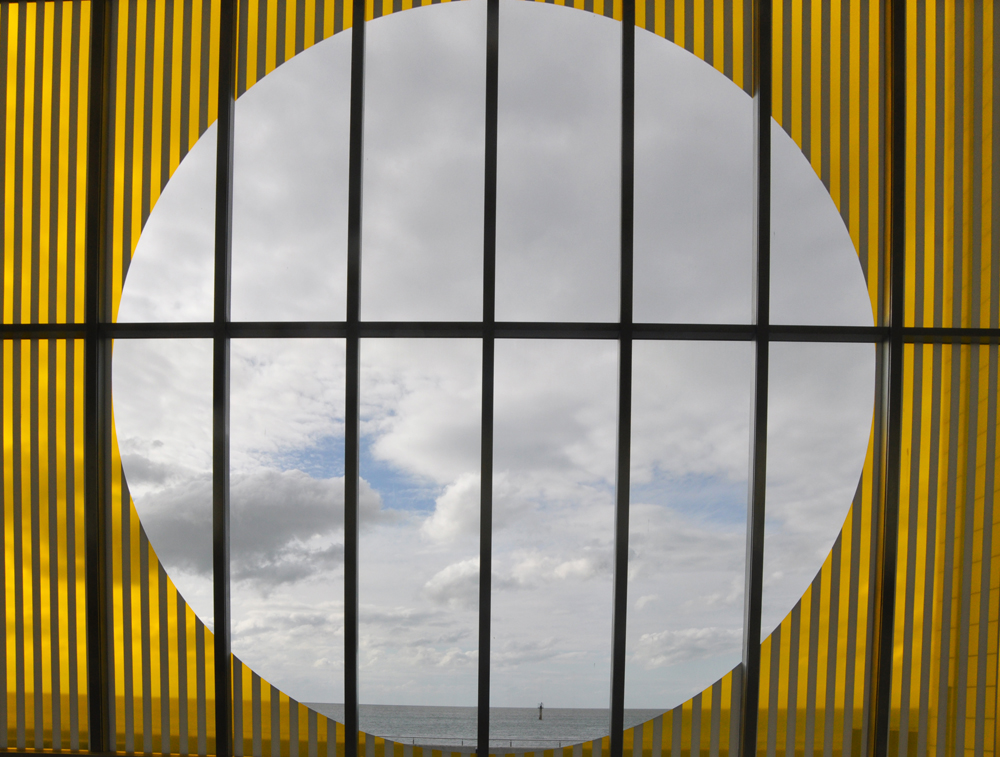
Daniel Buren, Borrowing and Multiplying the Landscape, 2011

Art is a window on the world. Well, in the case of Daniel Buren’s Borrowing and Multiplying the Landscape, installed for the opening of Turner Contemporary in Margate last year, it is. Buren’s installation modifies the view of the sea beyond the windows of the gallery foyer by covering much of the glass with coloured tape so that the sea is seen through a circular window cut into the yellow stripes. In a sense the work forms an inverse sun framing, on my visit at least, the greyness of and English summer afternoon. Ah well.

Continue reading

Smoke and mirrors

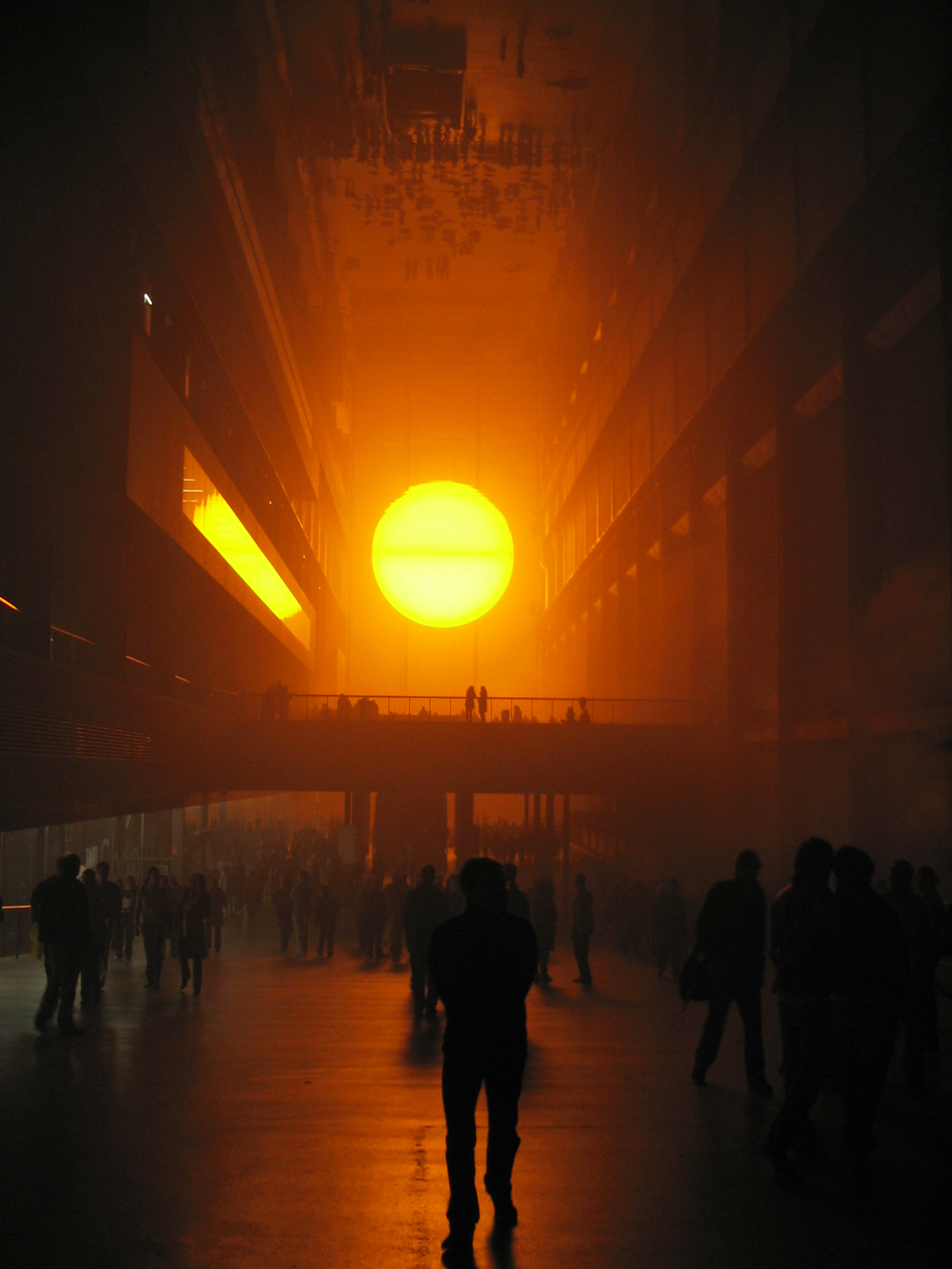
Olafur Eliasson, The Weather Project, 2003Olafur Eliasson, The Weather Project, 2003 (Turbine Hall, Tate Modern)

Mirrors can make a room look bigger. We all know that. They can also make a space confusing. We all know that too. At some stage, most of us have probably been in a public place with a mirrored wall and though the room extended further than it actually did. We may even have walked into the mirror by accident. These things happen.

The idea of a mirrored ceiling is a strange one. On the one, hand it’s an idea with somewhat seedy connotations. On the other hand, it can double the height of a room; okay, so it can only seem to do that, but you know what I mean. It’s this, somewhat disorientating, effect that Olafur Eliasson was going for when he installed a false ceiling in the Turbine Hall of Tate Modern as part of his 2003 installation The Weather Project. In the event, it both messed with our perception of the height of the space and made people behave in a way that they usually don’t in an art museum.

Continue reading

Upside down

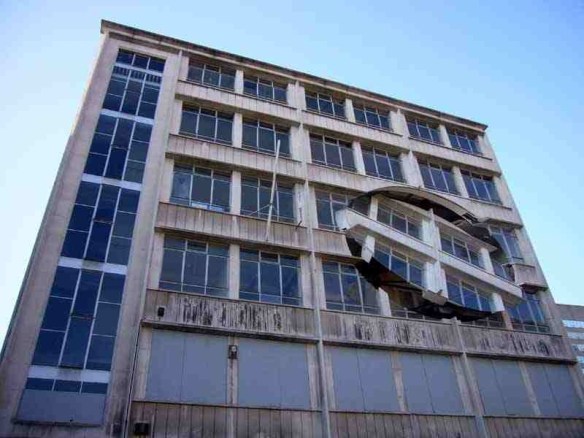
Richard Wilson, 20:50, 1987 (Matt’s Gallery, Martello Street, London)

Art can make us see the world differently. Certainly the way both Gordon Matta-Clark and Richard Wilson have cut away sections of buildings challenges our perception of architecture making us see city spaces differenttly in a literal but nonethheless interesting way.

Wilson’s iinstallation 20:50, a room with a seemingly mirrored surface at roughly waist height, offers a strangely new understanding of the space it’s installed in. For the unsuspecting visitor, the first clue about the nature of the surface is the smell, approaching the room one is greeted with a powerful aroma of oil. Suddenly the  title – 20:50 – makes sense: the room is flooded with used engine oil. A walkway leads out into the middle of the space, from which you get to see the features of the room reflected all around you.

Continue reading

Inside out

20120522-085354.jpg

Richard Wilson, Turning the Place Over, 2007

Quite high on the list of art I wish I’d seen is Richard Wilson’s installation for the 2007 Liverpool Biennial. Like other works by Wilson, who is probably best known for his installation 20:50 at the Saatchi Gallery (about which more another time, possibly even tomorrow now that it’s in my head), Turning the Place Over was an architectural intervention on an ambitious scale but unlike 20:50 this was a temporary installation made by messing with the fabric of an empty building.

Continue reading

Making good the gallery space

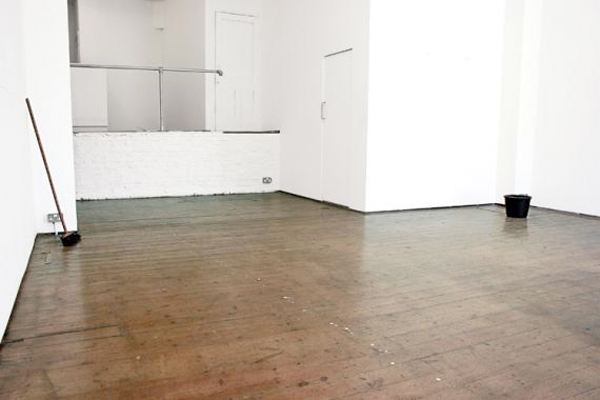
Susan Collis, Don’t Get Your Hopes Up, 2007

As the end of the academic year approaches, the time has come to turn a very messy art school studio into as good an approximation of a white cube gallery space as possible. I love the process of making the end of year exhibition but I’m not so keen on the construction part of it. All that filling, sanding, cleaning and painting is stupidly tiring – even for me, and frankly I mostly direct proceedings while others to the actual work – and pretty stressful. We always get it done but there’s always a point where it seems like we won’t. Which brings my thoughts to work that reminds me of the tools we need and the work that needs doing.

Susan Collis’s work fits the bill perfectly. After all, her exhibition Don’t Get Your Hopes was basically a gallery in need of some art, right? Well, appearances can be deceptive.

Continue reading

Half seen

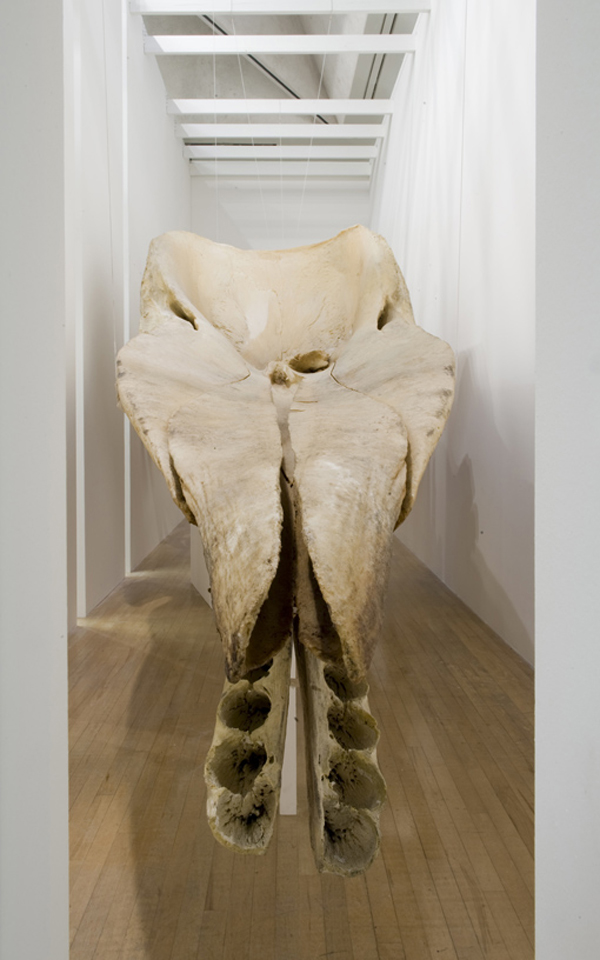
Lucy Skaer, Leviathan Edge, 2009Lucy Skaer, Leviathan Edge part of the installation Thames and Hudson, 2009

Since I’m on a bit of a skull theme, Lucy Skaer’s Leviathan Edge – the skull of a sperm whale borrowed from National Museums Scotland for inclusion in her installation Thames and Hudson – popped into my mind. The skull is rather larger than those adorned by Damien Hirst or Gabriel Orozco. By about 14 foot or so. The whale skull is vast and its shape utterly unfamiliar. It’s a curious object made all the more fascinating by Skaer’s tantalising presentation of it in an enclosed space so that we can only see small sections of it through narrow slits.

Continue reading

Everyday art

Jeremy Deller, Open Bedroom, 1993 (reconstruction)

Like David Shrigley, Jeremy Deller is an artist whose work doesnt always fit easily into the gallery space. Unlike Shrigley though, when his work is brought together as an exhibiton it exceeds expectations. Joy in People at the Hayward Gallery is a show that is much more than the sum of its parts. And there are some pretty great parts.

In 1993, while others were holding open studios, Deller staged Open Bedroom, his first exhibition, in his parents’ house while they were on holiday. The work, his teenage bedroom presented as art, is reconstructed here as the route into both the show and the head of the artist. We get to open drawers and cupboards and explore the ideas, images and objects that fascinated the young Deller. It’s a great start and a useful grounding for a show that picks up these enthusiasms and makes them art.

Continue reading

Motherhood as art

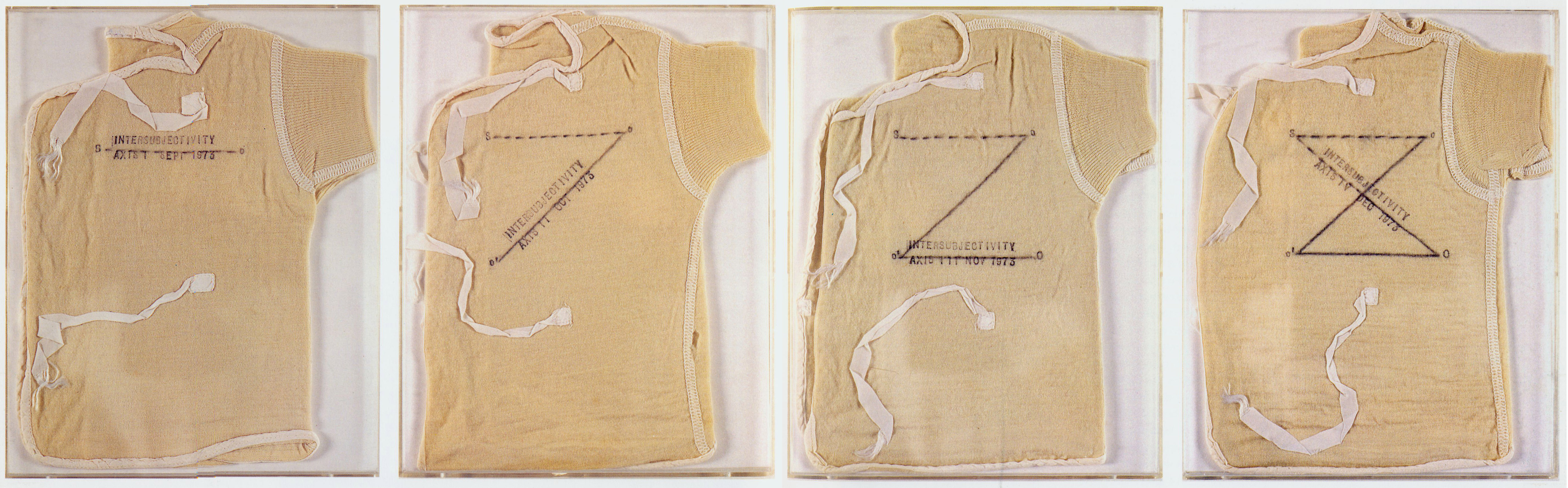
Mary Kelly, Post-Partum Document (detail: vests, from Introduction), 1973-79

Like Susan Hiller, Mary Kelly documented her pregnant belly as art but it is the work she made after the birth of her childfor which she is better known. Post-Partum Document made between 1973 and ’79, the first years of her son’s life, is an extensive document of the mother and child relationship and of the nature of motherhood. The work is in six sections and contains over a hundred items of documentation from the vests shown above to diary notes, graphs and other data and artefacts such as stained nappy liners. The work is driven by the process of making it and clearly parts of that process aren’t pleasant.

Continue reading